Showing posts with label Ekstrom. Show all posts

Sunday, January 29, 2023

Different Backgrounds, 52 Ancestors


During a recent family discussion, I was asked about the difference in the backgrounds of my Swedish great-grandparents. Since week two of the 52 Ancestors challenge calls for a photo, I'll explain a bit about their backgrounds and share their photo. The following is based on my research and impressions and any errors are mine alone. 

When I write about Sweden, I rarely show a map and rarely specify to which family the ancestor belongs. I want to do better this year. I have spent a lot of time studying parish maps, but have never shared the big picture and the geographical differences for this couple. 

Agnes Emilia Fors and Gustaf Emil Ferdinand Ekstrom married in 1888. Gustaf had already buried a wife and two children. The couple buried one more child before they emigrated in 1891 from the city of Linköping, in southern Sweden, to Chicago, Illinois. They opened a tailor shop in Evanston, north of Chicago. I hope they displayed this lovely portrait in their shop window to show off their handiwork.


Photo Colorized at MyHeritage, Digital layout from ClubScrap


Sweden is divided into counties that are are similar to states in the US. The couple came from three different counties of Sweden. Though the areas are close, there were differences in culture and in record-keeping. Agnes and her ancestors came from roughly the area shaded in purple: Södermanland County and Stockholm County. Gustaf's family was from the area shaded in orange: Östergötland County. There were a few ancestors from other counties in both families.


The couple also had somewhat different socioeconomic backgrounds. Both families have a history of poor farmers known by the term torpare, or crofter. The crofters often struggled to feed and provide for their families. Disease, including tuberculosis, was common and high infant mortality was a persistent problem. The families worked in the 1800's to improve their economic lives by learning trades. 

Gustaf was a tailor, as were his brothers and their father. Agnes' grandfather was also a tailor. The extended families included tradesmen such as shoemakers, carpenters and bricklayers. However, Agnes and her family had the more advantageous life. Her father was a bricklayer who worked for the railroad and had moved into management. Her aunt married a schoolteacher who moved to the railroad and into management. Her mother's background was full of military men of the lowest ranks: sailors (known as a båtsman), infantry soldiers (soldat) and cavalry men (ryttare). These men were of a higher socioeconomic level than the crofters. I suspect that nutrition and health were better for Agnes' ancestors.

There seems to be a difference in the survival of the families. There are many more relatives from the Fors side who show up in our DNA test matches. Gustaf is the only one of seven siblings to have living descendants today. I have not identified any other branch in either family that was as decimated as this single Ekstrom branch. The DNA match disparity also raises the possibility that the DNA from Agnes Fors is simply more dominant in my family.

In 2023, I am exploring the edges of my Swedish research. The records of Östergötland are more limited than the other counties, as reflected in the number of ancestors identified on each side. The first multi-post series explores an Ekstrom ancestral branch from the parish of Grebo in Östergötland. It started with one mystery woman, but grew into a research project that covered several generations and some 80 years of tax records. 

The star on the left side marks the ancestors that appeared in the previous post. The next post will explore the issue from a later generation that triggered the search.


Friday, April 13, 2018

Dead End Branches: 52 Ancestors


Every family tree has them: aunts, uncles and cousins who had no children. When you come to the end of a line, how do you react? I feel disappointed, relieved and disoriented. There will be no new cousins and no new clues. Perhaps a child died, a women died in childbirth or a soldier in a war. Conversely, the research on that line is at an end, fortunately. What branch is next? How many generations back is the next branch to research?

The Swedish part of my tree is full of those dead end branches. One branch came to America, yet still ended with no living descendants. My great-grandfather's younger brother, Ernst Viktor Leonard Ekstrom, came to America in March of 1889. He was born at Kristineholm, Björsäter, Östergötland, Sweden on January 27, 1865. Ernst trained as a tailor and brought that skill with him to the thriving Swedish community in Chicago.

A Swedish seamstress named Maria Charlotta Wenberg found her way to America in 1893. Lottie was born in July, 1868, in Stora Kil parish in Värmland. I don't know how Ernst and Lottie met, but it may have been through their work. They married in Chicago on July 18, 1896. To their union two daughters were born.

Grace M Ekstrom was born on July 25, 1898, and her sister Lillian Efrusine Ekstrom followed on October 21, 1899. Grace and Lillian were second generation Americans with one foot in Sweden and one in Chicago. They and their mother traveled several times between the two countries.

The girls, rather than marrying and raising a few children, instead helped raise hundreds of Chicago-area children. They both became teachers by the time of the 1920 census. Grace married Fredrick F Lech between 1932 and 1935. By the time of the 1940 census, she was no longer teaching. When I interviewed their cousin after her death, he said that Grace never had children. I've found very little about her online.

Lillian taught for many more years, as she never married. She attended Northwestern University during summer sessions and, in August, 1935, was awarded a Bachelor of Science in Education degree. She taught physical education at Kelvyn Park High School for many years. Lillian had signed the 1953 yearbook that was scanned into the Ancestry yearbook collection.


Lillian acquired from her parents the small apartment building that they owned at 4107-09 N. Greenview Avenue. The address is seen throughout the records for the family, starting in 1920. Based on the census, it appears the building had four to six apartments. Lillian lived there for most of her life.

Ernst Ekstrom died in Chicago on August 30, 1939. His obituary was carried in the Swedish American newspaper.
Svenska Amerikanaren Tribunen
Torsdagen 7 Sep 1939
På Ravenswood lasarett avled den 30 augusti f. skräddaren Ernest Ekström, boende i 4107 Greenview ave. Slutet föregicks av en tids sjuklighet. Den avlinde var född i Sverige och omkring 74 år gammal. Han sörjes av sin maka Lottie samt av dötterna mrs Grace Ekström Lech och Lillian Ekström. Hans begravning ägde rum den 2 sept. och omhänderhades av Edgars likbesörjningsbyrå i 4821 N. Damen avenue. Platsen för jordfästningen var Rosehill.


The Swedish American Tribune
Thursday 7 Sep 1939
At Ravenswood Hospital, the tailor Ernest Ekström, resident of 4107 Greenview Ave, died on 30 August. His death was preceded by a period of illness. The deceased was born in Sweden and about 74 years old. He is survived by his wife Lottie and daughters Mrs. Grace Ekström Lech and Lillian Ekström. His funeral took place on 2 September and was handled by Edgar's Funeral Home at 4821 N. Damen Avenue. The place of burial was Rosehill.


Lottie Wenberg Ekstrom died in Three Lakes, Oneida County, Wisconsin, in August of 1958. There was a brief funeral announcement in a Chicago area newspaper.

Marie C. Ekstrom. Three Lakes, Wis., beloved wife of the late Ernst; loving mother of Grace Lech and Lillian Ekstrom. Services Wednesday, Aug. 13, 11 a.m. at funeral home. 5303 N. Western avenue, corner Berwyn. Interment Rosehill cemetery.

Lillian Ekstrom died in Chicago on March 30, 1992, and is buried at Rosehill Cemetery.

Grace Ekstrom Lech died on April 28, 1993. No further information.

And so ends the Ernst Ekstrom branch of the Ekstrom family from Björsäter, Östergötland and Chicago, Illinois.

Sunday, February 11, 2018

She Died Far From Home: 52 Ancestors


When a birth, death or marriage occurs in an unexpected location, it adds challenges for the researcher. In the family of my Swedish Great-grandmother, Agnes Fors Ekstrom, there were two such events. A younger brother, Eric Anton Fors, was born in a parish where their parents never lived. And Agnes' young daughter, Edna Ekstrom, died far from her Chicago home.

Edna's name came up in all my family interviews. Everyone knew that she was my grandfather's sister and that she had died as a child. She appears, as a baby, in the 1900 Chicago census, living with her parents and siblings at 1353 Belmont Avenue, in the Lakeview area.  Her birth month is listed as May of 1899.


Edna's death record eluded me. She wasn't buried in the same cemetery as her parents. The only possible death certificate did not match their address nor did it name any parents. I was unable to locate the records from the Swedish Methodist Church that they likely attended, as the supposed archives claimed to not have them. Edna's story was unfinished for many years.

Recently, I decided to spend the time to follow Edna's grandfather as he moved from parish to parish, thanks to his job on the Swedish railway. There, in the Swedish church records, I unexpectedly found the rest of Edna's story.

By 1904, Agnes and Gustaf were well settled in Chicago after 13 years. They had added one more child to their family -- my grandfather, Alvar (Oliver). Gustaf's brother, Ernst, had been in Chicago for 16 years. Their tailor business must have been doing well, as their wives went traveling that summer.

Agnes and her two youngest children and Lottie, Ernst's wife, and her two children sailed to Sweden. Edna and Alvar got to meet their maternal grandparents, who were living in Kullerstad, Östergötland. While in Sweden, or on the voyage, 5-year-old Edna became ill. She died at the home of her grandparents, with the cause recorded as croup. She was buried in Linköping, most likely with her two older siblings and her father's first wife.

The records baffled me at first. Why would a little girl from Chicago have her death recorded in Sweden? However, with the thoroughness of the church records, it all finally made sense. The death of one small visitor generated a half-dozen records.

The first record that I found was the church book (församlingsböcker) that showed her grandparents' household. Edna was listed, not directly in the household, but a couple of lines down. Why was a five year old from Chicago by herself with her grandparents? Her birth (född) was recorded as being in Chicago on May 18, 1899. She both died (död) and entered (inflyttad) the Kullerstad parish on June 25, 1904. At first I thought maybe this was a courtesy entry for her grandfather.


But no, it was real. Her death was in the parish death book, with the notation that she was visiting (på besök).


Additional records showed that Edna was registered as entering the parish, probably because the records would be unclear without that information. More likely the family had been there longer, but the minister had no need to record their entry as they were merely visiting. Her death also appears in the Linköping death abstract for 1904, as the minister recorded the burial (begrafning), noting that the death had been in Kullerstad.

Having sorted out Edna's death, the next question was who was traveling along with her. Searching ship lists, I discovered that her mother and younger brother entered the port of Boston on the White Star Line's RMS Republic on September 30, 1904. I can only imagine that having lost Edna to illness, Agnes must have been terrified that little Alvar would also get sick. No doubt she was grateful to return to Chicago.

I found Agnes' sister-in-law, Lottie, and her daughters on a different ship, sailing into Boston a few days after Agnes and Alvar. It does seem strange that they would sail on different ships. Perhaps it is similar to families today who won't all fly on the same plane due to risk of accident. Finding Lottie's ship record was a bonus that shed additional light on the financial success of the family business.

With this serendipitous discovery, I can finally lay to rest the puzzle of what happened to Edna Ekstrom. Her story is now complete.

Friday, November 4, 2016

Did My Grandparents Cheer for the Chicago Cubs?


One of my co-workers asked how an Arizona native living in the American South had become a fan of the Chicago Cubs. Of course, it's all tied to family.

Thinking about my family's Chicago roots led me to the realization that sports affiliations are not a part of my family history knowledge. I failed to ask about sports when I interviewed an elderly cousin some 16 years ago. Now he's gone -- the last of a generation who knew my grandparents and great-grandparents through the eyes of a teenager.

It's hard to think of all the questions we should ask of our family, so this is just a little reminder to ask about sports if it's something you'd like to know.

Reminiscing about our Chicago history, I realized that the 1907 and 1908 World Series wins by the Cubs would have been a part of the fabric of the lives of my grandparents and their families. They lived in neighborhoods on the north side of Chicago, a few miles north of Wrigley Field. In their championship seasons, the Cubs played at the West Side Grounds, which was further south, but they were still the hometown team.

My grandmother, Ruth McFarlane, was a girl of nine in 1907. Her father had been badly hurt in a work accident on the Chicago street car system and the family struggled through financial difficulties. Her schoolmates and church friends would no doubt have been excited about the accomplishments of the home team and perhaps she and her younger sister were also. Did her parents have the luxury of enjoying the wins for a brief moment? By 1910, Ruth had dropped out of school and gone to work to contribute to the family income. I imagine that baseball was, for her, a background thought of no consequence.

My grandfather, Oliver Ekstrom, was four years old in 1907, and lived a life of financial comfort in the Andersonville Swedish-American community. He was the youngest of five living siblings and would have shared the excitement of his siblings and friends when the team brought home the championships. Were his immigrant parents also caught up in the excitement? Did they rejoice at the wins?

Nine years later the Cubs moved to what is now Wrigley Field. I'd like to think that Oliver was able to attend some of the games with his brothers or with his brother-in-law, a Chicago policeman. After Oliver and Ruth married, they went to Central America as missionaries, weakening the strong Chicago ties. With their early deaths, their children grew up in boarding schools in other places.

By the time the Cubs suffered the Curse of the Billy Goat and lost the World Series in 1945, Ruth and her parents were dead, as were Oliver, his father and two siblings. Only Ruth's sister and Oliver's mother and two siblings remained in Chicago, along with three of Oliver's nieces and nephews. That extended family still has members who live in the Chicago area; however, Oliver's children scattered, with three brothers eventually landing in Arizona.

Regardless of Oliver's connection to the Cubs, many of his descendants have embraced the Cubs and have enjoyed visits to the historic ballpark. I've been to Wrigley Field only once, though I've seen the Cubs play at other ballparks. I celebrate their 2016 World Series win as I reflect on the history of my family and our Chicago roots.


Quick drop page and elements from Digital Scrapper's Liberty (2009) and  Sports Mad (2012) kits


Saturday, November 15, 2014

52 Ancestors in 52 Weeks: #44 Oliver Ernest Ekstrom


Quick drop page from Destinations, ClubScrap

Ahlver Ernst Ekstrom was born in Chicago, Illinois, on May 22, 1903, the youngest child of Swedish immigrants. His oldest sister, Gertrude, did him the favor of Anglicizing his name to Oliver Ernest when she took him to enroll in school for the first time.

Oliver's father, Gustaf Emil Ferdinand Ekstrom, made a comfortable living as a tailor, permitting Oliver to attend school when many of his peers were dropping out to work. Oliver's mother, Agnes Emilia Fors Ekstrom, was a woman of deep faith, no doubt encouraging Oliver's love of God and dedication to His work.

At one time, Oliver worked for a safe company. One day he was using a screwdriver on a safe and it slipped, gouging into his eye and blinding it. From that time he wore glasses.

He pursued a religious education as a night student at Moody Bible Institute. There Oliver met Ruth Dorothy McFarlane, whom he married in Chicago on July 14, 1923. They had five children. In 1925, Ruth and Oliver were accepted into the Central American Mission (CAM) and assigned to the ministry in Guatemala.

After Ruth's untimely death in April, 1931, Oliver enlisted the help of various family members in the Chicago area. Leaving the children scattered, he returned to the Guatemala work.

In November, 1931, family legend says that he reluctantly traveled to Port Barrios to meet a newly assigned missionary. It was "love at first sight" when he met Bessie Douglas Cushnie. They married on October 11, 1932, at San Miguel Acatán, Guatemala. Bessie and Oliver had two children, one of whom was born after Oliver's death.

Oliver suddenly sickened while on a trip in October, 1935, dying on the 22nd. The CAM article on his death contains an error, as Oliver died from typhus, rather than typhoid. Typhus was a deadly disease requiring quarantine. The attending physician wrote his diagnosis as typhoid instead, because he knew Bessie was a nurse and would be able to care for Oliver as adequately as the hospital.

Oliver was buried in an unmarked grave at San Pedro Sacatepéquez, Department of San Marcos, Guatemala.

The CAM article also tells us about his life and his death:
To know Mr. Ekstrom was to love him and it was not long until his smiling face and cheery laugh were known all over the republic. Besides being a good preacher and a tireless evangelist, Mr. Ekstrom had marked musical ability and any service in which he had a part was certain to be one of life and interest. ...  
Every possible care was given this dear brother by his wife and fellow missionaries and by the local doctor but as the days passed it was evident that his heart could not stand the strain. He seemed to know that his life's work was ended and among other precious words, he said to his wife, "There are four things I am sure of; I am saved, I love you, I am going to heaven and we will meet again some day."
"Oliver Ernest Ekstrom", The Central American Bulletin 203 (Nov., 1935): 3-4, 15-16.

Tuesday, November 11, 2014

52 Ancestors in 52 Weeks: #43 Ruth Dorothy McFarlane Ekstrom


My grandmother Ruth Dorothy McFarlane was born in Chicago, Illinois, the eldest child of Walter McFarlane and Mary Ellen (Vossler) McFarlane on February 7, 1898. She had to drop out of school after seventh grade after her father was badly injured in a streetcar accident. To help support the family, she worked as a retail clerk and a telephone operator.

Ruth attended night school at Moody Bible Institute, where she met her husband, Oliver Ekstrom. They married on July 14, 1923. Dedicating their lives to Christ, they went as missionaries to Guatemala with Central American Mission in 1925.


Quick drop page from Sweet Comforts by Shabby Miss Jenn for Digital Scrapper, 2014

Ruth entered a Chicago hospital for minor surgery in 1931. When she hemorrhaged, her husband's blood was used for a transfusion. Unfortunately, the blood types were likely incompatible, based on the mixed types seen in their children. She died on the operating table at Swedish Covenant Hospital on April 23, 1931.

She was survived by her husband and five children. Ruth was buried in an unmarked grave in Chicago's Rosehill Cemetery. When a marker was laid in 2002, her eldest son, David, chose the inscription: "She was worth far more than rubies."  

Thursday, October 2, 2014

52 Ancestors in 52 Weeks: #37 Agnes Emilia Fors Ekstrom


My Swedish great-grandmother, Agnes Emilia Fors, was born August 29, 1864, in Södertälje, Stockholm, Sweden, to Erik Edvard Fors and Matilda Vilhelmina Viberg. Erik Fors was a stationmaster for the Swedish railroads, so the family, though financially comfortable, moved frequently.

As was the custom in Sweden, Agnes left home as a teenager to make her own way. She emigrated to America as a servant, but returned in less than two years. She married the widowed tailor Gustaf Emil Ferdinand Ekstrom in Linköping, Östergötland on May 20, 1888. He had buried two babies and a wife and, with Agnes, buried yet another baby.

The scarcity of food and resources in Sweden, along with the desire for religious freedom, drove the Ekstroms to emigrate in 1891, joining many of their countrymen in Chicago, Illinois.

Agnes raised her five children and a step-daughter with a deep and abiding love of God, as well as a love of fun and laughter. Her grandson remembered her enjoying afternoons of tea, cards and gossip with her neighbors.

She saw four more of her children buried during her life. She raised two abandoned grandchildren, as well as helping to raise her youngest son's five orphans.


Quick drop page from Big Deal by ClubScrap

Her life as a tailor's wife and widow was comfortable until her assets as a building owner were destroyed by the Depression not long after Gustaf's death in 1927. She grew bitter and resentful of her reduced circumstances.

Agnes died on November 01, 1946, in Chicago and was buried with her husband and daughter in the historic cemetery of Rosehill.

Thursday, September 4, 2014

52 Ancestors in 52 Weeks: #35 Russell George Johnson


One of my favorite family photos is this lovely wedding photo from 1938. Russell George Johnson was united in marriage with Bernice Dorothy Nyquist at the First Swedish M.E. Church of Chicago, on April 20th.


Quick drop page from Our Wedding by Digital Scrapper, 2010

Cousin Bernice allowed me to scan this photo when I visited her in the Chicago area shortly before her death. She and her son also told me the story of Russell and how he came to be raised by his maternal grandmother.

Russell George Johnson was born in Chicago on November 23, 1913, to Esther Ekstrom Johnson and George Walter Johnson. Esther died a short ten years later, leaving George a single father.

As you think about Chicago in the 1920s, one name should immediately come to mind: Al Capone. George Johnson was a Chicago policeman. One day he took young Russell to his grandparents, Agnes Fors Ekstrom and Gustaf Ekstrom. That was the last Russell saw of his father for many years.

When the family reconnected, they learned that George had received threats from the Chicago organized crime families. He had moved to Dayton, Ohio, and changed his name to Walter Hayes. He remarried and raised more children, but never sent for Russell.

As the 1920s progressed, Russell lost his grandfather and the family lost the income from his tailor shop. The Great Depression devastated the family real estate holdings, leaving Agnes and her grandsons in financial difficulty. Russell and his cousin Warren took jobs delivering telegrams for Western Union after school.

Russell and Bernice lived and raised their son in the Chicago area. Russell died in 1997 and Bernice died in 2005. They are buried together in Memorial Park in Skokie.

Saturday, July 12, 2014

A Peek at Our Swedish Heritage

This post is for you if:

  • You are a cousin in my Ekstrom - Fors family.
  • You are a cousin in my Nyström family.
  • You are curious about Swedish dwellings.

Our Ancestral Homes


I've never been to Sweden, though it's on my bucket list. It's hard to visualize how and where our ancestors lived their lives. Our cousin, Claes Nyström, has been researching the homes of our ancestors and has his own vacation cottage not too far from the area where the Nyström and Fors families lived.

Swedish farmers in the 1800s had varying degrees of wealth, from small tenant farmers to large land-holders. Eric Carlsson Nyström (1772-1857) was a crofter and a tailor. At his death, he had no debts, so he was apparently wise with his scarce assets.

Claes' Findings


Claes writes:

I finally found Näsbystugan which I have been searching for and haven't found on a map. Eric Carlsson married Brita Stina Olsdotter in 1807 and moved into Näsbostugan, later known as Näsbystugan, together with her parents already living there. They stayed there all their life until they died at, by that time, very high ages. Eric died at 85 and Brita Stina at 91.

Their son Anders [Fors] came back to Björnlunda from Wårdinge in 1860, back to Näsbystugan, with his family. Brita Stina was widowed since 3 years back 


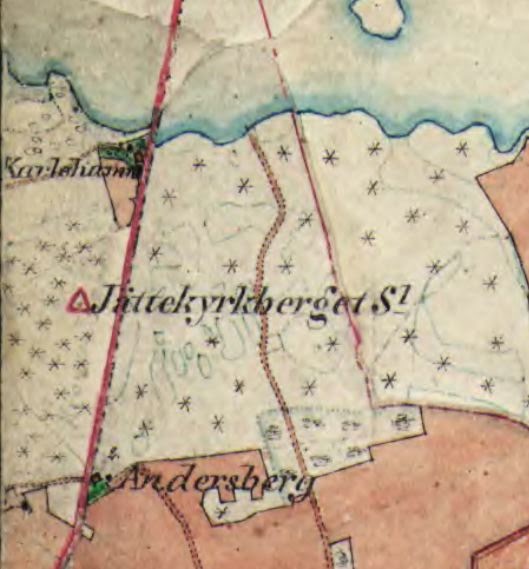
Anders' brother, Karl had rented a piece of land on the other side of Jättekyrkan and built a home, Karlshamn for his family on the other side of Jättekyrkan, by the shore of Lake Storsjön.


Anders [Fors] built a new house on the site of Näsbystugan and renamed the place Andersberg.


On the pictures we can see Andersberg ... and also "Lilla stugan" - presumably Näsbystugan.


The area of Sweden that Claes has written about is southwest of Stockholm. Follow the link to see a map of the general area. The size of the little cottage appears surprisingly tiny. At any time about five people were living in its close quarters. It appears to have a small attic or loft.

I also find it intriguing that Andersberg has never been renamed. It still bears the name that my great-great-great-grandfather, Anders Fors, gave it in about 1860.

Thank you for sharing your work, cousin.

Friday, July 11, 2014

A Twist in the DNA Journey -- Part Two

In the previous post we met "Sven", a new cousin from Sweden, identified through DNA testing. A few weeks after Sven and I connected, his father's DNA results had an unexpected match. Sven had no match and my Dad had no match.

The new match is for a woman of Chinese heritage who has moved from Taiwan to the USA. Let's call her "Lucy". How could Lucy from Taiwan share DNA with a man from Sweden at the 5th cousin to Distant Cousin level?

Let's expand the Ekstrom-Fors-Nyström family tree a bit.


Extending the family tree from the last post, we add Martin Nyström, a Swedish missionary to China. Martin, along with his wife and infant daughter, Ruth, disappeared in China during the Boxer Rebellion in 1900. Their story can be found on the website of the China Inland Mission. Martin's brother also was a missionary to China; however, he and his family escaped to safety.

Several European nations sent armies to protect their interests. It was a terrible time of chaos and violence in China. The Europeans raped and killed women and children, while the Boxers killed Europeans and Chinese Christians.

There are three possibilities for a Chinese woman to have enough Swedish heritage to be a match to the Nyström family:
  • The infant Ruth survived the slaughter and grew up to have her own family. 
  • Martin or his brother Fritiof fathered a child with a Chinese woman.
  • An unknown Swedish soldier, related to Sven's father, impregnated a Chinese woman.

What a mystery! With all the upheaval in China over the past 100 years, can this mystery ever be solved?

There is a bit of a DNA lesson in this story. Little Ruth and Sven's Dad were first cousins, but did not have the same grandmother. They were half-cousins. Instead of sharing 25 percent of their DNA, they would have shared closer to 12 percent. If "Lucy" is a Nyström descendant, her percentage of matching DNA would be similarly decreased. The Family Tree DNA estimate of 5th cousin (or further) makes a bit more sense when we consider that reduction. Rather than 5th cousin, a better estimate would be half-first-cousin 3 times removed.

Who would have thought that a simple genealogical DNA test could crack open a door that was thought closed over a century ago!

Wednesday, July 9, 2014

A Twist in the DNA Journey -- Part One

It's been a while since I've shared much about my genealogical DNA journey, but the past couple of months have been fascinating.

This post is for you if:

  • You are a cousin in my Ekstrom - Fors family.
  • You are a cousin in my Nyström family.
  • You are on your own genealogical DNA journey or thinking about it.
  • You are debating who in your family should be next to have a DNA test.

A New Contact


On May 7, 2014, an email arrived from a man who lives in Stockholm, Sweden. I will call this new cousin "Sven":
My name is "Sven" and if I get it right we are 4th cousins 1R! I got the result today from FTDNA regarding my father's Family Finder.
Eric Carlsson Nyström and his wife Brita Christina Olofsdotter were my great great great grandparents on my fathers side.
My great great grandfather Carl Erik Nyström was brother of your great great great grandfather Anders Fors. I guess Anders took on the name Fors ...


The Family Grows


We have a friendly new cousin in Sweden with a good command of English. He has shared some photos and a map which will be in a later post. Part two will add more family information and a twist, so stay tuned.

Here's a graphical representation of our relationships and the DNA matching results. In part two of this series, the family tree will be expanded.


Lessons in DNA

  1. Test the oldest generation. This match emphasizes what the DNA gurus teach. Sven and I both have results on file at FTDNA, but he and I have no DNA match. Fortunately, both of us took the step of having our fathers tested, also. Our fathers are in their 80s and we gathered that DNA while we could. For $99 each, we made this priceless connection.
  2. Post your tree (GEDCOM) to your DNA testing website. I had posted my Dad's tree and Sven was able to see immediately where the connection was in our trees. He could follow the generations to calculate the relationship of 4th cousin to Dad and then once removed to me. We didn't have to ping-pong email to find the connection.
  3. Work the closest matches first. Sven's Dad has a fairly close match to my Dad. FTDNA proposed a 2nd to 4th cousin match. Sven also has a match, but it was 4th to remote cousin. It might have been weeks or months before Sven worked through his own matches to the page where my Dad showed up. By working that closer match, Sven connected much more quickly.
  4. Don't expect new ancestor information from every match. I've done a lot of Swedish research and have not added much information since connecting with Sven. He has augmented some of my knowledge and vice versa. The more complete your tree is, the easier it is to connect. You may be able to share bits and pieces with your new cousin(s) that will eventually lead to new findings.
  5. Keep track of the matching DNA. I've added the following matching information to my files. When my Dad's kit has another match on any of these DNA segments, I'll know what family that match connects to.

Next time: The Nyström DNA takes a strange turn.
 

Monday, June 16, 2014

52 Ancestors in 52 Weeks: #24 Bessie Douglas Cushnie Ekstrom

My father speaks with great fondness of his stepmother, Bessie Douglas Cushnie. He feels that he and his siblings didn't give her a fair chance to be their new mother. Dad says that she was loving and kind and would have been a wonderful mother, had they opened their hearts to her.

Bessie married Oliver Ernest Ekstrom on October 11, 1932, in Guatemala. They were both missionaries with the Central American Mission. Oliver was a widower with five young children, but courageous Bessie married him anyway and added two more children to the family. The last child, a daughter, was born after Oliver's untimely passing in 1935.

Bessie wrote this in one of her letters home in 1934:
"It will be three years next Sunday since I left the dear old U.S.A. It seems like 10. I guess because so much has happened. Had my appendix out, fell in love, got married & had a baby. I know I haven’t done as much for the Lord as I should have."

Quick drop page from Lock and Key, ClubScrap

Bessie Douglas Cushnie was born on June 19, 1903, in Castle Shannon, Pennsylvania, the third of six children of Charles Christey Cushnie and Sarah Ann Wyllie. Bessie trained as a nurse before going to the mission field.

There are varying accounts of how she and Oliver met and fell in love. One legend was "love at first sight" in Guatemala. Another story is that they met at Moody Bible Institute, but had their relationship disrupted, only to continue it in Guatemala. Regardless, their love story was brief.

After Oliver's death, Bessie worked with the extended families to take care of the five orphaned children. Her youngest child died at six years old, and Bessie herself died on May 08, 1947, leaving her oldest child also orphaned.

Bessie was buried, along with her daughter and her parents, in Oak Spring Cemetery in Canonsburg, Washington County, Pennsylvania.

Tuesday, April 1, 2014

52 Ancestors in 52 Weeks: #13 Gustaf Ekstrom Comes to America

"Grandma Beth, why did our family come to America?"

I mentally flipped through my immigrant ancestors for a story that would be simple for my eight-year-old granddaughter to grasp. My great-grandfather, Gustaf Emil Ferdinand Ekstrom, is my most recent immigrant ancestor and the one about whom I know the most. He came to America in 1891, from Sweden, a country with fabulous records for genealogical research.

Sweden in the 19th century had a problem with growing enough food for the growing population. The soil was depleted and there just wasn't enough good land to grow adequate food. Gustaf and his younger brother Ernst made the difficult choice to move to the rich land that was America, leaving behind their parents, siblings and their homeland.

Gustaf was born at a place called Kristineholm, near Lake Risten in Östergötland. Adolph Ekstrom and Anna Charlotta Svensdotter had seven children, of which Gustaf, born on May 09, 1862, was the fourth.

Adolph was a skräddare, a tailor, and he raised his sons to also be tailors. Gustaf moved to the nearby city of Linköping to practice his trade, while Ernst stayed with his parents in Kristineholm.

On September 29, 1883, Gustaf married Johanna Sofia Pihltrad Gustafson at the Linköping Cathedral. Of their three children, two died before their first birthday. Johanna died just a few days before the third child, in January, 1887.

Left a widower with a toddler, Gustaf remarried on May 20, 1888, to Agnes Emilia Fors. This marriage was celebrated in a Methodist church, an unusual choice in a time when the Swedish state religion was Lutheran. However, this change from Lutheran to Methodist has never been mentioned in the family as a reason for leaving Sweden. The family believes that famine was the only driving force.

The first child born to the new marriage was in 1889, with the second child, born in May, 1891, dying within three weeks. Picture Gustaf and Agnes grieving over this tiny baby. In the span of eight years, Gustaf had buried three babies and a wife. In addition to those family members, he also had lost an older sister to an early death. Agnes had also lost a young sister. I imagine them thinking that there had to be some way to have a healthy and well-fed family. Their thoughts would have focused on America.

Ernst had already left Sweden, emigrating to Chicago in 1889. He would have written to Gustaf about the wonders of America and the opportunities for a skilled tailor to make a good life. Agnes had also traveled to America as a teenage servant. Gustaf and Agnes must have talked at length about America during the spring and summer of 1891.

With their two children, Gustaf and Agnes left Linköping in mid-August, sailing first to England. From Liverpool they sailed in steerage on the ship Alaska, landing in New York on September 14, 1891.

Template and elements from Destinations digital kit by ClubScrap

Gustaf and Agnes settled in the Lakeview area of Chicago to raise their family of two girls and three boys. They lost another little girl to an early death and their second daughter died at age 28, due to complications of diabetes.

Gustaf opened his own tailor shop in the suburb of Evanston and Agnes assisted him, as did one of his sons. He did well, buying a small apartment building. Gustaf and Agnes were also able to travel back to Sweden for a visit in 1924, this time sailing in second class.

Gustaf was remembered by the family for being a strict disciplinarian, for being very hard of hearing, and for being a very fine tailor. He died before the Great Depression impoverished his family. His death notice was carried in the Swedish newspaper.

Svenska Amerikanaren 
Torsdagen Den 14 Juli 1927
Dödsfall i Chicago
Gust Ekström, 1469 Winnemac ave., make till Agnes, fader till Gertie Johnston, Fred, Edward och Alver Ekström, afled den 4 juli.


Gustaf was buried, along with his wife and daughter, in the historic Rosehill Cemetery in Chicago.

I've recently finished researching all of Gustaf's siblings and have discovered that there are no living descendants of any of his siblings. Those who stayed in Sweden continued to experience high rates of infant mortality and low numbers of pregnancies. His brother Ernst had two healthy daughters born in America, but neither had children. I truly believe that Gustaf's decision to immigrate to America was critical to the survival of his branch of the family. In my generation there are over twenty cousins descended from this one Swedish tailor.

Monday, February 10, 2014

52 Ancestors in 52 Weeks: #6 Esther Mathilda Ekstrom Johnson of Chicago


Quick drop page from Two Hearts, Designs by Anita, Scrapper's Guide (now Digital Scrapper), Sep, 2012


Esther Mathilda Ekstrom was my great-aunt. I've seen only a few photos of her, as she died young of diabetes complications in 1923. Had she lived another year, insulin would have been readily available and that miracle drug would have enabled her to live a normal lifespan.

She was born on December 16, 1894, in Chicago, to Agnes Emilia Fors Ekstrom and Gustaf Emil Ferdinand Ekstrom. According to her birth record, she was born at her mother's home at 79 Baxter Street, Lake View Ward.

Esther married George Walter Johnson on December 18, 1912, at Bethany Swedish Methodist Church, Chicago. To this union was born only one child, Russell, in 1913. I suspect Esther's pregnancy triggered an unsafe diabetic state, discouraging any further pregnancies.

She died on May 1, 1923. Her brief obituary was published in a Swedish language newspaper.

Svenska Amerikanaren
Torsdagen Den 10 MAJ 1923
Dödsfall i Chicago
Esther M. Johnson, född Ekström, 2157 Summerdale ave., maka till George W. Johnson, moder till Russell, dotter till Gust Ekström och dennes maka, afled den 1 maj, 28 år gammal.
 

Thursday, June 20, 2013

Patronymic Puzzle

Were you one of the eagle-eyed readers who questioned my sanity last week? How could I not know the surname of Claes Jonas, son of Jonas Flink?

Honestly, I'm not losing my mind. You too may encounter patronymic puzzles in your research. Many European countries used the first name of the father as a base for the last name of his children. Some non-European cultures also have used this sort of naming pattern.

If you see Larsdotter (Lars' daughter) or Ericsson (Eric's son) in a tree, you are looking at a patronymic name from Scandinavia. In Wales, ap is son and verch is daughter. O'Neill is a patronymic from Ireland while McFarlane is from Scotland. Anglo-Norman names may use Fitz as a prefix, meaning son. If you see, in your tree, the surnames changing in each generation, take some time to study the naming patterns of the country or region.

Today I'm rambling about Swedish patronymics.


The family of Jonas Flink, from Södermanland is a mini-study in Swedish patronymics, which were outlawed in 1901. The move away from the patronymic system began earlier, however. The military, clergy and skilled tradesmen were some of the first to take other surnames.

Imagine you are a military leader and you want to tell Eric Larsson that his uniform is a mess. You shout for Larsson and ten men respond. You can see why the military assigned new names to the soldiers and sailors. Each member of a unit was required to have a unique, brief, surname.

If you have Swedish ancestry, be sure to research surnames that don't end in son or dotter. In this case, Flink means fast or fleet of foot. If he was an older man, I would have to research his past to determine if he had served in the military. However, he was a soldier until the time of his death at the age of about 32, so there was no need to question the source of his name.


Jonas Flink lived in Stora Malm parish and was the soldier (soldat) from rote 22, Klicksta. After his death in 1807, his widow and children moved to the home of soldier 6, possibly as servants.

His children here were recorded as son (S) and daughter (D), but without a surname. Brita retained her surname of Pehrsdotter (Pehrsdr). From this church record of 1803-1807, I don't know the original surname that Jonas carried, nor do I know the surname used by his children. They might have used Flink, but that was very unlikely. The missing surnames can only be found by moving backward in time for Jonas and forward in time for each child.

Brita had a fourth child out of wedlock in 1813. This record from 1813-1818, reveals some of the information I need.


It tells us that it is the family of the widow of soldier Flink. Daughter Ulrica is oäkta, or illegitimate, without a recorded surname. Miss Brita Casja also has no surname recorded. The sons have taken the surname of Jonsson. But did the sons keep the name Jonsson throughout their lives?

As the patronymic system was falling out of favor, they may have changed their name, with the priest's approval. The choice often was taken from nature or the name of the farm where they lived. My ancestor, Pehr Eric Jonsson, changed his name to Vidberg (Widberg) between 1834 and 1840. The new name means "by the mountain".

Pehr's siblings may have taken the name Vidberg, the name Flink, some other name or may have kept the patronymic. If Claes entered the military, he might even have become a Flink.

However, Ulrica presents yet another problem. Her father was not named in her birth record and he did not marry her mother. She still might have taken her father's name as a patronymic. She could have taken Brita's name, Pehrsdotter. It is possible that she became Ulrica Britasdotter. Only research can reveal the names that these siblings took to their graves.

The Ekstrom Question


I received a question via text message from a dear friend. She asked how a gentleman by the name of Walter Ekstrom from my home state of Arizona fits into my tree.

The name Ekstrom is not a common name in the United States. In 1920, there were no more than 600 families by that name living in the US. By comparison, there were over 60,000 families with the surname Johnson (source Ancestry.com).


A list of common non-patronymic names in Sweden always includes Ekstrom in the top 100. Ekstrom is a combination of the words oak and stream. It's a name derived from nature, as are many of the post-patronymic names such as Vidberg.

The answer to my friend's question is that Walt is not a known relative. It is possible that he is related, but it is more probable that his ancestors lived near a stand of oak trees and a stream, just as mine must have.

My earliest Ekstrom ancestor was the farmer Eric Andersson, who took the name Ekstrom by 1796. It's hard to imagine a farmer abandoning the patronymic that early, but he must have had lofty goals for his sons. Eric's sons and grandsons become skilled tailors, with the later generation bringing their trade with them to America.

Eric was my very first patronymic puzzle, as I followed my own surname back in time. However, he won't be the last, as I have many Swedish twigs and branches to follow through history.

Wednesday, September 5, 2012

52 Weeks of Abundant Genealogy, Week 31, Cousins

"Ekstrom, party of three."

My uncle and his party arrived at the hostess station only to find another group of the same number and uncommon name. The hostess clarified by adding a first name. But both men were named the same. They laughed and chatted a moment. Not only were their last names spelled the same, but they used the same nickname for their first name. Both had grown up in the Swedish-American community in the Chicago area and had migrated west as adults. My uncle lived in the Phoenix area, but was visiting San Diego that day. The other man lived in the San Diego area, while his father lived in the Phoenix area. They negotiated the table and went their separate ways with a cute story to tell about their unusual encounter. That might have been the end of the story.

But one day in 2003 an email arrived from Sweden. Benny Ekström lives in Östergötland, the same province where my Ekstrom roots originate. Four of his great-uncles had emigrated from Östergötland to America in the early 1900s and he wanted to find his American cousins. He had found my website which showed my Östergötland roots and he had noticed the similarity of names and parishes. Was my family related to his?

We emailed back and forth and decided to join forces and help each other. He sent me the names, birthdates and emigration dates of his relatives and I started digging on my American-focused subscription sites. I knew very little about my Swedish roots. I had gleaned only a few tidbits from Illinois vital records and ship lists and had no idea how to begin to research in Swedish records.

Benny was a godsend! 

He had printed out dozens of pages of Östergötland church record indexes that were available only through a local university. He paged through his file and emailed me birth dates for my great-grandfather and his siblings, along with parents names, marriage dates, birth dates and death dates. He also told me about the Swedish Genline website that provided images of the church records. I subscribed and begin my own journey through the wonderful records kept by the Lutheran church (that company has been acquired by Ancestry and is now included in their site). Benny later copied all the index pages and mailed them to me at no small expense to himself.

Benny knew about one branch of his American family. John had gone to Chicago and Benny was in contact with his descendants. I was looking for three more branches for him.

Karl Ekstrom had gone first to Chicago and died in Minnesota, but Benny knew nothing else. I soon found a candidate in prison in North Dakota in the 1930 census. Yes, Benny recalled that he had heard something about Karl being in prison. Through an archivist I learned that Karl had been sent to prison for abusing family members. We decided to do no further research on that branch.

David and Ernst were challenges. I finally found their immigration records. They had gone to Canada about 1928. There was no census and no Social Security death index to use for locating them. Using search engines, I found that a man matching David's birth date was buried on Vancouver Island in British Columbia. The online phone listings turned up 13 listings for the Ekstrom surname on Vancouver Island. It could not have been coincidence, so we took a risk.

I acquired Canadian stamps and sent a letter, a response form and a Canadian-stamped SASE to all 13 addresses. I received back a couple of nice letters and a couple of emails. We learned that David had died without issue. All the Ekstroms on Vancouver Island were descended from Ernst. One of the emails came from a sweet lady named Lynda. She and Benny began to use to web chats to get to know each other. Benny now had several Canadian cousins.

Benny and I think our families connect, but we have never found the link. The switch from patronymics to permanent surnames in Sweden means that unrelated families often share a surname.

We choose to call ourselves cousins, regardless.

My "cousin" Benny helped me overcome my apprehension about the Swedish records. He helped me with translation and comprehension and even engaged a seminarian friend for one very old record that he could not interpret. He opened up a whole new world for me. Today I have 118 Ekstroms plus many other Swedish relatives in my family tree, a gift from a wonderful cousin in the "old country".

Benny and his niece came to America to visit and we got together. Where were we? Of course we went to San Diego. They came to visit the Chicago-born cousin that he had known for years, the very same man that my uncle had encountered a couple of years earlier.


Ekstrom branches on ClubScrap Generations digital kit

Finding an overseas cousin is a blessing we don't all receive, but it's well worth the time to try.
 

Saturday, March 31, 2012

Fearless Females -- Agnes Emilia Fors Ekstrom

The Accidental Genealogist is another source for blogging prompts and today's grabbed me: pick one female ancestor and write a mini-profile (500 words or less). I'm pleased to introduce my Swedish great-grandmother, as well as show you a simple way to showcase a heritage photo with the pertinent genealogical research.

Agnes Emilia Fors was born August 29, 1864, in Södertälje, Stockholm, Sweden, to Erik Edward Fors and Matilda Vilhelmina Viberg. Erik Fors was a stationmaster for the Swedish railroads, so the family, though financially comfortable, moved frequently. As was the custom in Sweden, she left home as a teenager to make her own way. She emigrated to America as a servant, but returned in less than two years. She married the widowed tailor Gustaf Emil Ferdinand Ekstrom in Linköping, Östergötland on May 20, 1888. He had buried two babies and a wife and, with Agnes, buried yet another baby. Although Sweden’s official religion was the Lutheran Church, the Ekstroms were married in the Methodist Church, implying that they had changed religions as adults.

The scarcity of food and resources in Sweden, along with the desire for religious freedom, drove the Ekstroms to emigrate in 1891, joining many of their countrymen in Chicago, Illinois. Agnes raised her five children and a step-daughter with a deep and abiding love of God, as well as a love of fun and laughter. She saw four more of her children buried during her life. She raised two abandoned grandchildren, as well as helping to raise her youngest son's five orphans. Her life as a tailor's wife and widow was comfortable until her assets as a building owner were destroyed by the Depression not long after Gustaf's death in 1927. She grew bitter and resentful of her reduced circumstances. She died on November 01, 1946, in Chicago and was buried in the historic cemetery of Rosehill.

Her children were:
  • Step-daughter Gerda Linnea Thorborg Ekstrom, born May 17, 1885, Linköping, Östergötland, Sweden; died October 14, 1978, Chicago, Cook County, Illinois.
  • Frithof Benedictus Ekstrom, born March 21, 1889, Linköping, Östergötland, Sweden; died February 03, 1935, Chicago, Cook County, Illinois.
  • Erik Ferdinand Ekstrom, born May 29, 1891, Linköping, Östergötland, Sweden; died June 14, 1891, Linköping, Östergötland, Sweden.
  • Edward Gideon Ekstrom, born January 13, 1893, Chicago, Cook County, Illinois; died September 14, 1961, Evanston, Cook County, Illinois
  • Esther Mathilda Ekstrom, born December 16, 1894, Chicago, Cook County, Illinois; died May 01, 1923, Chicago, Cook County, Illinois.
  • Edna Ekstrom, born May 1899; died between 1900 and 1910.
  • Oliver Ernest Ekstrom, born May 22, 1903, Chicago, Cook County, Illinois; died October 22, 1935, San Pedro Sacatepéquez, San Marcos, Guatemala.

Agnes Fors and Gustaf Ekstrom on Club Scrap Renaissance paper kit

A Simple Heritage Layout

This layout is part of a series. It's a fast and simple way to showcase a heritage photo and show the relationships to other family members. A family tree can be created with genealogy software, written on a form or drawn by hand. Trees are especially important when sharing with non-genealogists, as it helps them visualize the relationships. This is an hourglass tree -- a tree showing both ancestors and descendants of the focus ancestor. I've also used ancestor trees and descendant trees in this series. The right type of tree depends on the size of the family and the genealogical knowledge about the subjects in the photo.

I've paired a Club Scrap foiled paper with a color-coordinated background that I added to my software, which is Family Tree Maker 11. Using standard letter-sized paper makes the tree easy to print at home.