Showing posts with label McFarlane. Show all posts

Sunday, January 10, 2021

Thousands of Miles and 200 Years


While the USA is in turmoil, it's hard to think about history. But sitting on my keyboard is a slip of paper which has graced my computer since being found in a fortune cookie several years ago. The advice is very timely:

The farther backward you can look, the farther forward you are likely to see.

So today I'm looking back 200 years, as promised to relatives on a Zoom call. 

Two very old pocket Bibles were passed into my keeping in 2019. While they don't add much to my research, they are precious family heirlooms that traveled from Scotland to America. The images are shared today for cousins near, far and future.

First will be photos of the Bibles. Second will explain briefly to whom they belonged. Third will tell what little they reveal to me and the questions they raise.


Taylor/Mitchell/Henderson Pocket Bible Images

These pocket Bibles are roughly the dimensions of an index card, or 3 inches by 5 inches. Both have missing pages and even missing sections. They are each part of a two-volume set. The date on the title pages is 1816 and they were printed in Edinburgh, Scotland.


Ann Taylor Mitchell Henderson's Old Testament, with Red Cover
 
William Taylor's New Testament, Containing Part of the Old Testament, with Brown Cover


A similar Bible, well preserved, was sold on EBay. This is how the covers would have looked when they were intact. The front part of each cover, including the tab, is now missing, as is the strap on the back cover.

Bible Sold on EBay
Red Bible Back
Brown Bible Back


Each had a volume number on the spine. 


Brown Bible, Volume 2
Red Bible, Missing Volume Number


The red Bible shows very little wear compared to the brown Bible. The red Bible is also missing a lot of pages.


Red Bible Wear
Brown Bible Wear


The red Bible has, written on the flyleaf, in ink traced over pencil: Peter Mitchell, Ann Taylor, 1822. There may also be the notation of a volume number, but that is unclear, as are some other marks.
 

Red Bible Owned by Peter Mitchell and Ann Taylor Mitchell Henderson


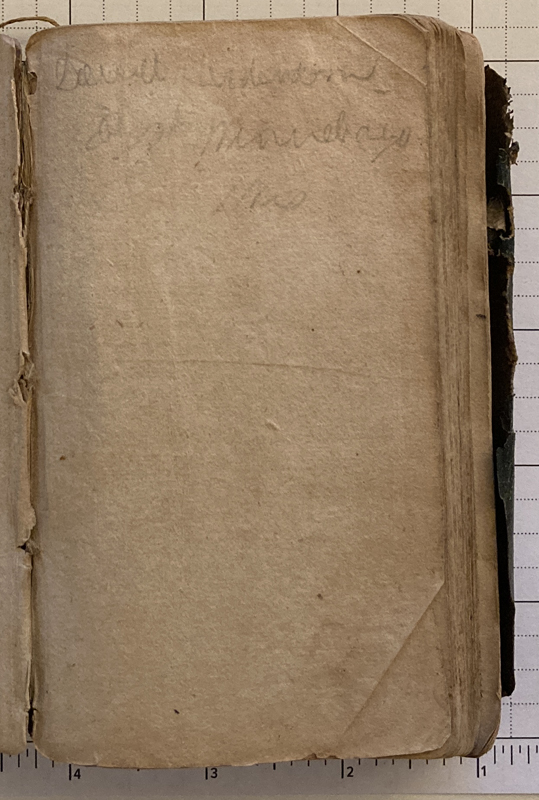
The flyleaf of the brown Bible has the words Willim Taylors Bible and No 2, along with stray marks. The next page has the words, written in pencil only, David Henderson, Fort Winnebago, Wis.
 

Brown Bible Originally Owned by William Taylor

Brown Bible Second Owner, David Henderson, Fort Winnebago, Wisconsin


Taylor/Mitchell/Henderson Pocket Bible Owners

The family immigrated to Wisconsin from Linktown, Fife, Scotland, which is on the north side of the Firth of Forth. I've written about the family members in the past and the posts are linked here.

Ann Taylor (ca 1800 - ca 1886) married Peter Mitchell in 1820 and the first of their four children was born in 1822. Ann married David Henderson (ca 1799 - ca 1880) in 1841. Ann's relationship to William Taylor is not known, but he was probably a brother or cousin. Ann had five children, three of whom have living descendants in 2021. The children were:

George Mitchell (1822-1907) married Phoebe Jane Drummond Gleason, no issue.

Helen Mitchell (1824-1841) died young.

John T Mitchell (1827-1911) married Mary McGregor. Two children (possibly three) have living descendants: Jennie Mitchell Duff (1866-1953) and John Gavin Mitchell (1868-1945).

Margaret Mitchell (1830-1885) married Joseph McFarlane. Their middle son, Walter McFarlane (1864-1922), had one daughter with issue: Ruth Dorothy McFarlane Ekstrom (1898-1931). This is my line.

David Henderson, Jr. (1843-1908) married Jane "Jennie" Robbins. Their eldest son, George Henderson (1887-1981), had one son with issue: Harold Henderson. The Bibles were found in Harold's basement after his death. His daughter "Connie" sent them to me.


Taylor/Mitchell/Henderson Pocket Bible Clues and Questions

 
The Bibles pushed me to dig into our roots in Scotland and Wisconsin. Unfortunately I found very little, especially about William Taylor, whose name is common and hard to research and sort out.
 
It appears that William Taylor's Bible was passed to David Henderson, Jr. If William had returned to Scotland or had children in America, his Bible would have gone to someone else. This is a clue that William died in America, without issue. William appears with the family in both the 1841 Scotland census and the 1850 Wisconsin census. No other Wisconsin records have been found. I look forward to digging into courthouse records when our lives return more to normal.

The names in Ann's Bible are an unexpected blessing that confirms her maiden name and her first husband as Peter Mitchell. Why is there a date of 1822? Was the Bible a gift to celebrate or record the birth of their first child? Were there pages, now missing, to record births, deaths and marriages? Why is her Bible fairly unused? The census tells us that she was literate. We know she sent and received letters. If she had a New Testament volume, it did not survive. Could it be that she preferred it and wore it out?
 
I also wonder about the long journey taken by Ann and her Bible. In late April of 1850, she and her husband and two youngest children started the journey of a lifetime. The first step was to travel the 60 miles to Glasgow and the port of Clyde. The family then boarded the Barque Clutha, which sailed from Clyde on May 2nd, for a five week journey to New York City. It must have taken a lot of courage to get on that ship, knowing they would never see Scotland again. They arrived in New York on June 8th, and had another thousand miles to travel to Wisconsin. How did they make that journey? They may have sailed on the Great Lakes, or traveled by rail, wagon or riverboat. Or they may have used several modes of transportation. Did Ann turn to her Bible for comfort over the many weeks of travel? Did she carry the Bible in her handbag to keep it handy, or was it packed away for safe keeping?

We will never know the answers to these questions and will never know the complete stories of these ancestors. Unfortunately, dementia has stolen the mind of the last Henderson family member who may know some of these family stories.
 
I deeply appreciate "Connie" sharing these heirlooms with me, her distant cousin, so that their images can be preserved for the use of future generations.

Sunday, August 5, 2018

A Letter Home: 52 Ancestors


One little error on a ship's passenger list created a brick wall in my Wisconsin research. A combination of serendipity and a miracle demolished that wall.

If you are part of my Dad's family or just appreciate a genealogical mystery, please stay with me through this amazing tale. If not, go straight to the miracle at the end of this post.

The serendipity started on the day of my Dad's memorial service. One of my cousins told me that he was planning a fall trip to Wisconsin. He would be willing to do some family research for me if he could. That would be nice, but there was a big problem -- I had been stuck for years and had not spent much time on these branches. With a willing victim, I decided it was time to dig back into Wisconsin. Thanks for the push, cousin!

You may think I'm strange, but I believe that those of us who research our family history receive inspiration from the other side: angels, spirits, heaven, whatever term fits for you. I started talking to my Dad asking him to send me help for all his brick walls.

My first step was reviewing specific surnames in DNA cousin matches for my Dad and Uncle. It looks like DNA matches will eventually solve our McFarlane puzzle, but there were no useful clues for the Mitchell family. It was time to face the possibility of a Mitchell surname study.

I knew very little about Margaret Mitchell. Her surname came from my great-grandfather's death certificate, which is not a primary source. Was the name even correct? She had been born in Scotland about 1830 and her eldest known child was born in Wisconsin about 1858. Her husband, Joseph McFarlane, had no wife living with him in Columbia County in 1850. There has been no marriage record found. She supposedly had family in Wisconsin.

That left some questions. Did they marry in Scotland and immigrate at different times? Had she been married before? Did she come to America as a Mitchell or a McFarlane or under some other name? I couldn't find any passenger list that fit. Also, not all ship lists have survived.

One of the challenges to finding a migrating ancestor is to be sure the person in the new location is found with some of the same people in the old location. That's true whether the move is across the ocean or across a state. Unfortunately I had no family context for Margaret.

However, there was one clue that I had never examined in depth. In the 1850 census of Columbia County, a woman named Margaret Mitchell of the right age was listed. She looked like a married woman, but there was no way to be sure. She was in the same household as a man named George Mitchell. Was she a wife or a sister or even a cousin? Was there a family connection to the Henderson family with whom they were living or were they hired hands? It was time to research this household, especially George Mitchell.

The 1850 census record is very hard to read. The head of the family is David Henderson, age 51, a weaver born in Scotland. With him are Ann Henderson, age 50 or 51; David Henderson, age 7; George Mitchel, age 27; Margaret Mitchel, age 20; William Taylor, age 57. Everyone was born in Scotland.


I had already seen the passenger list for the Henderson family. It looked as if Margaret Henderson had come to America with the family and then married George Mitchell. The Barque Clutha had arrived in New York on June 8, 1850, having sailed from Glasgow, Scotland. On board were David Henderson with wife Ann and family, listed as David Henderson and Margaret Henderson. The word Do stands for ditto. On the next page was Hugh Taylor, who may or may not have been the same man with them in Wisconsin.


By the time of the 1860 census, both Margaret Mitchell and William Taylor had disappeared from the family. Had she died or was she my Margaret? Since looking at these records in earlier years, indexes for the Scotland census of 1841 had come online at Ancestry. It was time to search through the 1841 census for George Mitchell, born about 1823.

There, in the 1841 census, was the answer to the family relationships. Had I braved the paywall at Scotland's People years ago, I might have unraveled this sooner. However, I hate how they structure their prices, so had avoided it. In order to look at the images of the census and church records, I have now conceded defeat and they have acquired a bit of my money.

In the 1841 census, David Henderson was living in the same household as Ann Mitchell and her three children: George, John and Margaret. The ages were rounded down in this census, so they do not align perfectly with the ages in the US 1850 census.


John Wilson was the head of the household. Also with him were Elizabeth Wilson; Ann Mitchell, age 40; George Mitchell, age 18; John Mitchell, age 10 (he was about 13); Margaret Mitchell, age 10; William Taylor, age 40; and David Henderson, age 40. Everyone was born in the County of Fife. William Taylor was listed as a tailor, but the rest of the males were linen hand-loom weavers, an occupation that was in decline due to the industrial revolution. Young John was an apprentice. They lived on a lane named Gas Wynd in the community of Linktown, which is near the town of Kirkcaldy and across the Firth of Forth from Edinburgh.

Research in the records of the Abbotshall Parish of the Church of Scotland revealed the parents of the Mitchell children were Peter Mitchell and Ann Taylor. They had another daughter, Helen, who had died. Ann Taylor had married Peter Mitchell on May 14, 1820. Peter's assumed death was not recorded.

The widowed Ann married David Henderson on November 22, 1841. Their son's birth was recorded as January 15, 1843, in Linktown.


The births of the Mitchell children were all recorded in the Abbotshall church records on a single page, rather than on pages spread over several years. It appears to have been either a transfer into the parish or an effort by the minister to document families, as other families are listed in the same mixed way on the page.


The Mitchell children were George born October 18, 1822; Helen born April 14, 1824 and died about January 19, 1841; John born October 7, 1827; and Margaret born February 26, 1830.

Returning to the erroneous passenger list, David Henderson, Sr., was the step-father to young Margaret, who then had sailed to America in 1850 under the Henderson name instead of the Mitchell name.

Having found all these lovely records for the family, the next question was whether they are my family or just a coincidence.

I traced the family forward, finding that John and George had lived near Margaret Mitchell McFarlane in Wisconsin at times. John Mitchell had moved to Chicago, where Margaret's only surviving son had later moved. There was a lot of circumstantial evidence, but I wasn't fully comfortable that this was the right Margaret Mitchell. All the other Mitchell lines ended or were impossible to find.

The next step was tracing the David Henderson family forward. Was it true that there was family in Wisconsin? Were there living cousins?

The descendants of David Henderson are few. I found two elderly gentlemen who are living, one of whom has a unique name. Searching for him on Google turned up a legal proceeding having to do with his land. The other gentleman has several descendants. One of the daughters -- I'll call her Connie -- was listed as having the power of attorney for her uncle. Included on the legal documents was her full address. The legal documents had disappeared from the internet only a couple of weeks later and were apparently online for only about a month. Finding her address so easily was truly serendipity.

I created a descendants chart for Ann Taylor, her children and grandchildren. I wrote an actual letter explaining who I was and asked if Connie could put me in touch with the family historian, if there was one. I sent off the letter and chart in the mail and waited impatiently to see if she would answer.

Connie responded by email and we've had an ongoing conversation for several weeks. She reported that her uncle was the one who knew all the family history, but now has dementia. She had never heard the names Mitchell or McFarlane, but would check into documents that she had received from her grandmother.

A few days later she sent me a scan of an amazing letter from 1862. The letter, which follows, proves without a doubt that Ann Taylor was the mother of Margaret Mitchell McFarlane and that George Mitchell was Margaret's brother. It also reveals a previously unknown child of Margaret's that fills in a six-year age gap in her children.

Connie had collected all the papers from her uncle's house when she moved him out. She'd thrown most of it away. For some reason he had saved this one old letter, but she didn't know why. In turn, she had saved it. I suspect they were curious as to the identity of the people who wrote the letter and to whom the letter was sent. The survival of this letter is truly a miracle and for me to have found the person who had the letter is yet another miracle. Connie and I have agreed that she will send the letter to the museum in Monroe County, Wisconsin, where the director has agreed to add it to their historical archives.

The letter to Ann Taylor Mitchell Henderson reads as follows:


Jefferson, Monroe
April 1st 1862
Dear Mother
     It is at present my sorrowful duty to inform you of the death of Margaret's youngest boy .. he died in the morning of the 21st of March at 4 A.M. and was buried on the saturday afternoon following. His trouble was Measles and whooping cough. Her oldest boy (Joseph) has had the same troubles and has not yet got well? of the whooping cough. Many of the children round here ar similarly afflicted, also diphtheria or putrid sore throat is pretty prevalent in this part of the country. As for the rest, all are well.
     I am living with Margaret for a little till I can get my own house fixed. I received your last letter and Mr. McFarlane also received the one you sent him. We both join in writing this and hoping you are all well. The snow is wearing very slowly away and we are afraid the spring will be rather late cattle feed is scarce, many have nothing at all to give their animals - we are not so bad but don't care how soon the grass were up.
     I can't devine who is meant by Betty Brand let me know when you write.
Yours Afftly,
Geo. Mitchell
Joseph McFarlane
Direct
St Mary's P.O.
Monroe, Wis.


Wednesday, August 1, 2018

Take a Sidestep: 52 Ancestors


Sometimes the only way to push back a generation is to step sideways and research siblings and cousins of your ancestors. Stuck in Wisconsin research for years, I recently decided to research a man named George Mitchell, who might be a relative of my great-great-grandmother. Indeed, he turned out to be her brother. The miracle of how that relationship was proven is a story for another day. Today, I'm introducing George to my family.

George Mitchell was born October 18, 1822, in Fife, Scotland. It appears that he and his siblings had their birth dates recorded at the new church when they moved within Fife, so the actual parish of birth is unclear as of this writing. In the 1841 census of Scotland, he was listed as an 18-year-old with the occupation of linen hand-loom weaver. Power looms were soon to threaten his livelihood.

In the spring of 1849, George left Scotland for America, arriving in May, possibly on the ship Cuthbert. Six months later he was living in Columbia County, Wisconsin. There he declared his intent to be naturalized, but he did not recall his exact arrival date in New York.


George was farming by September of 1850, when the census taker came calling, and he continued farming for the rest of his life. By 1859 he was paying taxes on just over 72 acres of land in section 9 township 13 north range 9 east, Fort Winnebago Township.


George Mitchell's 1859 tax receipt is still in the hands of a family member


George was a single man of nearly 40, yet living with his mother and her second family in June of 1860. In November of the following year, no doubt after the harvest, he sold his land to his mother. Some 80 miles to the west, in Jefferson Township, Monroe County, he joined his younger siblings. He lived for a while with his sister Margaret Mitchell and her husband, Joseph McFarlane, and their children.

A man named George Mitchell was purchasing land in Jefferson Township as early as 1858; however, it is unclear if it was the same George. The land was within two miles of land purchased by his brother and brother-in-law, so it is possible. There was another George Mitchell in the area and there has also been some online confusion with others. This is an opportunity for further research in land records.

Men in Jefferson who were subject to military service were placed on a list in August, 1862. George and his younger brother John were both on the list. However, it appears that neither served during the Civil War. Other local men did serve, among them a man named Emanuel P Gleason. He died in Louisiana in 1865, leaving a widow and three small children. George Mitchell married Phoebe Jane Drummond (or Drummonds) Gleason on May 10, 1866, becoming the step-father and guardian of the children: Mary, Samuel and Louis. George and Phoebe had no other children.


By the time of the 1870 census, George had moved a few miles north to Angelo Township. In 1874, he purchased, from the federal government, 160 acres in Angelo Township, in section 34 of township 17 north range 3 west. By 1897, much of this land, plus more, had been transferred to his stepsons, Samuel H Gleason and Louis N Gleason. It may be that George had invested in land with the military pension he was collecting on behalf of the children.

Throughout the rest of his life, the census reported he was a farmer, but the 1880 census said he was teaching school. That may have been an error on the part of either the census taker or a census copyist. Or it may have been something he tried in his later years or did in the winter.

George Mitchell died on July 24, 1907. His death record shows that the retired farmer died of exhaustion with contributing factors of myocarditis and senility. He was buried at Farmers Valley Cemetery, Monroe County, Wisconsin. Phoebe Jane Drummond Gleason Mitchell died on January 20, 1912, and was buried in the same cemetery.

Sunday, July 8, 2018

The Hunting Accident: 52 Ancestors


Was it really possible for a man to accidentally shoot himself in the face with a muzzle-loading rifle? Not knowing much about guns, I sat down with a co-worker who is a competitive shooter. He explained how the rifles popular during the Civil War were loaded with gunpowder, bullets, a ramrod and a percussion cap. He also felt it was highly possible that such a rifle could misfire.

The discussion reminded me of a 19th century pistol that I found in my grandmother's dresser. The local pawnshop owner was able to date it and warned that it would be dangerous to actually fire. It might hurt or kill the shooter.

So, yes, it does seem possible that a man could shoot himself in the face accidentally with a muzzle-loading rifle. That was the fate of my great-grandfather's older brother.

Young Joseph McFarlane, Jr., went out hunting alone in 1882 and was found dead, with a rifle on one side of his body and the ramrod on the other side, indicating he was loading the weapon when it fired. I don't know the age of the rifle, but it was probably older than Joseph's 24 years and may have been fouled from years of use.

His father had immigrated to Wisconsin from Scotland in 1849. He probably didn't bring a rifle with him on board ship. He purchased his farm on the Wisconsin frontier in the next ten years and would have needed a rifle for protection and hunting. He likely purchased his rifle sometime during the 1850's. Being farmers, I doubt the family would have purchased another rifle, unless one of the boys saved up to buy his own gun.

Joseph McFarlane's death was certainly a tragedy for the family, as he left behind only his 18-year-old brother to farm with their aged parents. The Sparta Herald published the following account on December 26, 1882.

Tragedy in Jefferson [Township]

The tragic death of young Joseph McFarland, of Jefferson, in this county, is a forcible instance of the danger attending the carless [sic] use of fire-arms. He started out hunting, the 17th inst., and that was the last seen of him alive. His dead body was found in the woods next day, his face and head blown to pieces with the charge, which seemed to have entered his mouth, the gun lying at his right hand, and the ramrod on the other. The inquest jury determined that the shooting was accidental, as no cause could be assigned for suicide, and the deceased was a quiet, steady young man, not likely to be impelled to self-destruction. He was the only support of his parents, to whom the event must be a terrible blow.

An earlier, shorter news item stated on December 23:
... from the positions the coroner's jury rendered a verdict of accidental shooting.

Joseph had not married and left no known issue. His place of burial is not known. Following is a copy of the longer news article that reported on this tragic death in my family.


Friday, November 4, 2016

Did My Grandparents Cheer for the Chicago Cubs?


One of my co-workers asked how an Arizona native living in the American South had become a fan of the Chicago Cubs. Of course, it's all tied to family.

Thinking about my family's Chicago roots led me to the realization that sports affiliations are not a part of my family history knowledge. I failed to ask about sports when I interviewed an elderly cousin some 16 years ago. Now he's gone -- the last of a generation who knew my grandparents and great-grandparents through the eyes of a teenager.

It's hard to think of all the questions we should ask of our family, so this is just a little reminder to ask about sports if it's something you'd like to know.

Reminiscing about our Chicago history, I realized that the 1907 and 1908 World Series wins by the Cubs would have been a part of the fabric of the lives of my grandparents and their families. They lived in neighborhoods on the north side of Chicago, a few miles north of Wrigley Field. In their championship seasons, the Cubs played at the West Side Grounds, which was further south, but they were still the hometown team.

My grandmother, Ruth McFarlane, was a girl of nine in 1907. Her father had been badly hurt in a work accident on the Chicago street car system and the family struggled through financial difficulties. Her schoolmates and church friends would no doubt have been excited about the accomplishments of the home team and perhaps she and her younger sister were also. Did her parents have the luxury of enjoying the wins for a brief moment? By 1910, Ruth had dropped out of school and gone to work to contribute to the family income. I imagine that baseball was, for her, a background thought of no consequence.

My grandfather, Oliver Ekstrom, was four years old in 1907, and lived a life of financial comfort in the Andersonville Swedish-American community. He was the youngest of five living siblings and would have shared the excitement of his siblings and friends when the team brought home the championships. Were his immigrant parents also caught up in the excitement? Did they rejoice at the wins?

Nine years later the Cubs moved to what is now Wrigley Field. I'd like to think that Oliver was able to attend some of the games with his brothers or with his brother-in-law, a Chicago policeman. After Oliver and Ruth married, they went to Central America as missionaries, weakening the strong Chicago ties. With their early deaths, their children grew up in boarding schools in other places.

By the time the Cubs suffered the Curse of the Billy Goat and lost the World Series in 1945, Ruth and her parents were dead, as were Oliver, his father and two siblings. Only Ruth's sister and Oliver's mother and two siblings remained in Chicago, along with three of Oliver's nieces and nephews. That extended family still has members who live in the Chicago area; however, Oliver's children scattered, with three brothers eventually landing in Arizona.

Regardless of Oliver's connection to the Cubs, many of his descendants have embraced the Cubs and have enjoyed visits to the historic ballpark. I've been to Wrigley Field only once, though I've seen the Cubs play at other ballparks. I celebrate their 2016 World Series win as I reflect on the history of my family and our Chicago roots.


Quick drop page and elements from Digital Scrapper's Liberty (2009) and  Sports Mad (2012) kits


Saturday, November 15, 2014

52 Ancestors in 52 Weeks: #44 Oliver Ernest Ekstrom


Quick drop page from Destinations, ClubScrap

Ahlver Ernst Ekstrom was born in Chicago, Illinois, on May 22, 1903, the youngest child of Swedish immigrants. His oldest sister, Gertrude, did him the favor of Anglicizing his name to Oliver Ernest when she took him to enroll in school for the first time.

Oliver's father, Gustaf Emil Ferdinand Ekstrom, made a comfortable living as a tailor, permitting Oliver to attend school when many of his peers were dropping out to work. Oliver's mother, Agnes Emilia Fors Ekstrom, was a woman of deep faith, no doubt encouraging Oliver's love of God and dedication to His work.

At one time, Oliver worked for a safe company. One day he was using a screwdriver on a safe and it slipped, gouging into his eye and blinding it. From that time he wore glasses.

He pursued a religious education as a night student at Moody Bible Institute. There Oliver met Ruth Dorothy McFarlane, whom he married in Chicago on July 14, 1923. They had five children. In 1925, Ruth and Oliver were accepted into the Central American Mission (CAM) and assigned to the ministry in Guatemala.

After Ruth's untimely death in April, 1931, Oliver enlisted the help of various family members in the Chicago area. Leaving the children scattered, he returned to the Guatemala work.

In November, 1931, family legend says that he reluctantly traveled to Port Barrios to meet a newly assigned missionary. It was "love at first sight" when he met Bessie Douglas Cushnie. They married on October 11, 1932, at San Miguel Acatán, Guatemala. Bessie and Oliver had two children, one of whom was born after Oliver's death.

Oliver suddenly sickened while on a trip in October, 1935, dying on the 22nd. The CAM article on his death contains an error, as Oliver died from typhus, rather than typhoid. Typhus was a deadly disease requiring quarantine. The attending physician wrote his diagnosis as typhoid instead, because he knew Bessie was a nurse and would be able to care for Oliver as adequately as the hospital.

Oliver was buried in an unmarked grave at San Pedro Sacatepéquez, Department of San Marcos, Guatemala.

The CAM article also tells us about his life and his death:
To know Mr. Ekstrom was to love him and it was not long until his smiling face and cheery laugh were known all over the republic. Besides being a good preacher and a tireless evangelist, Mr. Ekstrom had marked musical ability and any service in which he had a part was certain to be one of life and interest. ...  
Every possible care was given this dear brother by his wife and fellow missionaries and by the local doctor but as the days passed it was evident that his heart could not stand the strain. He seemed to know that his life's work was ended and among other precious words, he said to his wife, "There are four things I am sure of; I am saved, I love you, I am going to heaven and we will meet again some day."
"Oliver Ernest Ekstrom", The Central American Bulletin 203 (Nov., 1935): 3-4, 15-16.

Tuesday, November 11, 2014

52 Ancestors in 52 Weeks: #43 Ruth Dorothy McFarlane Ekstrom


My grandmother Ruth Dorothy McFarlane was born in Chicago, Illinois, the eldest child of Walter McFarlane and Mary Ellen (Vossler) McFarlane on February 7, 1898. She had to drop out of school after seventh grade after her father was badly injured in a streetcar accident. To help support the family, she worked as a retail clerk and a telephone operator.

Ruth attended night school at Moody Bible Institute, where she met her husband, Oliver Ekstrom. They married on July 14, 1923. Dedicating their lives to Christ, they went as missionaries to Guatemala with Central American Mission in 1925.


Quick drop page from Sweet Comforts by Shabby Miss Jenn for Digital Scrapper, 2014

Ruth entered a Chicago hospital for minor surgery in 1931. When she hemorrhaged, her husband's blood was used for a transfusion. Unfortunately, the blood types were likely incompatible, based on the mixed types seen in their children. She died on the operating table at Swedish Covenant Hospital on April 23, 1931.

She was survived by her husband and five children. Ruth was buried in an unmarked grave in Chicago's Rosehill Cemetery. When a marker was laid in 2002, her eldest son, David, chose the inscription: "She was worth far more than rubies."  

Tuesday, July 29, 2014

52 Ancestors in 52 Weeks: #30 Walter McFarlane, A Reluctant Farmer


The challenge of life on a farm in 1885 is hard enough for me to grasp, but to my grandchildren it would seem like the dark ages. Imagine no cell phone, no computer, no electricity, no gas and no running water. The nearest phone was likely miles away. The outhouse might have an old mail order catalog, not soft toilet paper. Water would be carried from the nearest source and wood chopped for heating and cooking. There were no big red tractors, no big green harvesters, no cars or pickups. Candles and lanterns were the source of indoor lighting.

The more family members could share the work, the better. Fields needed to be plowed, sown and harvested. Crops had to be taken to market. A garden provided food and some of the yield would need to be canned for use throughout the year. Animals had to be fed, watered and cared for. Some had to be slaughtered for food. Fences, wagons and tools required repair. Meals had to be prepared and dishes washed. Laundry, sewing and cleaning were constant tasks.

Just thinking about the amount of work is overwhelming. My great-grandfather, Walter McFarlane, must certainly have been overwhelmed when he inherited the Wisconsin family farm at the tender age of 21. Within the past three years the rest of his family had died: first his older brother, then his father, Joseph, and finally his mother. Unfortunately, Walter despised farming, according to family legend. But was it the work he hated or was it the solitude?

Suddenly he was all alone and grieving his family. He would have been exhausted trying to do everything that needed to be done. Did he hire a field hand or household help? Could he even have afforded to do so? Did he have time to go courting and find a wife? If so, he was not successful.

Walter's mother, Margareth Mitchell McFarlane died in October of 1885. In February of 1888, Walter sold the Monroe County farm. He had farmed on his own for less than 30 months when he threw in the towel.

Walter was born on July 20, 1864, so was not yet 24 when he walked away from the farm to make a new life. The next few years are a mystery to me. By 1896, Walter was living in Chicago and working as a motorman on the city's streetcars.  How did a Wisconsin farmer become a Chicago motorman? That seems like quite a change.

On April 07, 1897, he married Mary Ellen Vossler in a ceremony performed by the pastor of a Presbyterian Church. Mary Ellen's brother, John Vossler, worked with Walter on the streetcars and roomed in the same boarding house as Walter. It's possible that Mary Ellen also lived there. The couple certainly met through John or their living situation.


Quick drop page from Full Circle, ClubScrap

Walter and Mary Ellen had two daughters: Ruth in 1898 and Margaret in 1900. Their comfortable life came to an end between 1904 and 1905. Walter was injured at work and was left brain-damaged. After healing, he was able to do only menial work. He briefly returned to farming in Bartlett, Illinois. He also worked in a factory and was a night watchman at the historic Rosehill Cemetery in Chicago.

Walter McFarlane died in Chicago on August 21, 1922, and was buried in an unmarked grave at Rosehill Cemetery.

Saturday, July 26, 2014

52 Ancestors in 52 Weeks: #29 Joseph McFarlane of Wisconsin in the Lost and Found

Found: One Joseph McFarlane

Location: Monroe County, Wisconsin

Goal: Reunite Joseph with his family


Identifying Statistics:

  •     Born in Scotland between 1814 and 1820
  •     Married between 1850 and 1860, probably in Wisconsin, to Margareth Mitchell
  •     Died in 1884 or 1885


Joseph had three documented children, only one of whom had known issue:
  •     Joseph McFarlane, born about 1858, died December 17, 1882, in or near Monroe County.
  •     Walter McFarlane, born July 20, 1864, in Monroe County. Died August 21, 1922, in Chicago.
  •     William McFarlane, born about 1867, died young.

Joseph arrived in New York City on the ship John Kerr on July 28, 1849. Listed with him were Ann, age 31, and Elizabeth, age 17, while he was listed as age 30. Also on board was Robert, age 48. None of these persons have been found living with Joseph in Wisconsin. However, the next page is missing from the 1850 census and that might show differently if it becomes available.

In the census of 1850, Joseph McFarlane, age 30, was a farmer in Fort Winnebago Township, Columbia County, Wisconsin. On October 29, 1850, in the Circuit Court of Columbia County, he filed his Declaration of Intent to become a naturalized citizen of the United States. He stated that his age was about 32, that he sailed from Glasgow, Scotland in May, 1849, and that he arrived in New York in July, 1849.

By 1860, Joseph had married Margaret Mitchell and was living in Jefferson Township, Monroe County, Wisconsin, with a stated age of 45. Joseph bought and sold land in Jefferson and Sheldon Townships. In 1875, he described his house as part of proving his homestead claim:
... a log house, one story high, 15 x 20 feet with shingle roof, two floors, one outside door, 3 windows and is a comfortable house to live in.
Joseph sold all his land to his wife on December 26, 1884. That may have been his strategy to avoid probate or the deed could have been forged after his death by his wife for the same reason. Margareth mortgaged a portion of the farm on January 10, 1885. When Margareth died in October, 1885, she was a widow, which places Joseph McFarlane's death in 1884-1885, most likely around the dates of these land transactions.

If you've lost this Joseph McFarlane, please leave a comment so we can connect.

Tuesday, May 6, 2014

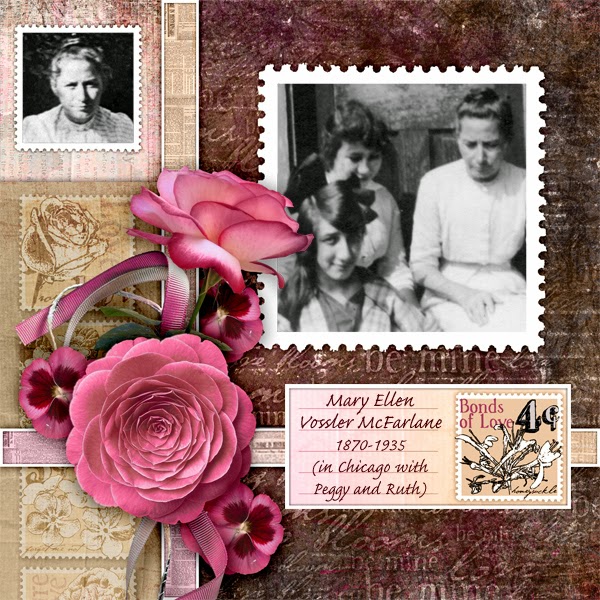
52 Ancestors in 52 Weeks: #18 Mary Ellen Vossler McFarlane

My great-grandmother has left me with three big questions:
  1. What was her nickname?
  2. Where was she raised?
  3. By whom was she raised?

Quick drop page from Love Blooms, ClubScrap

Mary Ellen Vossler was born March 22, 1870, near Decatur, Illinois. She had one older brother, John, and five older half-brothers. Little is known about her father, George Vosseler. He was an immigrant from the German principality of Wuerttemberg.

Mary's mother was Elizabeth Childers, who was born about 1833, in Bristow Cove, Alabama, and was the widow of John Wilson. By 1875, Elizabeth and George were dead or missing. McFarlane family legend reports that Mary was then raised by a childless aunt and uncle in far southern Illinois.

Mary Ellen married Walter McFarlane on April 7, 1897, in Chicago. They had two daughters: Ruth Dorothy McFarlane and Margaret Elizabeth "Peggy" McFarlane. Mary lived as a typical Chicago housewife. As she grew older, she was crippled by rheumatoid arthritis. She was remembered as being loving and kind with her grandchildren during the years she cared for them. She died on October 23, 1935, in Chicago, and is buried in an unmarked grave in Ridgewood Cemetery in Des Plaines.

Family legend reports that Mary's nickname was "Molly". However it is more likely to be "Polly", a common nickname for Mary. If she was raised by German relatives, might she instead have been called Marie? She is nowhere to be found in the 1880 census under any of these names. I've searched for many years and never found her. If that elusive census record comes to light, it should solve all three questions and put the mystery of Mary Ellen to rest.

Monday, March 24, 2014

52 Ancestors in 52 Weeks: #11 Margaret Mitchell McFarlane in the Lost and Found

Found: One Margaret Mitchell

Location: Monroe County, Wisconsin

Goal: Reunite Margaret with her family 

Goal has been met! See A Letter Home, published in August, 2018


Identifying Statistics:

  • Born in Scotland about 1830
  • Married between 1850 and 1860, probably in Wisconsin, to Joseph McFarlane (sometimes spelled McFarland)
  • Died on or about October 10, 1885, with probate entered in Monroe County, Wisconsin


Margaret Mitchell McFarlane had three documented children, only one of whom had known issue:
  • Joseph McFarlane, born about 1858, died December 17, 1882, in or near Monroe County.
  • Walter McFarlane, born July 20, 1864, in Monroe County. Died August 21, 1922, in Chicago.
  • William McFarlane, born about 1867, died young.
In 1850, Joseph McFarlane was a single man in Fort Winnebago Township, Columbia County, Wisconsin. By 1860, he had married Margaret Mitchell and was living in Jefferson Township, Monroe County, Wisconsin. Their property was very near Vernon County, Wisconsin. I have found no marriage record in any of the three counties as of this writing. Nor have I been able to identify Margaret's parents or siblings.

If you've lost this Margaret Mitchell, please leave a comment so we can connect.

Tuesday, January 7, 2014

52 Ancestors in 52 Weeks: #1 Margaret Elizabeth McFarlane

Thanks to a lovely challenge from the blog No Story Too Small, I'm joining a lot of others committed to blogging about one ancestor a week during 2014. I want to also use this challenge to do more scrapbooking, so I plan to include a new heritage layout each week.

This week I present my great-aunt Peggy, whose middle name I share. My father thought of his Aunt Margaret Elizabeth McFarlane as a mother figure.

Her comfortable childhood was disrupted by her father's brain injury when she was about four years old. Leaving school early to help support the struggling family, one of her proudest moments was the day she graduated from Moody Bible Institute. She worked in a needle factory and as a telephone operator, as well as doing secretarial work for many years.

After her older sister died, she proposed to her brother-in-law that they marry, so she could help raise her niece and four nephews. He was not interested, instead marrying another woman. He died four years later, leaving the five orphans to be raised by relatives and in boarding school. Aunt Peggy stepped in to help guide and raise the children, never marrying. Her niece and nephews saw her as the nearest thing to a mother in their turbulent young lives.

Aunt Peggy never learned to drive and never owned a car, depending instead on Chicago's mass transit. Born on August 2, 1900, in Chicago, she died in a Florida retirement center on July 16, 1992.


Quick drop page, Bookshelves digital kit from ClubScrap


Wednesday, September 25, 2013

A Binary Search

Have you ever done a binary search? Yes, it's a computer term, but I bet you've done it without knowing what it is. I did one during FGS 2013 at the Allen County Public Library (ACPL) and thought I'd share the concept.

One of my ancestors was injured in a work accident in the Chicago area and I'd like to learn more about it. I've heard two different versions in family legends. Searching newspaper archives by name and location has not turned up an article.

In the 1900 census, Walter McFarlane was a "motorman", most likely on the streetcars. In 1910, he was a night watchman at a cemetery. His injury had left him brain-damaged and able to do only menial work. The period from 1900 to 1910 is a huge time span for searching Chicago newspapers.

The ACPL has Chicago city directories on microfilm. If they had been books, I would have looked at each one in order to see Walter's job. But it takes a lot longer to load film and then find the right page.

A binary search says to go to the middle of the span being searched. So I first checked 1905, which said watchman. I just eliminated half the years.

Split the difference between 1900 and 1905, I chose 1902. Motorman.
Split the difference between 1902 and 1905. I chose 1904. Motorman.

City directory information is gathered some time before publication. But I now know that the injury occurred sometime during or after the compilation of the 1904 directory and before the compilation of the 1905 directory.

I found that by looking at only three microfilms. Going in order through each one, I would have looked at five.

If you've done a binary search, you now know the name for it. If not, I hope you have a new idea that might apply to one of your research opportunities.
 

Monday, February 6, 2012

52 Weeks of Abundant Genealogy, Week 5, Life Experiences

The idea of blogging about my genealogy, as well as sharing layouts, grabbed hold of me while watching the live feed from RootsTech 2012. I really need a great source of prompts to give me direction -- otherwise I'd be wandering randomly. I missed the first four weeks and am overdue for week 5, but better late than never. The prompts are coming from Amy Coffin at WeTree and are published at Geneabloggers.

Week 5 prompt is:
  • Sometimes the challenges in life provide the best learning experiences. Can you find an example of this in your own family tree? Which brick wall ancestor are you most thankful for, and how did that person shape your family history experience?
There is one ancestor whose life experiences must have been overwhelming, yet she persevered. She's no longer a brick wall, but I have not finished finding her story. She is the Elizabeth whose name I proudly bear.

Elizabeth Childers Wilson Vossler 
The Value of Collateral

Club Scrap Generations digital kit
Looking for Elizabeth

To find Elizabeth, I had to collaborate with many members of my extended family. To push back each generation required me to look sideways for assistance, using contemporary collateral lines. I could not have found her by myself or by pushing straight back. Nor would I have any of these photos without the help of others.

The story begins with my paternal grandmother, Ruth Dorothy McFarlane and her sister Margaret Elizabeth McFarlane. My grandparents died very young, leaving my father and his siblings orphaned. Aunt Peggy stepped in to provide as much guidance as she could, though the children went to boarding school. The gaps in family knowledge are vast, compared to the rich storehouse that came from my mother's family.

I toyed around with genealogy for several years before getting serious about finding my roots. When my maternal grandfather died, it struck me how much history was being lost from his generation. I immediately delved into his widow's family, as I knew my time with her would be limited.

Dad was jealous, so I worked a bit on his ancestry as well. My father and uncle weren't even sure of their grandmother's name, so my first stop for this line was the census. This was an early mistake. I needed to talk to other relatives, but did not. After all, they all knew the same facts, right?

One day in 1999, my father asked what I had learned about his grandmother. I was stuck. I knew her name was Mary E. and that in each census from 1900 to 1920, she knew that she was born in Illinois and her father in Germany, but her mother's birthplace was USA.  There were several candidates in the Illinois death index, but I didn't know which one to start with. 

Dad walked away and thought about it for a while. He then asked if I had talked to my Uncle C. Embarrassed, I admitted to omitting that step. I failed to consider that the children had spent time with different relatives over the years and that indeed they each would have different pieces of family history. Today I understand that even close siblings may have absorbed their experiences differently.

Dad explained that while the rest of the family had been overseas with their father at his death, Uncle C had been in Chicago with his paternal grandmother. To her fell the task of telling little C that his father and maternal grandmother had died within a day of each other. Sure enough, there was the name in the death index: McFarlane Mary Ellen 1935-10-23 Chicago.

If I had talked to Uncle C, I would have saved a year of fumbling. 

I sent off to the Illinois archive for the death certificate, but when it arrived, my hopes were crushed. Her father's name was given as George Vossler of Germany. Her mother's information was all marked unknown. Her birthplace read only Illinois. Now what? 

Mary Ellen Vossler was born in March, 1870. Maybe she would be in the 1880 census soundex of children under 10, and she should certainly appear in the 1870 census with her parents. Several more months passed. On each trip to the Family History Center in Mesa, AZ, I would spend some time with the census indexes. I tried every spelling variation I could think of. I asked a German friend how she might pronounce Vossler and she suggested Fusler. Still I could not find George Vossler in the indexes.

Among the available records at the FHC, I found two marriages in Decatur, IL, for George Vossler. Was I looking at my ancestor? I was stuck again until Easter of 2000. Uncle C was hosting two other uncles and his wife invited me to dinner. You bet I went!

Uncle David had a clue for me.

While discussing the puzzle, my Uncle David gave me another piece of the puzzle. Mary Ellen had also been orphaned at a young age. She went by the nickname Mollie and she claimed to have been raised by a childless aunt and uncle in far southern Illinois. Aunt K knew where Mollie's grave was and that it was unmarked. I then broadened my search to all Vossler families in southern Illinois. The wall held.

There was one more person who had information. In 1969, my younger brother, a mere child, had interviewed our older relatives in the Chicago area. He had drawn out a family tree, but it was in storage while he was overseas. He promised to retrieve it when he came home to Arizona later in the year. The wait felt interminable, but it was worth it. There on his tree was something no one else remembered.

Mary Ellen Vossler McFarlane had an older brother named John Vossler.

His death certificate again showed mother's information unknown, but his birthplace said Decatur, IL. The informant had been his sister, Mary McFarlane. Hallelujah! I researched every Macon County record I could find, but other than two marriage records, there was silence.

Computerized indexes were the key.

While at the FGS 2000 conference in Salt Lake City, I bought a wonderful CD that provided a searchable Illinois 1870 census index. I filtered and sorted and combed through it and finally found the family. George FASSLER from Wurttemberg with wife Elizabeth from Alabama, and children John and Mary. But who were these other children? Three boys named Wilson were in the household: Sylvester (14) born in Alabama, and Henry (10) and George (8), both born in Arkansas. Next door was Joel Wilson (12), also born in Alabama.


Elizabeth Vossler was married before.

Oh, my! How would I find a Wilson needle in an Arkansas haystack in 1860? Or would they have been in Alabama? I knew that Sylvester Wilson would be the only unique name that would lead me to the right family. I did some methodical searching of the census index and microfilm and found the John Wilson family in Searcy County, AR. There were even more Wilson children, older than Sylvester. I added them to my files. Armed with the childrens' names, I headed for the various forums then available. 

Linda Cates posted about Sylvester Wilson.

Linda was a descendant of an older Wilson son, and was looking for missing information on the family, leaning on the name of Sylvester Wilson, also known as Vess. We both were leveraging this common collateral line with an unusual name. Had she not left this information readily available, would I have broken through?

From her postings, I was able to find the records showing that Elizabeth Childers had married widower John Wilson in Blount County, AL. Linda and I met in 2001, and shared our research. I was able to connect with other Childers descendants. I also connected with Suzy Burt, a researcher who was involved with a family association that published a book on another collateral line, Our Blackburn Branch.

Without my collateral relatives, and those of my ancestors, I would have been stuck far longer than the couple of years this quest required. Coming early in my research, I truly learned to appreciate the value of collateral.

Elizabeth's Story
Courage in Adversity

Elizabeth Childers was born about 1834 in Blount County, Alabama. She married John N Wilson on December 10, 1853. He was the father of 7 children and had 5 more with Elizabeth. 

When the rumblings of war began in 1860, John joined an Arkansas Peace Society, also known as the Yellow Rag Boys. Along with others, he refused to enlist in the Confederate forces, but was forced to serve on pain of death. After making his way home partway through the war, he was bushwacked, likely by Confederate sympathizers. His teenage son escaped the attack and watched as his father was hanged.

The Wilson boy ran from Arkansas, joined another traveler and ended up in Illinois. Seeing a place of peace and plenty, he returned to Arkansas for his family. Elizabeth Wilson sold the farm for Confederate dollars and took her young sons to Illinois. The Wilson family legends are silent on the the intervening time before her marriage to George Vossler. How did she survive with small children and worthless money? Did she regret selling the farm, her only collateral?

George Vossler and Elizabeth Childers married in Macon County, IL, on October 30, 1866, and are last seen in the 1870 census. Wilson legend says they went to Missouri and disappeared. The youngest Wilson boys were placed into the guardianship of their elder siblings in Searcy County in January of 1875. The two Vossler children next turn up in the Chicago city directories in the early 1890s. 

Elizabeth's story is still unfinished. I want to know where she went and what happened to her. I am waiting for the day the right records come online. Then I can close the chapter for myself and all our collateral relatives.

Where Did the Photos Come From?

Uncle C and his wife have a number of family photos in their keeping. I took my portable scanner to their home one day and Aunt K took the photos out of frames and out of albums and allowed me to scan them. The two photos at the bottom of the layout are from their collection.

The photo at the top left is scanned from the book, Our Blackburn Branch.

The photo at the top right is an image of an early daguerreotype. The image was placed in a booklet about the Cox family that was in the keeping of Suzy Burt. Since the lines were not hers, Suzy sent the booklet to me. After scanning the relevant parts of the booklet, I passed it along to a Childers-Cox descendant. 

Only through collateral lines was I able to acquire these scans.