Showing posts with label DNA. Show all posts

Saturday, September 9, 2023

A Missing Link, 52 Ancestors


Why does my family have DNA cousins from the Upper Peninsula (U.P.) of Michigan? These cousins and my family have a cousin in common who is descended from my Swedish 4th-great-grandfather, Peter Persson Fröling. But how do these Michigan cousins relate? 

I gathered those mystery cousins into a list, reviewed and validated their trees and researched two Swedish ancestors that were common in those trees. One of those ancestors was easy to trace back to Sweden, but the other ancestor was a brick wall. Of course, you know what that means -- their brick wall ancestor is the link to my Fröling family! 

This post examines the connection using research and DNA and makes the information available to all the Fröling cousins. You will get to decide whether I've solved the puzzle.

Charles Paulson of Au Train, Michigan

The name of the mystery man in America was Charles John Paulson or Charles Fred Paulson or Charles Frederick Paulson or Charles John Fred Paulson. It was baffling that both names, John and Fred, were found in records. 

The 1900 census of Au Train Township, Alger County, Michigan, showed that Charles Paulson was born in Sweden in April, 1854. His immigration year was listed differently on every census, so it's useful only to identify a general timeframe. The years listed were 1882, 1880 and 1872. He married Elina Christina Magnusson, in the city of Marquette, on October 12, 1885, so any of those immigration dates are reasonable.

Charles initially worked as a miner, but by 1900, he had been naturalized, claimed land, begun farming and had built a log house that today is a museum on the National Register of Historic Places. If you visit the area, you can even rent a guest cottage or stay at a B&B on the land that he owned.

Charles John Paulson died in Au Train Township on June 10, 1925, leaving a widow, three daughters and several grandchildren. The information on his death certificate was provided by his daughter, Anna, and asserts that his birth was on April 24, 1854, in Norkoping, Sweden. Remember April 24, as you will see that day again. With geographical context, that birth would have been in the industrial city of Norrköping, Östergötland County, Sweden. No such birth was recorded in any of the parishes that were part of the city of Norrköping. 

When Swedish immigrants came to America, their birth place often was stated as the nearest city, rather than a church parish, which was used in the church records within Sweden. In Swedish-American churches, those original church parish names might be recorded. However, Charles was not listed in the local Lutheran churches of Michigan. His stated birth place had to be discarded as a church parish and, instead, the area around the city had to be considered. Widening the search area still did not locate a matching birth record.

A New Search

I've probed the mystery of Charles Paulson several times over the past few years. The indexes at ArkivDigital have continued to expand, but he remained a mystery. I tested hypothetical DNA relationships using a tool called "What Are the Odds" or WATO. I felt confident that he was a Fröling descendant, but in what branch?

In 2023, I embarked on a quest to learn which of my Swedish ancestors had siblings with living descendants, especially descendants who emigrated to the United States. Recently, I started researching the descendants of Peter Persson Fröling. His eldest son, Sven Peter Persson, is my ancestor, so I have been researching Sven's siblings. Of the 14 children born to Peter and his four wives, seven lived to adulthood and six had children who lived to adulthood, indicated by the green boxes in the chart below. All six of them have descendants who have DNA tested in the past ten years.

While researching the descendants of those six children, I found a candidate for Charles Paulson. The DNA hypothesis looked reasonable. But did the paper trail support the theory? I've not found any online document that proves the connection. The paper trail is encouraging, but not definitive.

If you are a Fröling descendant or interested in a genealogical mystery or in Swedish research, please keep reading. Otherwise, I won't be offended if you stop right here.

The Children of Peter Persson Fröling

Click on the image below to view a larger version of the family tree showing the children of Peter Persson Fröling. He had two sons and four daughters who have living descendants. This analysis references four branches: Sven Peter Persson, Maria Fröling, Inga Lisa Fröling and Johannes Gustaf  Fröling


Carl Johan Fröjd of Sweden

Notice the youngest daughter in the tree. Inga Lisa Fröling was the youngest child of Peter Persson Fröling and his second wife, Inga Stina Svensdotter. Inga Lisa married the soldier Paul Larsson Fröjd in Yxnerum parish. The parish had sections in two different counties and was less than 25 miles from the cities of Linköping and Norrköping. 

Carl Johan was born in the Kalmar area of Yxnerum parish on 24 April 1852, the third of four children. The name Fröjd was a military name. Using his father's military name, he was Carl Johan Fröjd until he left Sweden and arrived in America. If he had used patronymics, he would have been Carl Johan Paulsson. Charles is a common English version of Carl, while Johan becomes John. So his Swedish name, Carl Johan Fröjd, would become Charles John Fröjd in America. With a surname that would have sounded like a first name to Americans, he could easily have chosen the patronymic and become Charles John Paulson or even Charles John Fred Paulson.

Carl Johan Fröjd did not grow up physically close to his cousins. Peter Persson Fröling and his family lived in a fairly small area, though it seems larger on maps. It is about 35 miles from Peter's birthplace in Hannäs to the cities of Norrköping and Linköping. Björsäter parish was the center of the family and I refer to it as the family parish. Peter moved his family into the parish in 1814, living at Sjöberga until his death in 1842. Some of his children stayed in the parish, while others, like Inga Lisa, moved to nearby parishes. All his children stayed within a 15 mile radius of Sjöberga. However, before automobiles, the six miles from Carl's home to his nearest cousin was not a short distance. 

Open the legend at the top left or click on a marker to explore the family's locations.


For a deeper understanding of Carl's story, some cultural background is needed. That is found on another page, which will open on another tab or window if you click the link.


The Life and Emigration of Carl Johan Fröjd

When Carl was 16, his soldier father died during the famine year of 1868. He had been noted as sick for several years in the military records. The family was able to stay in the soldier's cottage, as his older brother, August Fröjd, age 21, was approved to take over his father's soldier position. August was the third and last soldier from the Fröjerum rote to use the Fröjd military surname. Carl and their two siblings also kept Fröjd as their surname.

Carl left home to find work the following year. He stayed in the parish until 1871, when he was 19. He took a job about 8 miles away, in the family parish of Björsäter. He was a laborer on the lands of Missmyra, near the home of my great-great-grandparents, Anna Charlotta Svensdotter and Adolph Ekström. Anna was Carl's much-older first cousin. For the first time in Carl's life he attended the same church as his cousins and could sit down on his day off to have drinks with relatives, including cousins near his age. 

After one year in Björsäter parish, he returned to his home parish and moved from farm to farm for a few years. On 9 April 1880, Carl was given a moving certificate to leave Yxnerum parish and emigrate to North America. He was 27 years old when he left Sweden.


The Moving Out List of 1880 for Yxnerum Parish.
The 5th person to leave during the year was the laborer Karl Johan Fröjd from page 216
of the clerical survey. The date was 9 April, and he was a single man, living at Majängen,
who was moving to North America.


Two of his cousins received similar moving certificates in Björsäter parish that same week:

  • Per Gust Fröling, laborer, born in 1857, was living at Brånstorpet on the lands of Målstena and received his certificate on 8 April 1880. Per was a son of Johannes Gustaf Fröling, the youngest of the Fröling siblings. 
  • Eric August Pettersson, born in Björsäter in 1836, with his wife and four children, received his certificate on 7 April. He was a farmer at Rosendal, which had previously been the home of his parents, Maria Fröling and Peter Ericsson. 

Eric's sister, Johanna Pehrsdotter, had emigrated 13 years earlier with her husband, Carl Thoren. They had settled in Negaunee, Michigan, in the U.P., and no doubt had written of their good fortune in America. The mines of the U.P. were hiring and may have even paid passage for the men. Eric Pettersson was probably the instigator and leader of this group of emigrant relatives. His home was about three miles from the workplace of Per Gustaf Fröling and about seven miles from that of Carl Johan Fröjd. The men could travel together, join extended family and find mining jobs in Negaunee. Eric, being the eldest, could look out for the younger men.

The police list in Göteborg (Gothenburg) included Eric and his family members, along with his two cousins, leaving on 16 April 1880. The group sailed on the ship Orlando to Hull, on the east coast of England, with a final destination of Negaunee, Michigan. 


Göteborg police list showing the eight family members. All were listed as from Björsäter, Östergötland,
 except C.J. Fröjd, who was listed as a 27-year-old from Yxnerum, Kalmar.


Arriving in Hull the following day, the group traveled across England to Liverpool on the west coast. They boarded the Cunard Line mail steamer S.S. Scythia, setting sail on 24 April, Carl's 28th birthday. The immigrants arrived in New York City on May 5th. Their travel method to Michigan is unknown, but may have been by train or on a ship that traveled the Great Lakes.


Settling in Negaunee

The group arrived in Michigan in time to be captured in the 1880 census, which was to be taken as of June 1st. On June 29th, the miner [Eric] August Peterson and his family were enumerated in the City of Negaunee, Third Ward. Shortly after that date, a fifth child joined the family. On June 5th, the tailor Charles Thoren with wife Johanna [Pehrsdotter] and their four children were enumerated in the First Ward. And on June 19th, a boarding house was enumerated in the Second Ward with a number of young miners. Included in the list were two Swedes: Peter Freule, age 23, and Charles Free, age 26.

How would you pronounce Fröjd and Fröling as a speaker of Swedish? If you have a translator that will pronounce the Swedish words for you, give it a try. I used Google Translate to hear the names. It is certainly possible that new immigrants could have pronounced their names in such a way that the census taker or the Irish landlord heard Free and Freule.

This 1880 census is the dividing line between Carl Johan Fröjd and Charles John Paulson, in terms of online records.


Evaluating the Evidence

No direct evidence was found online that links Charles Paulson to the Fröling cousins. However, considering he did not grow up close to the others, it is possible that it felt normal to him to be loosely connected after he moved 40 miles east to his homestead. At that time, before automobiles, 40 miles was a significant distance.

I've reconciled the name and explained the fuzzy birth location. The emigration date as shown on the census is ignored, as the wildly inconsistent dates cannot be reconciled. 

The birthday of April 24 is a match; however, there is a two-year discrepancy in his birth year. It's not common for ages of Swedish emigrants to be listed incorrectly in census records. It does happen though. Emigrating with family and settling nearby provides a "FAN" club of family, associates and neighbors. However, lack of online records limits the ability to research the FAN club of Charles Paulson. 

It is certainly possible that some evidence exists offline. The following online evidence was searched without results:

Probate

Though Carl Johan Fröjd's father died while he was a child, his mother and unmarried sister died after he emigrated. His mother's probate was not found, probably because she was elderly and living with her son. Sister Carolina Sofia's probate listed only her two brothers who lived in Sweden. It may be that the law did not require siblings outside Sweden to be listed. It is also possible that a choice was made to exclude Carl, they may have lost touch with him, or he may have been dead and not our candidate. While his absence from his sister's probate is disappointing, it may also signify nothing.

Swedish-American Church Records 

Some Swedish immigrants joined the Evangelical Lutheran Church in America (ELCA). The ministers kept many records in the same way they had kept the records in Sweden. Charles Paulson was listed only in his marriage record, death record and in the christening record for one child. No helpful birth or name details were included.

Newspapers

One of the ways to identify family connections is through local newspapers. Articles for obituaries, funerals and weddings are often rich in family context. Unfortunately for this research, the surviving old newspapers of Alger County are not available online. Another man of the same name lived in Marquette County and appeared in those newspapers, while I was not able to find Charles Paulson of Alger County mentioned in a useful way. The newspaper site is searchable, but OCR is not perfect. It is certainly possible that I missed something.

Naturalization

Each male immigrant needed to declare his intention if he desired to become a naturalized citizen of the United States. The biographical content of the "Declaration of Intent" differs over time, but can be a valuable source. Finding the document can be difficult, as the process could be done in different courts. Some documents are online and others are not. The documents for Charles Paulson have not been found online.

One Positive Sign

Reviewing trees at Ancestry for both these men revealed that American researchers and Swedish researchers are all stymied. American researchers cannot go back and Swedish researchers cannot go forward. One American researcher has a theory that the father of Charles Paulson was Carl Fröjd. The researcher has associated the two names. Unfortunately the tree has no sources, no stories and no comments. However, there must have been some document that they found. I reached out to some researchers and received no response.


DNA Evidence


The puzzle started as a DNA matching question, and DNA can be used to analyze the possibility that C.J. Fröjd is the same man as Charles Paulson. The tool What Are the Odds (WATO) calculates the odds of relationships, based on the strength of DNA matches. It works best with matches above 40 cM, but can be used with lower values. The analysis is only as good as the tree and does not support endogamy, double-cousin relationships or 3/4 siblings.

First, how does DNA suggest this relationship? Most people take DNA tests at Ancestry and other companies because they are curious about their ethnic background. However, the power for genealogical connection does not rely on ethnicity. How do I know that the Fröling family is the most likely place in my tree where this connection exists?

When I find a possible Swedish connection, the first question is if both my father and his half-brother match the other person. If there is a similar match, the connection is probably Swedish, as the brothers share only their Swedish father's DNA. 

The next step is to look at the matches that are shared with the other person. Let's call that person Target X. There will be people who share DNA with Target X and my father and/or his two brothers. All the people will not be the same, but having three testers increases the chance of useful connections. 

If there are common matches to known cousins, a branch is identified to explore. In this case, all three testers and Target X share a match to a descendant of Peter Persson Fröling who is descended from a different wife, so a half-cousin. That eliminates Peter's wives as possible sources of the shared DNA. This analysis can then be focused on Peter and his siblings.

Checking the Known Cousin Match


The WATO tool was first used to check the relationship of our known Fröling cousin. This connection had been made before the WATO tool was available, so it's useful to validate if the match is possible. The ancestry of the known cousin was placed into the tree, as was my family's ancestry. For each tester in my family who has a DNA match to the known cousin, that cM match value was put into the tree. The yellow lines in the tree indicate half-sibling relationships. Johannes G Fröling was a half sibling to Sven Peter Persson, and of course my half-uncle is also shown with a yellow line as a half-sibling. 

Relationships were added parallel to the documented known cousin line, as hypotheses to be checked. The question being asked is whether the known cousin belongs at the documented place in their tree or whether the relationship could be one generation earlier or one generation later. 

My own match and my sibling's match were ignored by the tool because our father has a match. The numbers are included as an example of how DNA is randomly inherited and disappears over time. I received the entire DNA clump from my father, while my sibling received only about half.


A What Are the Odds diagram showing DNA match probabilities
for three matches to their known half-fourth cousin (click to enlarge).


The WATO analysis evaluates the hypothetical relationships and calculates the probabilities. It confirms the documented relationship is a good hypothesis, as is one generation later. One generation earlier is statistically possible, but less likely. 

The tool presents the analysis within the tree, as well as in a more detailed list of probabilities. The analysis shows that my half-uncle has the highest match to his cousin. There is a probability of 19% that my half-uncle is a half 3C1R to the known cousin, and a probability of 49% of a half 4C or a half 4C1R. The paper trail shows that the relationship is actually half fourth-cousin (half 4C). In this situation my half-uncle has the identical relationship as my father to the half-cousin. 


The WATO detailed matrix of the probabilities for each hypothesis.


Evaluating the Match for Target X


One of the descendants (Target X) of Charles Paulson has very useful match strengths to my testers. Others have weaker matches. Building a new WATO chart with Target X, eight hypotheses were inserted, since there is no firm evidence of the relationship.


A What Are the Odds diagram showing DNA match probabilities
for three matches to a possible fourth cousin (click to enlarge).


This analysis uses a beta version of the tool. The original tool rated all possibilities as equal, while the new version evaluates dates, as well as match strengths. One of the relationships is not possible, based on dates. 


The WATO detailed matrix of the probabilities for each hypothesis.


The anticipated fourth-cousin (4C) relationship is a strong possibility, as is a half 3C1R. The others are less probable.

As a researcher, I really want to find some hard evidence. I do like the probability that they are the same man, but am still undecided. You will have to decide for yourself.


To Do List

I hope one of the descendants of Charles Paulson will be able to finish the research on-site in Michigan. My list would be:
  • Find his naturalization documents, probably in the Marquette court records.
  • Find his obituary in both English and Swedish-language newspapers of the Munising area.
  • Look for articles or notices about the weddings of his daughters, as they may refer to extended family.
  • Send for the file where he fulfilled the steps to claim his homestead. That requires both time and money and would not be my first choice.

Sources

  • Swedish church records, including birth, death, marriage, moving and clerical survey: 
    • Björsäter, Yxnerum, Gärdserum, Ringarum, Sankt Laurentii, Östra Ryd, Hannäs, Vist, Landeryd, Svinstad, Grebo, Värna 
  • Probate records: 
    • Tjust häradsrätt
    • Söderköpings rådhusrätt och magistrat 
    • Hammarkinds, Stegeborgs och Skärkinds domsaga
  • Military records: 
  • Göteborg Police emigration records
  • UK Newspapers:
    • Shipping and Mercantile Gazette, 20 April 1880, FindMyPast.com
    • The Liverpool Telegraph, 24 April 1880, FindMyPast.com
    • The Journal of Commerce, 26 April 1880, FindMyPast.com
  • Ship list for SS Scythia, Ancestry.com
  • US Census records for Michigan, Ancestry.com
  • Michigan Marriage and Death Records, Ancestry.com
  • Evangelical Lutheran Church in America, Swedish American Church Records, Ancestry.com
  • US Newspapers:
    • Battle Creek Enquirer, 28 November 1971, Newspapers.com
    • Lansing State Journal, 15 July 1984,  Newspapers.com
  • GLO BLM Land Records 
  • Website: Paulson House at AuTrain Lake
  • Upper Peninsula Digital Network newspapers
  • What Are The Odds at DNAPainter.com
  • Lantmateriet.se Historical Maps
  • Google Maps
  • Google Translate
  • Ancestry DNA
  • Ancestry Family Trees
  •  

Thursday, July 18, 2019

DNA and The Butterfly Effect


Would law enforcement be able to use genetic databases like GedMatch to solve crimes if Ancestry had provided a chromosome browser to their customers?

The CEO of Ancestry this week cautioned that consumers need to be careful about the companies with whom we share our DNA. She pointed out that Ancestry has the highest standards around privacy and does not cooperate with law enforcement.

I almost fell off my chair laughing. In another post I'll explain how Ancestry reduced privacy options recently in a way that has me highly concerned and caused me to unlink several DNA tests from my tree.

The CEO's statement made me think also about cause and effect.

If Ancestry had provided a chromosome browser, they would have been able to serve their customers who want hard science in addition to warm fuzzy feelings. We would not have needed to turn to GedMatch and other companies for this service.

Additionally, if Ancestry had accepted DNA uploads from other companies, they could have provided cross-company matching and captured a larger share of the market. Instead they ceded this market to GedMatch and now to other companies.

I did a (non-scientific) check of my top 3000 matches on GedMatch. A full 50 percent of my matches were from Ancestry. And my family and I have better privacy on GedMatch than on Ancestry, which is a story for another day.

My opinion is that Ancestry's choices have been an important cause of the growth of GedMatch. I'm personally on the fence about law enforcement using genetic databases. However, I also think Ancestry needs to own its part in the situation, rather than denigrate companies that fill gaps in Ancestry's DNA offering.

So I ponder if the Golden State Killer was caught thanks to a long-ago decision made by Ancestry. Was it cause and effect?

Sunday, July 14, 2019

The Case of the Missing DNA


A recent inquiry from a DNA match sent me into the mysteries of AncestryDNA matching. I was appalled at what I learned.

In the field of data science, we use the term "single source of truth." You would expect that DNA matching would be consistent across all the different testing companies, so any and all of them would be a valid source of truth. Not so. If you skip the story, please take a moment to look below at the explanatory graphic.

It started with a routine email from a gentleman I'll call Lou. He found our match on Family Tree DNA and asked if it was possible we were related through a particular surname. He closed by telling me he was of African-American descent.

Knowing the challenges faced by African-Americans who are researching their roots, I gave the email far more attention than I would have if it had been from a Caucasian match.

Lou and I had no shared matches on FTDNA, so  I turned to Ancestry, where I have identified many cousins from that branch of my family. But there was a problem. Our match on Ancestry was only 8 cM (1 segment), where on FTDNA it was 27 cM (3 segments). How is that even possible?

Our FTDNA match includes a couple of short segments. Eliminating them leaves our FTDNA match at 19.9 cM (1 segment), still more than double what AncestryDNA showed. We exchanged some emails to discuss the source of the data.

  • Lou had uploaded his AncestryDNA results to FTDNA, MyHeritage and GedMatch. 
  • Lou had tested with 23AndMe and uploaded that result to GedMatch.
  • I had directly tested with FTDNA and MyHeritage, in addition to AncestryDNA. 
  • I had uploaded my AncestryDNA result to GedMatch. 

All match combinations except AncestryDNA are in the range 17.8-19.9 cM, with one segment in the same approximate range in chromosome 12. Of course we can't see what AncestryDNA is suggesting.


Choose Your Source of Truth


My brother's match to Lou is also in a similar range to these numbers. At Ancestry DNA, Lou's brothers and daughter have a stronger match to me than Lou does. However, none of them have uploaded to GedMatch, so we can't see the science behind the numbers. This particular chromosome range does appear to fall in or near an ISOGG-documented slight pile-up area.

So this leaves the possibility that AncestryDNA has chosen to ignore some of the match due to pile-up. Wouldn't it be nice to be told that?

Does Ancestry have a computational error on my match with Lou, since Lou's daughter matches me more strongly than Lou matches me? Or does she match me in an entirely different way via her mother's lines?

What is the best source of truth? If you are using only AncestryDNA for your DNA matching, you are not seeing the whole truth. GedMatch is free. FTDNA is inexpensive. MyHeritage has some great tools. You can choose your source of truth.

Friday, October 5, 2018

Fishing for DNA


Power BI Aquarium visualization by Enlighten


Have you thoroughly fished your family DNA pool? The experts of DNA repeatedly remind us to test the oldest generation and to test everyone we can. My latest fishing trip proved that theory in a very dramatic way. Rather than bore you with numbers, let me introduce the fish in this little DNA pool.

My cousin Connie, the woman who had the miracle Civil War era letter, had done an autosomal DNA test at MyHeritage, as had I. A comparison of Connie's match to my Dad (salmon), my uncle (purple) and me (blue) turned up small, but respectable matches.

Connie had not tested her older generation. She and I discussed testing options for her elderly family members and she decided to test them at MyHeritage, also.

Connie's Dad showed a stronger match to all of my tests, as we would expect. My Dad's fish is yellow, while my uncle's is gray and mine is blue.

Taking the extra step and paying the extra cost to test more relatives paid off dramatically. Her uncle had the strongest match to every member of my family. My uncle had the strongest match (turquoise), while my Dad and I had a smaller, but identical, match. The uncle to uncle match actually provided the most information.

Connie's uncle is missing one segment on chromosome 11 that all the rest of us inherited. He provides several other matching segments, on five different chromosomes, to help us with identifying more cousin matches in our Taylor line.

Of course, for those of you who want to see the centimorgan (cM) numbers, here they are.


If you haven't fished your DNA pool yet, the holiday specials should be starting in a few weeks. It's time to go fishing!

Sunday, September 30, 2018

Tangled DNA, Farming Out the Children: 52 Ancestors


What's a father to do when his wife dies, leaving him alone with young children? In 1825, he had fewer options than today. Many widowed men and women turned to their extended family for help.

Today, for family history researchers, the choices our ancestors made can lead us to wrong conclusions based on the census. Were the children in a family the children of the head of household? Were they siblings, nieces, nephews or cousins? The census records before 1880 don't give a relationship.

If you're baffled by DNA cousin matches, maybe it's time to take another hard look at those early census records. Expand your tree and see if it leads to new conclusions.

For Joseph Allee, we have to ask some hard questions. Joseph was born about 1802, in Virginia, to Nicholas Allee and his second wife, Mary Dennis. Joseph first appears in the census of 1830 as a young head of household in Lawrence County, Alabama. His age is actually marked incorrectly.

There is a legend that Joseph had a daughter, Nancy Jane Allee, born about 1825 to an unknown wife, possibly named Lapruda. However, Nancy Jane did not appear with Joseph in the 1830 or any other census. It appears she was "farmed out" to be raised by other family members. Or was she even Joseph's daughter? Were there other children of this mystery marriage?

Joseph Allee [Alley] was married on August 29, 1834, to a woman named Pricila Mallin or Pruda Mallin. Was this woman named Lapruda and not the mother of Nancy Jane? Was Joseph even married more than once? The marriage record is hard to read.


The 1850 census tells us that Joseph was a farmer and leads us to assume five children was born from this marriage before the death of the wife. The children were: Caroline, Nicholas, Elizabeth, Sarah and Emaline. Those of us who have researched this family believe that Nancy Jane returned from Arkansas to help raise these younger children after the death of their mother.

Nancy Jane's story will be in a future post, as her descendants have the biggest DNA challenge in this family branch.

Joseph joined many other family members when he moved his family to Saline County, Arkansas, by the time of the 1860 census. It was there that Caroline Allee married Newell Fowler on August 2, 1859. Elizabeth Allee married Marion McManaway on January 8, 1862. I don't know what happened to Emaline. Supposedly Sarah married another McManaway, though I have not found a marriage record.

On November 16, 1860, Nicholas J. Allee paid $80.00 for 80 acres in Saline County. He joined the Confederate Army, dying on September 26, 1862, at Graysville, Georgia. In 1872, his land claim was questioned. His sister, Caroline Fowler, appeared at the land office in Little Rock on February 14, 1872. She filed a declaration that Nicholas had lived on the land since November 16, 1860, until his death, and that she had lived there after that time.

Joseph Allee, a  68-year-old widowed farmer, appeared in the 1870 census of  Grant County, Arkansas, then was not found again in the census.

The DNA of the descendants of the Allee families of Alabama and Arkansas must be examined carefully to identify all the children of Joseph and to identify his wives. There is even the possibility that Joseph might have married the sister of one of his brothers-in-law or sisters-in-law. Y-DNA is not useful. MtDNA from the direct female lines of Nancy and her sisters might or might not show different mothers. The autosomal DNA test from Ancestry and other companies is most useful for cousin matching.

Next time: Nancy Jane Allee Grant.
  

Monday, September 17, 2018

Tangled DNA, The Patriarch: 52 Ancestors


Who were the parents of Nicholas Allee? What was his ethnicity? Was his mother a Native American? Were his wives?

There are many questions surrounding Nicholas Allee. He died in 1808, with his probate being entered in July in Montgomery County, Virginia. His will was written on May 20, 1808, and is recorded in Will Book I, page 347.

His will names:
Mary Daughter of Joseph Denis deceased who is married to me ... my seven children by the said Mary namely Anne Nicholas Merry Betty Joseph Isaac and Hannah ... Thomas Denis that now lives with me ... my six children by my former wife to wit Sarah Stephens Jemimah Hays Keziah Robins David John & William Allee ... Rhoda Cox my Grand daughter ... Peter Saunders and John Long to be Exrs ... 
Nicholas had married Mary Dennis on April 13, 1794, in Montgomery County. His eldest (known) child was Sarah Allee Stephens, born about 1756. His first marriage would have occurred about 1755. That would place his birth before 1738, and it is believed to be 1735. His first wife was named Ann and has been assumed to have been named Ann Stephens, based on family stories about his Bible, which was given to his eldest son, David.

The questions surrounding the birth and parentage of Nicholas were well stated by the author of Alley Ancestors, who wrote:
He is thought by some to have been born an Allee, while others believe he was an Alley ... From a study of land transactions related to a Nicholas that was done by an Allee researcher, "he" was noted in 12 such in 1751-1767. A review of these actions raises at least three questions:

1. Some transactions occurred in 1751 and 1752 - a little early for someone born in 1735.
2. The spelling of the name noted is as follows: Alee - 1, Alle - 1, Allee - 3, Allee & Alley - 1, while Alley was noted 6 times.
3. Was there more than one "Nicholas"?
Two theories have been passed down and written about his ancestry. One is that his paternal ancestry was British or Scotch and that the name should have been spelled Alley. Another is that it was derived from the French Huguenot name D'Ailly. This second theory has proposed a father named Nicholas, related to a family from Charleston, South Carolina. This man could have been the man named in the early land transactions and would also help explain our Nicholas spending time in South Carolina. To the best of my knowledge, neither theory has been proven to date.

Nicholas provided service and supplies to the military. On September 28, 1758, Nicholas petitioned the Virginia House of Burgesses:
... setting forth that in June last he was ordered out as a Guide to a Party of the Brunswick Militia, sent out for the protection of the inhabitants and in a skirmish with some Indians was shot through the body with two bullets and had his right arm broke which has entirely disabled him from getting the Consideration of the House ...
He was awarded 25 Pounds for his suffering.

On May 31, 1770, Nicholas was back:
... in the year 1757 the Petitioner supplied the militia of Prince Edward County with 372 pounds of Neat Pork, 2 barrels of Corn for which he hath never received any satisfaction; and that the Petitioners said claim was rejected because, as he was informed he did not attend and show why he had not applied sooner, the Reason whereof was that having been wounded in an Engagement with the Indians, soon after he removed to South Carolina where he remained until 1764; and therefore praying the House to make him a reasonable allowance ...
He was awarded 3 pounds, 9 shillings and 9 pence.

Nicholas also provided supplies to the American side during the Revolutionary War. 

Nicholas bought and sold quite a bit of land, holding at one time over 600 acres. Virginia counties changed and split throughout his life and tracing the land records would involve records from half a dozen different counties across the southern and southwestern area of Virginia. The inventory at his death included several horses, cows, bulls, geese and sheep, as well as bee hives. The crops still in his possession included rye and wheat.

The six children from his first marriage moved to Barren County, Kentucky. His eldest son, David, had served on the Virginia Continental Line during the Revolutionary War and had been awarded land in Kentucky for his service. His siblings joined him in the move, which was before Nicholas' death.

The children from the marriage of Mary Dennis and Nicholas Allee moved to Lawrence County, Alabama, by 1820. However, there may not have been such a clear split in the branches. The mystery connection will be covered in another post.

The paternal ancestry of Nicholas Allee can be analyzed via Y-DNA testing of Allee-named male descendants, comparing to others with the Allee/Alley surname variations. The Y-DNA test is not available via AncestryDNA. Family Tree DNA is the testing company to use for this sort of test and there is an Alley/Allee surname project available.

The maternal ancestry of Nicholas can best be determined from mtDNA testing of his unknown sisters via an unbroken female line. The identity of his father would need to be proven first. The ethnicity of his wives can be determined from mtDNA testing of his daughters via an unbroken female line. Again, mtDNA testing is best done at Family Tree DNA.

Autosomal DNA testing is also a possibility to determine his ancestry and that of his wives, though it would be a challenge due to the number of generations since Nicholas. This is the most common and least expensive DNA test. This type of cousin matching needs clarity of ancestry, which is the purpose of this series of explanatory posts for a tangled branch of the Allee family.

Next time: Joseph Allee, son of Mary Dennis.

Sunday, September 16, 2018

Tangled DNA


Have you taken a genealogical DNA test yet? If not, why not? It's easy, inexpensive and a little bit of fun. The fun ethnicity results are less useful than the ability to identify cousins, but the latest ethnicity estimates from AncestryDNA are a huge improvement for me. Your mileage may vary.

Identifying cousins who are DNA matches can be tricky due to intermarriages. Some of those marriages are within religious or ethnic groups. Some are within small communities and even within families. If you are trying to figure out your DNA cousins, you probably have seen some trees that leave you scratching your head in bafflement.

Within one of my families, there are a handful of generations where the DNA is so tangled that making cousin assumptions can lead to incorrect conclusions. DNA may someday untangle the branches, but only with careful analysis and triangulation outside the tangled branches.

I don't carry any of the tangled DNA, but I want to share my research for my known and unknown cousins. The next few posts in the 52 Ancestors series will be about ancestors in the Allee family and the challenges that I have found during 20 years of research into the large family of my mother's adoptive father. 

Allee-Lucas Family, about 1909


Monday, January 18, 2016

Why Should I Use GEDMatch for My DNA?

Addie is an adoptee, looking for her birth parents. She tested her autosomal DNA with 23AndMe. Addie has a good match with some people who tested at FamilyTreeDNA and with some who tested at AncestryDNA. But there's a huge problem: how does she find those matches? Each company shows only matches from within their own customer base.

GEDMatch is the answer.

GEDMatch expands the playing field for all autosomal DNA testers and it provides the chromosome browser and triangulation tools that are missing from AncestryDNA. Fortunately for Addie, a number of her matches had uploaded their DNA results to GEDMatch.

My father, who tested at FTDNA, is second on Addie's match list at GEDMatch, while my brother, who tested at AncestryDNA, is first. Our first cousin is 13th, while my half-uncle and I don't match at all. Of course, there are many others on her match list. Several researchers now have a multi-way conversation going on to try and help with her search.

Along with the larger conversation, I have a one-on-one conversation going on with one man. We think that there is a relationship not only between his aunt Ethel and my dad, but also between my mom and Ethel. That is because my brother matches Ethel in other chromosome locations than my dad matches Ethel. If we were working only at AncestryDNA, we would never have known about that subtle nuance.

Jim Bartlett recently shared on his blog ten reasons to upload to GEDMatch (or FTDNA). Note that GEDMatch is entirely free, while FTDNA is not. In the comments on that blog post Jim explains just a bit about how to download and upload DNA results. Instructions are also available at GEDMatch once you register for an account.

The team at GEDMatch has made some changes since I last wrote about this fabulous website. The match list still shows the kit number, the Y-DNA haplogroup and MtDNA haplogroup and the matching segment totals, including matches on the X chromosome. The display of the email addresses and names of testers has been improved. One of the features that I most appreciate is the concise listing of matches. Both AncestryDNA and FTDNA require a lot of scrolling.

This is the top of my match list. My dad and daughter are 1 generation away from me, while my brother is 1.3 and other family members are 1.5 to 2 generations away. Beyond immediate family, the number of generations rapidly rises to 4 and beyond.

The first letter of the kit shows if the test was done at Ancestry (A), FTDNA (F) or 23AndMe (M).


17th on my match list is my third cousin once removed. When I click on the "A" in the Autosomal column, I can run the one-to-one chromosome comparison, with or without a graphical representation. I like to include the graphs, rather than numbers alone, because I can better visualize the match. Clicking on the X for an X-chromosome match works in a similar way.

I see that we have matching DNA on chromosomes 2, 4 and 18.


At the end of the compare are some statistics about the match.

     Largest segment = 20.4 cM
     Total of segments > 7 cM = 41.8 cM
     Estimated number of generations to MRCA = 4.2

I can use this information as part of mapping my chromosomes to ancestors. These segments probably came from our shared Mooney/Alexander ancestors. We still need to verify them against other Mooney and Alexander descendants.

I've also shared about the ethnicity models at GEDMatch and how I can run my family's DNA through different ethnicity models, depending on their known ethnicity. The result is a pie chart with a legend.


GEDMatch does all this for free. I choose to donate to help support the site, so I do have access to some other tools. Fellow DNA testers -- readers and cousins -- come along for the ride and enjoy the new discoveries that await you at GEDMatch.

Sunday, January 3, 2016

My 2016 Genetic Genealogy Goal


Looking for descendants of Aaron Lake, born about 1775

  • Aaron Lake lived in Breckinridge County, Kentucky, at the time of the 1820 census.
  • Is he the same Aaron Lake who lived in Perry County, Indiana during the 1820 census?
  • Was he the man enumerated in Washington County, Pennsylvania in the 1800 census?
  • Did he pay taxes in Washington County, Pennsylvania in 1800?
  • Did he marry and have children in Hunterdon County, New Jersey?
  • Was he the same Aaron Lake who died in Morgan County, Illinois, on July 6, 1835?
  • Which man, if any, is my ancestor?


Researchers have shared this tidbit online: Mary Ann Lake (daughter of Aaron Lake) was born about 1794, in Hunterdon County, New Jersey. She died in 1852, in Leopold, Perry County, Indiana, where she was buried in the St. Augustine's Catholic Church Cemetery. She married John Baptist Alvey on June 8, 1813, in Breckinridge County, Kentucky.

My ancestor, Lindsay Lake, was born in Breckinridge County on May 5, 1813. He named his eldest son Aaron. Lindsay died in Morgan County, Illinois on August 19, 1876. Lindsay has the dubious distinction of my ancestor who married the most times. His son said it had been seven times, though it may have been eight. Son Aaron, born in 1835, is my ancestor.

An Illinois neighbor, Israel Lake, provides additional clues. He was born in Pennsylvania about 1809 and married in Perry County, Indiana, in 1829. One of his descendants and I have an autosomal DNA match at the 5th-8th cousin level. Israel's death is unknown, but was after 1880 and most likely was in either Cass County or adjoining Morgan County, Illinois.

William Lake was born December, 1800, in Pennsylvania. He married in Perry County, Indiana, in 1824, and died in Vermillion County, Indiana, on Aug 27, 1868. His probate mentions Linzey Lake, likely my ancestor. I have a trace autosomal DNA match to a descendant of William Lake. William named his eldest son Aaron and another son Israel.

Lord Harrison Lake was born in Pennsylvania before 1800, married in Perry County, Indiana, in 1822, and died in Cass County, Illinois about 1846.

Both Y-DNA and autosomal DNA can help with this relationship puzzle. If you are a male Lake descendant, with all male Lake ancestors back to any of these men, please join the Lake surname project at FamilyTreeDNA. If, like me, your Lake ancestry wanders between males and females, your autosomal DNA can help. Consider testing with the FamilyTreeDNA Family Finder or with Ancestry DNA. Also be sure to upload the results to GedMatch.com. Let me know via a private comment here, if you do one of these tests. The more cousins who test and communicate, the more we can learn about the Lake family.

Lindsay Lake had a mix of step and natural children. Obviously, we need DNA from only his natural children. Fortunately for us, his heirs had a court battle over his estate. His named heirs, all believed to be natural children are: Aaron Lake, Cynthiana Lake Fanning, John L. Lake, Susan Lake, Josephine Lake, George B. Lake, and Isaac H. Lake. I have a 4th-6th cousin match with a descendant of Cynthiana.

The minor children of the Aaron Lake who died in Morgan County in 1835 were named in his probate:
  • Angeline married George Sibert
  • Rebecca married Edward Hardy

I look forward to hearing from Lake cousins near and far!


Wednesday, August 26, 2015

Fun with Ethnicity via DNA Results


A co-worker and I somehow wandered onto the topic of using DNA tests to learn about ethnicity. I've been surprised by the comparison of my own family's DNA results and had even planned to share these charts so that each family member could see at a glance how similar or different their profile is to the others of their generation.

Using the fabulous and free GedMatch website, I have access to DNA results from both Ancestry and FTDNA. As of this month, we now have access to results for ten immediate family members and four more distant, known cousins.

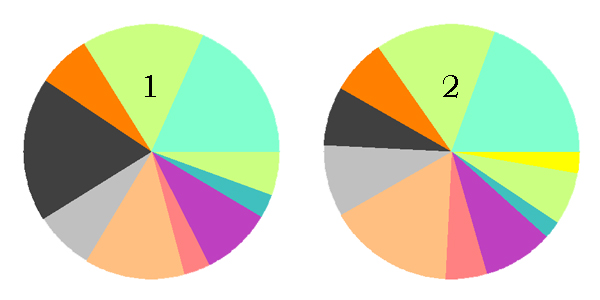
Take a look at this trio. Two are siblings and one is a first cousin. Each profile is different, which truly shows the randomness of inheritance from grandparents. Which two do you think are the siblings?


If you said one and two are the siblings, you are correct. 

The above pie charts use one of the GedMatch Eurogenes models, which focus primarily on European ancestry. GedMatch offers a selection of ethnic models, which is handy when ethnicity is more diverse, as in the next set.

Here are four siblings, using an MDLP model. Siblings one and two are full siblings and they are half-siblings to three and four, who are full siblings. There are two sets of two, if that makes sense. 

You can see that no two of these siblings have exactly the same ethnic profile. One and three have that yellow area. Three and four have a light blue area. Number one has a tiny slice of dark green, which four has in a larger proportion.


While we're looking at half-siblings, here is one more set, using the same Eurogenes model as the first three. One of these is a parent to siblings one and two at the top. 


No, it's not number two. Number one (with no yellow) is the parent. The yellow of the children must have come from the other parent.

I don't have any science to share. I am advocating for testing everyone you can. As always, I believe that GedMatch is a fantastic resource. There you can connect with testers who used other labs and you too can experiment with ethnicity models.

Family, if your profile is here, drop me an email, text, or call, and I'll send you the legend that goes with your chart. And for the missing one of the ten, just ask.

Wednesday, October 15, 2014

Autosomal DNA Matching 101, Class Two: A New Word


While reading the latest post from Roberta J Estes at DNAeXplained, I had to stop and look up a new word as it relates to autosomal DNA matching. Here's another look at my autosomal matching results so far. Those yellow boxes are areas of my ancestry where this new word applies.


Roberta shared and commented on the perspective of  Tim Janzen, a conference presenter:
"... endogamous relationships are a tough problem with no easy answer. Polynesians, Ashkenazi Jews, Low German Mennonites, Acadians, Amish, and island populations. Do I ever agree with him!  I have Brethren, Mennonite and Acadian in the same parent’s line."

Endogamous is a new word to me. However, seeing the words Mennonite, Amish and Brethren really got my attention. Wikipedia tells me that endogamy refers to the tradition of intermarriage within a cultural group. The ancestors who are the source of my matches in the yellow blocks fall into these specific cultural groups.

I know that there are many more matches in both those areas of my tree. The Swiss-German Peffley family at the bottom right is strongly associated with many other such families, yet I can't find the common ancestor with matches from those families. It must be due to those multiple intermarriages to which Roberta and Tim are referring. Now I understand that these groups are challenging and the answers may not be as easy as I had supposed.

As you work with your own difficult autosomal matches, be sure to notice and consider such clusters and remember this concept. Endogamous cultures may be a challenge for you, also.

Friday, August 8, 2014

Autosomal DNA Matching 102, Class Two

In a previous post, I wrote about watching out for randomness in DNA matches. A new cousin match has helped me find a simple example of how just one match can be misleading. It's so important to find multiple matches to validate a conclusion.

This randomness in matching is called Identical by State or IBS. Matches due to family relationships are Identical by Descent or IBD. There are other complications in matching, but this is intended as a simple explanation of IBS.

This new match is from my father's Fry/Derrick family. On GedMatch, I've run a one-to-one match against our new cousin, "Helen", with each of the kits I manage. The blue shows the small area of chromosome 3 where we each match Helen.


Notice the tiny red edges that I added on the second and third lines. Those bits are where there is a random match, IBS, that is not a relationship match or IBD. How did I know that?

Let's explore the numbers. You don't need math, just logic.


On top is my Dad, who is a fourth cousin once removed to Helen. For now I'll assume that his entire match is Identical by Descent or IBD.

For me, any matching fragments lower than 22134900 are not part of the Fry/Derrick match, as those fragments did not come from my Dad. They came from Mom. Any match fragments higher than 29810802 are also not valid, as they came from Mom, too.

The same logic applies to my daughter's match and my granddaughter's match. I can only pass on what I have -- I can't add Fry/Derrick DNA and pass that on.

My matching fragments end too high and my daughter's matching fragments start too low. So my red area on line two is just a random fragment at the high end. My daughter's red area on line three is a random fragment at the low end. Those little bits are Identical by State to Helen, not Identical by Descent.

We need other people who are not members of my direct family to confirm the numbers and help weed out any other IBS randomness in this match.

You might think that I'm selling DNA tests! Honestly, I'm not. I am sharing the little lessons that I'm learning from administering multiple kits. I'm advocating for testing as much as we can and for using every tool at our disposal. I'm anxious to add my brother's kit to the mix, as I expect there will be many more lessons to learn.

Sunday, July 20, 2014

Autosomal DNA Matching 102

In the last post you met my cousin Mary, who has DNA tested at Ancestry and uploaded her results to the free GEDMatch site. We know our common ancestors, William and his wife. But I also mentioned a "gotcha".

Mary and I are related through my mother. Our matching DNA on chromosome 2 is from 74188298 to 105591639. But I can't assume that everyone who matches me in those segments are matches on my mother's side. It's so very important to look at chromosome matching in detail after you have identified a known relationship. GEDMatch is just one tool that will help do that.

Another good tool is DNAGedcom. It is a free site that works only with files from FTDNA and 23AndMe. Note that it cannot work with Ancestry files.

DNAGedcom will pull my DNA information and my matches right from my FTDNA account and will upload the files to the website. I can then run a report that will graphically show my matches for each chromosome. These graphics are far better than GEDMatch and FTDNA for seeing the shared segments.

Here's a part of my DNAGedcom report for chromosome 2. I can see the name and email address for each person who matches me at FTDNA. If they have put surnames on file, I can hover over their information to see those surnames. I can also hover to see the names of the people who match me in common with that person.

Mary is not on this report, as she has not uploaded her results to FTDNA. The large fuchsia line at the top is for my Dad. The yellow boxes show the areas where I have matching DNA with Mary.


Notice the top yellow box. I have matches that are up to 85044774 that match my Dad (fuchsia on the left), yet are in the range where I match Mary. Then there are several matches starting at 84408203 that do not match my Dad. Is the matching DNA random, or IBS (identical by state)? Or is there a real match?

Is part of my match with Mary IBS? I need more confirmed matches to know if the DNA matches are real or random. The point is to not make assumptions based on one match. Keep working with your matches to find more confirmed cousins and to build your knowledge of what your DNA reveals.
 

Friday, July 18, 2014

Autosomal DNA Matching 101

A friend who is just embarking on the genealogical DNA journey says it's too complicated. I have to agree that it can be overwhelming.

  • If you are taking the AncestryDNA test, focus on learning about autosomal DNA. 
  • If you are taking the Family Finder test at FamilyTreeDNA, it is also an autosomal DNA test.
  • Ignore Y-DNA and mTDNA for now.

The first thing that I suggest is to subscribe to the DNAeXplained blog by Roberta J Estes. Sometimes her posts pertain, sometimes they don't, but her work is a great resource.

After you subscribe to the blog, visit the publications section of Roberta's DNAeXplain.com website. Scroll down to the section titled Working with DNA and see what you might want to download and read.

You've ordered an autosomal test, but what will it do for you? The purpose of an autosomal DNA test is matching your DNA to that of cousins known and unknown. It can answer:
  1. Who shares my DNA? 
  2. How much DNA do we share? 
  3. What segments do we share? 
  4. Who else shares those segments? 

Unfortunately Ancestry only answers question 1 and hints at question 2. However, the genealogical community uses Ancestry more heavily than FamilyTreeDNA , so that's where more matching will take place. The Family Finder test at FTDNA answers all 4 questions. The free website GEDMatch also answers all 4 questions.

When your test is completed, you can download your results from Ancestry, FTDNA or 23AndMe, which I don't use. You really don't want to look at your results file -- it's big and has a lot of numbers and letters. But it's yours and you will want to get that download file to use at other websites now and in the future.

What can you do with your downloaded file?
  • GEDMatch levels the playing field for matching. It is a free site supported by donations and we who use it need to donate. Bear that potential cost in mind, as well as the possibility the site could vanish.
  • An Ancestry test result can be uploaded to GEDMatch.
  • GEDMatch accepts uploads from FTDNA.
  • GEDMatch accepts uploads from 23AndMe.
  • FTDNA accept uploads from Ancestry. It's $69 today to upload.
  • FTDNA accepts uploads from 23AndMe, also $69 today.
  • Ancestry will not accept an outside test result. 
  • DNAGedcom will  accept uploads from FTDNA and from 23AndMe. More on this tool next time.

GEDMatch is the free site where we all can meet, regardless of the original test company. I've chosen Ancestry for my brother's autosomal DNA test, knowing it gives me flexibility in handling the results.

I'll use my cousin Mary as an example of matching via Ancestry and GEDMatch. She and I both tested at Ancestry, which predicted that we were in the range of 4th cousin to 6th cousin with a 96% confidence factor. We also have a leaf that we have a common ancestor in our trees. We had already connected, so none of this was a surprise.


We both uploaded our Ancestry results to GEDMatch.

GEDMatch provides a list of matches, similar to Ancestry. It also includes matches who have tested with other companies.


I look in my match list for Mary (in yellow), make a note of her kit number, and click on a link to run a one-to-one match. The match process provides a very clear answer to how much DNA we share and what the segments are.


GEDMatch estimates 4.2 generations to our Most Recent Common Ancestor. Mary is my 3rd cousin, once removed. Our common ancestors, William and his wife, are 4 generations from her and 5 generations from me. Both Ancestry and GEDMatch have done well with their estimates.

GEDMatch gives us other tools, including the ability to see others who match both of us. Someone who matches us both on chromosome 2 between 74188298 and 105591639 is now known to be related to us in the lines of William or his wife or both. As we accumulate matches, we can refine our knowledge. There can be a "gotcha" here, which I'll cover next time.

As I write this post, GEDMatch is in the midst of a transition with many tools unavailable and new uploads not being accepted. I have every confidence that they will be back to provide for Ancestry users the missing tools.

FTDNA works in similar ways to GEDmatch, but the interface is prettier and comes at a price. Here we see a couple of my Dad's matches.


The top is his confirmed cousin from Sweden. The little green icon shows that there is a family tree (GEDCOM) loaded by that person. The estimated 2nd-4th cousin has been replaced by the actual relationship that we calculated and then manually set.

The bottom match has no tree, but has listed some of her surnames. I'd rather see a tree. That's so important to facilitate making the connection.

FTDNA provides graphical comparison of matches and allows me to download my matches, their email addresses and the chromosome matching segments, similar to those shown above. It also provides a tool to see who else matches both me and one or more of my matches. One of the downsides of FTDNA is that a lot of the participants have not provided a family tree.

The autosomal DNA test is another tool in your genealogical toolbox. You still have to figure out the connections.

I hope this post helps with some basic understanding. Next time: the magic of DNAGedcom.

Friday, July 11, 2014

A Twist in the DNA Journey -- Part Two

In the previous post we met "Sven", a new cousin from Sweden, identified through DNA testing. A few weeks after Sven and I connected, his father's DNA results had an unexpected match. Sven had no match and my Dad had no match.

The new match is for a woman of Chinese heritage who has moved from Taiwan to the USA. Let's call her "Lucy". How could Lucy from Taiwan share DNA with a man from Sweden at the 5th cousin to Distant Cousin level?

Let's expand the Ekstrom-Fors-Nyström family tree a bit.


Extending the family tree from the last post, we add Martin Nyström, a Swedish missionary to China. Martin, along with his wife and infant daughter, Ruth, disappeared in China during the Boxer Rebellion in 1900. Their story can be found on the website of the China Inland Mission. Martin's brother also was a missionary to China; however, he and his family escaped to safety.

Several European nations sent armies to protect their interests. It was a terrible time of chaos and violence in China. The Europeans raped and killed women and children, while the Boxers killed Europeans and Chinese Christians.

There are three possibilities for a Chinese woman to have enough Swedish heritage to be a match to the Nyström family:
  • The infant Ruth survived the slaughter and grew up to have her own family. 
  • Martin or his brother Fritiof fathered a child with a Chinese woman.
  • An unknown Swedish soldier, related to Sven's father, impregnated a Chinese woman.

What a mystery! With all the upheaval in China over the past 100 years, can this mystery ever be solved?

There is a bit of a DNA lesson in this story. Little Ruth and Sven's Dad were first cousins, but did not have the same grandmother. They were half-cousins. Instead of sharing 25 percent of their DNA, they would have shared closer to 12 percent. If "Lucy" is a Nyström descendant, her percentage of matching DNA would be similarly decreased. The Family Tree DNA estimate of 5th cousin (or further) makes a bit more sense when we consider that reduction. Rather than 5th cousin, a better estimate would be half-first-cousin 3 times removed.

Who would have thought that a simple genealogical DNA test could crack open a door that was thought closed over a century ago!

Wednesday, July 9, 2014

A Twist in the DNA Journey -- Part One

It's been a while since I've shared much about my genealogical DNA journey, but the past couple of months have been fascinating.

This post is for you if:

  • You are a cousin in my Ekstrom - Fors family.
  • You are a cousin in my Nyström family.
  • You are on your own genealogical DNA journey or thinking about it.
  • You are debating who in your family should be next to have a DNA test.

A New Contact


On May 7, 2014, an email arrived from a man who lives in Stockholm, Sweden. I will call this new cousin "Sven":
My name is "Sven" and if I get it right we are 4th cousins 1R! I got the result today from FTDNA regarding my father's Family Finder.
Eric Carlsson Nyström and his wife Brita Christina Olofsdotter were my great great great grandparents on my fathers side.
My great great grandfather Carl Erik Nyström was brother of your great great great grandfather Anders Fors. I guess Anders took on the name Fors ...


The Family Grows


We have a friendly new cousin in Sweden with a good command of English. He has shared some photos and a map which will be in a later post. Part two will add more family information and a twist, so stay tuned.

Here's a graphical representation of our relationships and the DNA matching results. In part two of this series, the family tree will be expanded.


Lessons in DNA

  1. Test the oldest generation. This match emphasizes what the DNA gurus teach. Sven and I both have results on file at FTDNA, but he and I have no DNA match. Fortunately, both of us took the step of having our fathers tested, also. Our fathers are in their 80s and we gathered that DNA while we could. For $99 each, we made this priceless connection.
  2. Post your tree (GEDCOM) to your DNA testing website. I had posted my Dad's tree and Sven was able to see immediately where the connection was in our trees. He could follow the generations to calculate the relationship of 4th cousin to Dad and then once removed to me. We didn't have to ping-pong email to find the connection.
  3. Work the closest matches first. Sven's Dad has a fairly close match to my Dad. FTDNA proposed a 2nd to 4th cousin match. Sven also has a match, but it was 4th to remote cousin. It might have been weeks or months before Sven worked through his own matches to the page where my Dad showed up. By working that closer match, Sven connected much more quickly.
  4. Don't expect new ancestor information from every match. I've done a lot of Swedish research and have not added much information since connecting with Sven. He has augmented some of my knowledge and vice versa. The more complete your tree is, the easier it is to connect. You may be able to share bits and pieces with your new cousin(s) that will eventually lead to new findings.
  5. Keep track of the matching DNA. I've added the following matching information to my files. When my Dad's kit has another match on any of these DNA segments, I'll know what family that match connects to.

Next time: The Nyström DNA takes a strange turn.
 

Tuesday, July 8, 2014

52 Ancestors in 52 Weeks: #27 The Amish DNA of Elizabeth Estella Lake Maddox Donnelley

You got it from your mother. I got it from mine. Our mothers got it from their mothers. It's the DNA that powers our cells. It's mitochondrial DNA, or mtDNA for short.

Last year my father and I each had our mtDNA tested by FamilyTreeDNA (FTDNA). With his mother's mtDNA, he matched nearly 100 people. I matched only a handful. I was curious as to why my matches were so few.

During the recent attack on Ancestry, I spent some quality time on FTDNA closely studying the tree of my closest match. Following women ancestors can be tough, but I can follow my maternal line back to about 1760. The match also has his line back to the mid-1700s. I could see that our families relate in other ways, but I couldn't see where our match was.

Fortunately, he knew something unique about his maternal line: the branch is Amish and/or Mennonite. No wonder our matches are few. Amish descendants of Amish women won't be doing DNA testing!

My maternal line was Swiss-German Baptist who later became Church of the Brethren. However, it's very possible that pushing back another generation or two may turn up that connection to Amish/Mennonite.

Elizabeth Estella Lake's mother, Sarah Elizabeth Bosseck, was probably raised in the Church of the Brethren. When she married Aaron Lake in Cass County, Illinois, in 1857, she broke the pattern and married outside the Swiss-German community. The Lake family was Methodist in the last half of the 1800s.

Lizzie Lake was born February 11, 1861, the second of ten children. She and her older sister, Nellie, married two brothers. Lizzie married Joseph Allen Maddox and Nellie married George S Maddox.

Lizzie was a bit of an adventurer. She married at 15, while lying that she was 18. It appears that she forged a parent's permission note for Al, who was also underage at 19. They married in his home county of Scott County, Illinois, on June 13, 1876.

The Lake and Maddox families had financial troubles and together joined a wagon train to Kansas in about 1879. The Bosseck family had gone to Kansas earlier and the rest of the family joined them in Wilson County by the time of the 1880 census. Al Maddox doesn't appear in the census with the rest of the family. He was both a miner and a farmer and was likely mining elsewhere.

One of the family stories passed down is that Lizzie and Al would go out driving at night. Al would propose a horse trade in the dark with unsuspecting travelers. Sometimes he would come out ahead and other times behind. They would leave their children in the care of the eldest, Daisy, my great-grandmother. It seems that Al was quite a gambler and scoundrel and Lizzie must have enjoyed the game.

Lizzie and Nellie, their father, Aaron, and their families moved westward to Kingman County, Kansas, leaving behind most of the Bosseck family. When the opening of the Oklahoma Cherokee Strip was announced in 1893, they were living in an ideal spot to plan for and execute a land run. The family story is that Al ran for the land on foot, while Lizzie followed, with the children, in a wagon.

Lizzie and Al built a soddy on their homestead and began the work of cultivating the land and building a permanent house. However, Al battled with tuberculosis and alcoholism through his adult life. He died in 1895, leaving Lizzie with five children and an unfinished house. Aaron Lake is credited with finishing the house for her. She was able to keep the homestead, which Al had wanted to secure for their son, Archie.

On January 7, 1900, Lizzie married Charles Ford Donnelley, a widower with seven children. They had one more child, lucky 13. The photos show the couple, along with their son. Lizzie is also shown with three of her sisters and with her daughter Daisy.


Quick drop page from Mother is a Verb by Krystal Hartley for Digital Scrapper

To care for herself and her family, Lizzie was a milliner and taught the skill to her daughters. She opened a lovely store called Rosedale in Enid, Oklahoma, where the family moved in 1918.

Lizzie died on November 23, 1924, and was buried in Enid Cemetery.