Showing posts with label Allee. Show all posts

Wednesday, December 31, 2014

52 Ancestors in 52 Weeks: #52 Leona Violet Crispen Cole Allee

As the 52nd and last ancestor featured in 2014, I'm honoring my grandmother, who started me on this journey.

Over 20 years ago, my grandmother and I spent many hours going through her photo collection. If it were not for the photos, I might never have delved into my family history. When we started going through them, I had no idea who all these people were and how they related to me or to each other. I couldn't keep them straight on paper, so I bought my first genealogy program and started putting in names and dates.

The unknown photos captured my imagination, and I soon found myself launching into the research that has now grown my database to nearly 6000 names. Along the way I've identified unknowns, met new cousins and acquired photos for relatives I never knew I had. And I also turned to scrapbooking as a way to present and preserve the photos.

Leona Violet Crispen was born in Van Buren County, Michigan, on October 1, 1909, the youngest of three daughters of Daisy Myrtle Maddox and Clark Earl Crispen. The family later settled in the Lake Michigan resort town of Benton Harbor. Leona was the son her father never had. Instead of sewing, she learned to use his blacksmith forge, work on cars, develop film and print photographs.

Her parents divorced in 1921. I can't begin to image the impact on the young Leona. She must have lost friends and certainly her home life was disrupted. Her father moved to the house across the street, so she was able to move freely between her parents' homes. Because they had a civil and close relationship, she never doubted their love for her and her sisters.

During high school, Leona wrote poetry for the school newspaper and for the yearbook. Her love of writing poetry persisted through her life, as she contributed poetry to church and civic publications. After high school she took a job as a telephone operator.

On March 20, 1928, she eloped to South Bend, Indiana, with Clifford Royal Cole, a young man who worked in a foundry. She soon learned that he was unfaithful and cruel. His actions left their only daughter nearly blind and left Leona unable to have more children.

As the stock market crashed in the fall of 1929, her father lost the portfolio he had inherited from his sister. He was able to keep his house and, Leona, living with her father and her husband, decided to file for divorce. Imagine, for a moment, being 20 years old with a blind infant, an aged parent with no job, the economy in free fall and still choosing to end an abusive marriage. Her strength amazes me.

Leona decided about 1931 to leave the cold of Michigan and move to the warmth of California. Following the famous Route 66, she miscalculated a bit. She ran out of money and gas in the Northern Arizona town of Kingman. With her daughter, she lived under a bridge and in their car while she looked for some way to support them.

Her photography experience was her salvation. The old man who ran the local photography studio wanted to retire, so he hired her and she eventually was able to take over the business. However, she lived day-to-day and struggled through two more bad marriages and divorces during the Depression years. She married Everett Melvin "Jack" Stormer in 1932 and James Robert "Jim Bob" Turner in 1940.

About 1935, Leona had to place her daughter in boarding school at the Arizona School for the Deaf and Blind in Tucson. She left Kingman behind and relocated to be near her daughter. World War II found her fixing airplanes and later working at the ration board.

On December 20, 1941, she married Fayette Franklin "Fate" Allee, her daughter's math teacher and, as a family, they built a stable life. After the war she found a secretarial job in the Tucson school district, where she worked until retirement.


Template and elements from Weekend at Home by  Kate Hadfield for Digital Scrapper, 2014

Leona cared for her mother in her final years, as well as helping her sisters care for their father during his decline. She was a nurturing person who also raised a nearly blind daughter and married a nearly blind man. Her kind, loving, fun and generous spirit was an anchor for our family throughout her life.

She was diagnosed with both breast cancer and skin cancer in the final few years of her life. Gardening in the hot Arizona sun for many years was the likely cause of the skin cancer that took her arm in 1997.

We invited family, neighbors and friends to help us celebrate her 90th birthday at her Oklahoma retirement center in October of 1999. She had a blast being the birthday girl.

The cancer took her from us on February 13, 2001. She was buried with her husband and her mother in South Lawn Memorial Park in Tucson.

As Leona's choices shaped her life, they affect her family to this day. Her descendants are an Arizona family because she stopped and stayed in Kingman. Her photographic experience became a life-long passion, leading to the vast collection of photographs, negatives and slides that came to me at her death. It is directly due to her choices that I am a scrapbooker and genealogy buff. And, of course, because of those hobbies, this blog exists.

So ends the series, 52 Ancestors in the 52 weeks of 2014. Please join me at Murder at Mauvaisterre Creek, as I share the story of the murder of Leona's great-grandfather.

Saturday, November 8, 2014

52 Ancestors in 52 Weeks: #42 Fayette Franklin Allee, Changed by a Rock


Let's play war! "Fate" Allee had turned eight on May 8, a few months before the snow that blanketed western Oklahoma, near Hammon. He and his siblings and cousins and friends built their forts and stockpiled snowballs as ammunition.

As the battle raged, young Fate popped up from behind the fort and caught a snowball in his face. Embedded in the snow was a rock that hit his left eye. I've never heard the details of what happened right after that. I think it's likely that his parents, Laura Pryor and Thomas Allee, tried to treat him, but soon had to seek medical attention from a doctor.

My grandfather, Fayette Franklin Allee, was very nearly blinded by that rock in the winter of 1913-1914. His life as an ordinary farm boy was over. A newspaper article in the Tucson Daily Citizen in 1970 reported:
During the next three years, the injury began to affect his right eye. Finally, the left eye was removed, but the damage to his good eye had been done.

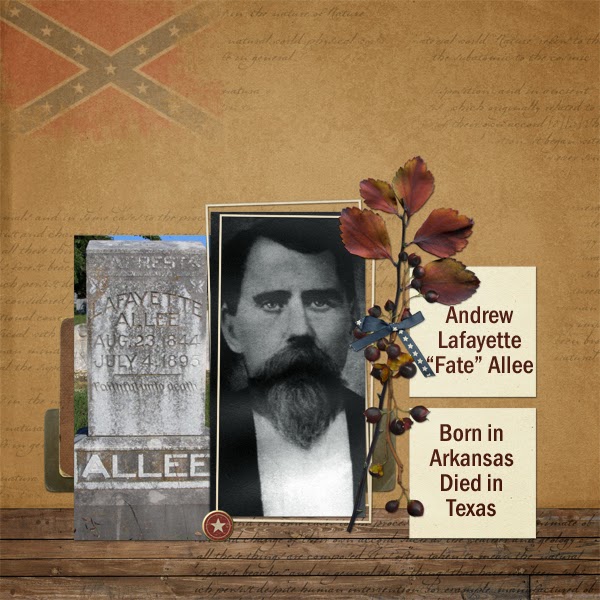
Fate soon moved to Muskogee to attend boarding school at the Oklahoma School for the Blind. In addition to the subjects we all studied, he learned to read and write Braille and to compensate for his limited vision in all aspects of his life. He was trained in skills that used his hands. During high school he tuned pianos in the area around Muskogee to earn money to help pay his expenses. In some capacity, he stayed on at the school until 1929.

The Arizona State School for the Deaf and Blind was in need of teachers in 1929 and letters were sent to schools around the country. Fate was recommended by the Oklahoma staff and shortly thereafter moved to the Arizona school in Tucson.

His wife, my grandmother, wrote a letter about him to the Tucson newspapers and kept her drafts, which I now have. The bulk of this post consists of excerpts from those drafts.


Notepaper from Scholarship, quick drop page from Tribal, both from ClubScrap

In 1929, at age 24, he started teaching classes and supervising the boys (both deaf and blind) at night for the magnificent salary of $70 a month and room and board, which at that time was an excellent opportunity. There were two teachers in the department for the blind and about 10 or 11 students. There were about 50 students in the whole school. 

His parents had moved from Oklahoma to [Pueblo County] Colorado in 1926, but a couple of years before that the whole family had been baptized in a cow pond by a Baptist minister, except for the babies. He has (in 1970) two living sisters and three living bothers (and two dead). [All are now deceased in 2014.]

In 1934, he met his future wife [Leona Violet Crispen] when she brought her daughter, age five, to school for the first time. This tiny red-headed five-year-old soon won the heart of her arithmetic teacher and invited him to her home for Sunday dinner. In 1941, her match-making won out and her teacher and her mother were married [on December 20, in Lordsburg, New Mexico].

He has been a father-figure to hundreds of visually handicapped children in Arizona for three generations. Little five-year-olds have sat in hs lap when homesick and away from their parents for the first time. Others have learned to coordinate their hands by his patient, long-suffering help as they learned to cane chairs, weave rugs, weave baskets, do woodworking projects, lace leather objects, and many other lessons to help them perceive the world around them with their fingers.

Among his former students are many college graduates, lawyers, business men, administrators of programs for the blind, as well as homemakers. His present principal is one of his former students. He has taught reading, language, spelling, social studies, algebra, geometry, as well as the shop subjects with kindness, patience and gentleness these 40 years.

Although he has struggled to attain a great many University credits, he has never been able to accumulate a Bachelor's degree. Any university course is a hardship for this blind man, but he is noted for his patience and persistence. He is a calm, quiet man and all children adore him, send him Valentines and Christmas notes saying, "I love you." When they were grown and married, some have sent him the sweetest letters saying how grateful they are now that he was so patient with them and taught them so much.

Mr. Allee is an avid sports fan, enjoying football, baseball and basketball on radio and TV. In years gone by, he has worked with Boy Scouts as a Leader and conducted camps, cook-outs, and hikes in nearby Catalina Mountain sites. For many years he was chairman each year for the annual Rodeo Party or Picnic in the mountains.

He is a man of very few words, absolute integrity, dedication to his task, self-sacrificing, and accepting of all people and completely without guile, who gives of himself and between 10% and 15% of all he earns to Christian and charitable works.

After his retirement in June, 1970, Fate continued to teach adults through the Tucson Association for the Blind. One of the skills he taught was chair caning, which earned him features in the newspaper and even on TV. Over his lifetime he had two or three corneal transplants. His vision improved with each surgery and worsened with time. He was always legally blind and was never able to drive.

In 1995, Fayette and Leona Allee moved to a retirement community in Tahlequah, Oklahoma, near his former home in Muskogee. He died on December 2, 1997, and was buried in South Lawn Memorial Park in Tucson.

Wednesday, August 27, 2014

52 Ancestors in 52 Weeks: #34 An Ice Bucket for Dana Allee


My cousin Dana Allee was diagnosed with the horrible disease of ALS before her fiftieth birthday.

As the ice bucket challenge sweeps the world, I've made my donation in lieu of the dousing. I challenge all our Allee relatives to take the challenge or just pick up your checkbook or credit card and make a donation to the ALS Association as they work toward finding a cure. You can also donate with Paypal or Amazon.

Dana Allee was survived by her husband, parents, children, grandchildren, sister, nephew, niece and many cousins. For the sake of their privacy, I'm not sharing her married name or other identifying details. Her sister wrote a touching tribute for Dana's memorial folder and graciously agreed to share it, along with some of these beautiful photos.


All elements from ClubScrap's Lotus Pond digital kit

Dana’s highly distinctive, loving and artistic style can be seen in her magical garden home, and her enormous talent is further revealed with floral and landscaping designs that benefited so many local charities.  She participated in the “Martha Stewart Entertaining” Garden Tour and the “[area] Holiday Home Tours”.  Dana was selected one of the top floral designers in [the area] by the [newspaper].  She was an extraordinary and amazing person, gifted, and giving, truly an Angel on earth.  May her spirit live on!

Dana bravely concluded her graceful and spirited fight with ALS (Lou Gehrig’s disease) and peacefully closed her eyes on Christmas Eve in her fairy tale home surrounded by those dearest.  Her ashes will be scattered at the family ranch in her beloved Colorado.


In lieu of flowers, Dana requested that donations be directed to the family and shall be distributed to the Aids Orphans that captured her heart.
Dana's request that donations be sent to Africa shows that her loving and selfless spirit endured to the end of her life.

Wednesday, August 13, 2014

52 Ancestors in 52 Weeks: #32 Martha Elizabeth Grant Allee

Martha Elizabeth Grant was born about 1846 in Alabama. Her parents, Thomas Jahue Grant and Nancy Jane Allee were married in Lawrence County, Alabama, on June 30, 1844. Martha was the eldest of the seven children that have been discovered so far. The family moved about 1856 from Alabama to Hot Spring County, Arkansas. Just across the county line to the east lived another branch of the Allee family, that of Andrew Lafayette "Fate" Allee.

Fate and Martha would have grown up knowing each other and spending time together at family events. After the end of the Civil War, they married in Saline County, Arkansas, on May 06, 1866. By 1870 they were living in Denton County, Texas. The couple had three children:
  • Josiah Thomas Merrill Allee, born February 11, 1867, in Arkansas
  • Mary Jane Allee, born September 25, 1871, in Texas
  • Abraham Frank Allee, born December 28, 1872, in Texas

Martha Elizabeth Grant Allee died between Frank's birth in 1872 and Fate's second marriage in 1876 in Collin County, Texas. There is information on the web that she died in Plainview; however, that is probably a misunderstanding of oral history. It is much more likely that Martha died in Plano, as did others of the extended Allee family.

I don't have a photo of Martha and her gravesite is unknown; however, a picture of her parents has been shared with me. Thomas Jahue Grant is holding a sword that he must have carried in the War.


Template from Milestones, elements from Generations, all from ClubScrap


Tuesday, August 5, 2014

52 Ancestors in 52 Weeks: #31 Bettie Allen Allee, The Old-Maid Schoolteacher

Joe Allee hated his new stepmother. He'd rather drive cattle to market than live with a schoolmarm. The family legend says he ran off at age 12 to join a cattle drive from Texas to Kansas.

When I look at the face of my great-great-grandmother, I see a very forbidding woman. Anna Elizabeth "Bettie" Allen was a 31-year-old schoolteacher when she married Andrew Lafayette "Fate" Allee and became a stepmother to three children under the age of 10.


Quick drop page from Expressions, ClubScrap

Bettie Allen was the eldest child born to Thomas Allen and Majincy Davis of Beaufort County, North Carolina. The couple are believed to have lived near the community now known as Leechville. However, they were on the move away from the coast and toward the west. Bettie claimed to have been born near Fayetteville on May 19, 1844. The 1850 census finds the family in South Surry (Yadkin) County, not far from the town of Lewisville, North Carolina.

By 1860, the Allen family had moved to Barry County, Missouri, and into northwestern Arkansas by 1870. The couple valued education, raising two schoolteachers and a newspaper editor. Bettie was teaching school in the area north of Dallas, Texas, by 1876. Was that how she met the widowed Fate Allee?

Bettie Allen married Fate Allee in Collin County, Texas, on January 30, 1876. They soon moved to the area of Mineral Wells in Palo Pinto County, Texas, where they farmed and added four children to their family.

Bettie was widowed in 1895. She spent the rest of her life alternately living in Mineral Wells and spending time with her children and their families. She never remarried and was able to claim a pension for Fate's Civil War service to the Confederacy.

Bettie died on March 25, 1932, while visiting her oldest son, Thomas Allee, in Pueblo County, Colorado. She was buried in Brookside Cemetery in Rye, Pueblo County.

Tuesday, July 15, 2014

52 Ancestors in 52 Weeks: #28 The Records of Andrew Lafayette "Fate" Allee

The life of my great-great-grandfather Andrew Lafayette "Fate" Allee is detailed in government records. I wish all my ancestors were so well documented.

His story begins with the marriage of his parents.


State of Arkansas
County of Saline
I J. H. Williams an acting Justice of the peace in and for Saline County do hereby certify that I did on the 29th day of December, 1842 Solemnize the rites of matrimony between Josiah Alley of the County aforesaid and of the age of 21 years and Mary Jane Pelton of the Same place and of the age of fifteen years. Given under my hand this 30th Day of December 1842.
J.H. Williams J.P.


A child is born.

Fate was born on August 24, 1844, twenty months after his parents married. Within another two years both his parents were dead and his Uncle Abraham Allee became his legal guardian. His father's estate was billed for medical care for his young mother in 1846, setting her death date between March and October of 1846.

The guardianship was documented in 1847.

State of Arkansas
County of Saline
I Abraham Allee do solemnly swear that to the best of my knowledge and belief the estate of Josiah Allee deceased is worth the sum of three hundred dollars. Andrew Lafayette Allee is the only child of the deceased and resides in this County. he died without a will...
Sworn to and subscribed before me
this 26th day of July AD 1847
A R Hockersmith Clerk

Fight for an orphan's pension.

Josiah Allee died while serving in the Mexican-American War. The name Allee was often misspelled or misunderstood in handwritten records. His service record was interpreted as Isaiah Allen. Abraham Allee had to fight the military bureaucracy to set the record straight and to collect the military pension that Fate was due as an orphan.

Department of the Interior
Orphans Claim
I certify that Andrew Lafayette Allee, Child of Josiah Allee, deceased, who was a Bugler, Company I, Arkansas Mounted Volunteers, in the service of the United States and died on the seventeenth day of October 1846, is entitled to receive pay ...

The estate grew.

Abraham Allee not only collected the orphan's pension, but also obtained a military land warrant for Josiah's service. Fate also received money from two estates in his mother's family, Samuel Pelton and James Adams. At the last known guardianship accounting in 1860, Fate's worth was about $650, plus 80 acres of land.

The Confederacy called.

Fate volunteered very quickly when the Civil War began. Just prior to his 17th birthday, he enlisted in Company F, 11th Arkansas Infantry on July 19, 1861. He was one of 7000 Confederates who valiantly defended Island Number 10 near New Madrid, Missouri, until the commander was forced to surrender on April 8, 1862. Fate spent several months as a prisoner at Camp Douglas, Illinois. Later that year he was part of a prisoner exchange at Vicksburg, Mississippi.

He then served in the 11 & 17 Consolidated Arkansas Infantry; Co B, Anderson's Unattached Battalion, Arkansas Cavalry as a 2nd Lt; and as an independent scout in the McMurtry Brigade, under Captain Webb. A story told by a member of Webb's forces depicts Fate as an honorable man, although Webb's forces were generally considered to be less than honorable.

The military and prisoner records tell the basics of his service.


Quick drop page from Outdoor Dad kit by Brandy Murry for Digital Scrapper

On May 6, 1866, Fate married a cousin, Martha Elizabeth Grant. The area in Arkansas where they lived had been overrun during the Battle of Jenkins Ferry in 1864. Fields, streams and rivers were rife with spent ammunition. Although the family stories don't tell us, we can only surmise that the Allee family members who left Arkansas did so due to the devastation of the war.

Fate relocated his family about 1869 to Denton County, Texas, along with Abraham and some of his family. Fate and Martha had three children, all of whom married into the Lucas family. Sometime after Frank's birth in 1872, Martha died.

The widowed Fate married Anna Elizabeth "Bettie" Allen on January 30, 1876, in Collin County, Texas. Fate and Bettie farmed in Palo Pinto County, adding four more children to their family before his death on July 4, 1895. He was buried in Ballew Springs Cemetery in Parker County, Texas.

The final record is a widow's pension.

The widowed Bettie Allee filed in Texas for a Confederate widow's pension. The pension file tells us that A. Lafayette Allee died in Palo Pinto County, Texas. It also gives the marriage date and place for his second marriage. Bettie did a good job of detailing his military service. Many soldiers don't like to talk about their service, so this level of detail is surprising. Perhaps the couple documented the service so that the family would have the facts in case of his death.

Other records.

In addition to the mentioned records, there exist tax, land and marriage records, plus censuses.

Wednesday, May 14, 2014

52 Ancestors in 52 Weeks: #19 Laura Ann Pryor Allee

I still remember that early morning phone call that I received while in college. My last living great-grandmother, Laura Ann Pryor Allee, had died on February 9, 1975, at the age of 90 years, 6 months and 7 days. I barely remember her, as we didn't often visit her home in the city of Pueblo, Colorado. She was the loving mother of eight children, four of whom predeceased her.

Laura Ann Pryor was born in Mineral Wells, Palo Pinto County, Texas, on August 2, 1884, the fifth of six children. Her father, Benjamin Franklin Pryor, died when she was five years old. Her mother, Mary Jane Smith Pryor, did her best to run her small farm, looking to her extended family for help.

On August 31, 1902, the eighteen-year-old Laura married Thomas Merrill Allee in Mineral Wells. Their marriage record was issued in nearby Parker County, as the courthouse was easier to reach. Family legend tells that they married in the church, but the marriage index reports the marriage was performed by a Justice of the Peace. Perhaps they had two ceremonies.

The couple farmed in Oklahoma, where they buried two children. Their eldest son, Thomas Gilbert, died at age 16, and Ura Maggie, twin to Ima Nora, died in infancy. The couple moved on to Pueblo County, Colorado in 1928, farming in Rye. They moved to the city of Pueblo in 1942.

Laura was widowed in 1948. She lived on in Pueblo, nurturing her children, grandchildren and great-grandchildren until her death. She was buried next to Thomas in Brookside Cemetery in Rye, Colorado.

Quick drop page from All That Jazz, ClubScrap, 2010

Sunday, January 26, 2014

52 Ancestors in 52 Weeks: # 4 Thomas Merrill Allee of Pueblo County, Colorado

I never knew my great-grandfather Allee, as he died before my birth. One of the keepsakes held by a cousin is a hand-written memorial booklet from his funeral. I was fortunate to be able to scan it during a family reunion, and the obituary portion of it is transcribed here with a few punctuation changes.

Thomas Marrell [sic] Allee was born at Garner, Texas, January 5, 1877, and departed this world January 22, 1948. He was united in marriage to Laura Ann Pryor at Mineral Wells, Texas, August 31st, 1902, and to this union eight children were born.

Two have preceded in death -- Gilbert, July 7, 1919; Ura Maggie, June 16, 1907. Survivors are four sons, Fayette F., Tucson, Arizona; Willie G., Beulah, Colo.; Thomas M. Jr., Alhambra, Calif,; and Bert, Pueblo, Colo. Two daughters, Ima Hersinger, Lake City, Colo.; Cleda Blue, Cheyenne, Wyo. Three brothers, Andrew, Beulah, Colo.; Elbert, Riverside, Calif.; and Joe, Elk City, Okla. One sister, Mrs. Margaret Harwood, San Diego, Calif. and his widow Laura A.

In September, 1902, he and bride moved to Duncan, Oklahoma, and farmed in different parts of the state until February, 1928, when he and family moved to Colorado, farming in the Rye and Beulah districts until moving to Pueblo in March, 1942, where he was employed by the city of Pueblo, until he took ill October 20th, 1947.

He was converted at Buffalo, Okla., in Sept., 1926, and became a member of the church there. Membership was transferred to Rye Community and Beulah Methodist Church then to Bruner Park Church where he was a member until death.

Other tidbits:
Music selected was Jesus is Tenderly Calling and God Be With You Til We Meet Again.
Interment was at Brookside Cemetery in Rye, Colorado.


Quick page from Photographie kit by Joanne Brisebois, Digital Scrapper, October, 2012


Sunday, July 22, 2012

52 Weeks of Abundant Genealogy, Week 28, Mistakes

The prompt to write about genealogical mistakes beckoned to me. I've already written about some things I've done wrong. I have tried very hard to not climb the wrong tree, but the little mistakes are important, too. My top mistakes include:

  • Not interviewing living relatives
  • Not documenting sources
  • Not visiting courthouses
  • Believing family legends
  • Accepting other researchers' conclusions

When I first started playing with genealogy, I didn't realize how important the documentation of sources is to the process and the professionalism of genealogy. The lack of sources for my earliest work continues to haunt me 20 years later. Every once in a while I have to stop and look for why something appears in my tree. And sometimes I will remove a so-called fact because I don't have any foundation for it.

Today I'm careful to have a reasonable source for each fact. Sometimes that source is flimsy, but at least I document it. Another researcher's conclusion is one type of flimsy source that I now am very careful to document. If I can't verify it, I am more inclined to note it and place it in a file, and only rarely add it into my tree.

Another regret is not interviewing my grandfather, Fayette Franklin Allee, while he was alive and mentally alert. It was his death in 1997 that propelled me from lazy collector of facts to active seeker of facts. He had a long and storied life. Since I recently scrapped two newspaper articles about him, I share them here to honor his years of teaching deaf and blind children and adults in Tucson, Arizona.

Per my earlier tip, the newspaper articles were copied from the original yellowed and crumbling copies onto matte photo paper. The copies appear here and the originals were discarded.


ClubScrap Body and Soul paper kit

ClubScrap Friendship paper kit


Saturday, March 3, 2012

52 Weeks of Abundant Genealogy, Week 9, Cemeteries


Cemeteries are not often featured in my heritage scrapbook pages. However, I’ll share a couple of ways I’ve included them. First, I invite you to join me on a trip to my favorite cemetery.

A Visit to Kansas

You’re standing on a rise in south-central Kansas on a warm September day. A sea of golden-brown flows to the horizon in all directions. Trees dot the landscape where distant farmhouses rise from the empty fields. The unfettered prairie wind tugs at your hair and whistles in your ears. In the distance, a freight train rolls westward, while cars scurry along the state highway that divides the small town below you. Suddenly deer appear, bounding through nearby fields, and you watch them until they vanish in the distance. Some local farm boys drive past, hauling a load of hay. They wave and call out a greeting, leaving a dust cloud hanging over the dirt road.

Slowly you enter the tiny cemetery, admiring the intricate metal crosses that adorn the top of the fence rail. The grass is calf-high, but dry and dormant. You fervently hope there are no snakes as you walk towards the few visible markers, drawn to a double marker with the inscriptions Mother and Father. You trace the words, reading “Sarah died in 1892 and Aaron died in 1909”. Staring out across the endless prairie, you realize this is the very land they walked, the view they saw, the wind they felt. Little has changed in 120 years. The neighbors have exchanged their wagons for automobiles and a few roads have been paved. This place is unchanged and you feel their closeness here, as nowhere else.

You turn to leave, acknowledging the rest of the family: John with his Civil War marker and Effie and George with their large double stone. You bid them good-bye, along with the rest of the permanent residents of this little piece of the Kansas prairie.

Kansas background by Scrapbook Customs
Cemetery Thoughts
 
I haven’t shared the name of the family, the cemetery or the town. The vandalism that happens in cemeteries is unconscionable and I do not want to put this small and precious place at any more risk than it already faces.

This cemetery and other small rural cemeteries are a part of the fabric of the lives of the nearby residents. When I visit such a cemetery, I feel grounded in the place. A large or city cemetery feels to me less connected to the locality and more like any cemetery in any place.


Scrapping Cemetery Photos
 
I prefer to put photos of people in my heritage scrapbook pages, rather than places or things. I’ve used cemetery and tombstone photos in only two ways. One is to document a trip or visit to a cemetery, as I’ve done with the cemeteries in this Kansas county. The second is as a substitute for a photo of a person.

My grandfather’s elder brother died at age 16. There are no known photos of his face other than as a young boy. Even his marker displays his little-boy photo. This layout shows the faces of the people who appear in the group photo, but in later years of their lives. Gilbert Allee is instead represented by his marker.
 
Club Scrap Autumn Splendor paper kit

They Made the Markers
Digital Collection, Fall Carnival blog train, Sep 2010

I also have an unusual reason to feature grave markers on a layout. My fourth cousin's ancestors were the premier makers of monuments in their area of northwestern Pennsylvania. I commemorated our visit to their family plot and other cemeteries. The most memorable monument we visited sits in the town square of Clarion, PA, to commemorate the Civil War.

I hope this has inspired your own thoughts about whether and when to include cemetery photos in your heritage layouts.