Showing posts with label Fors. Show all posts

Saturday, May 27, 2023

Whereabouts Unknown, 52 Ancestors


Can you imagine losing track of an adult child who has moved away from home? It must have been a source of worry and frustration for my 3rd-great-grandfather. The story has not been passed down in my family, so I can only read the records and wonder.

Carl Leopold Fors lived a short life before he disappeared. He was born on 15 November 1851, in the parish of Vårdinge, near Gnesta, about 30 miles southwest of the city of Stockholm. His father, Anders Forss, was a crofter (torpare) and tailor (skräddare). His mother, Catharina Andersdotter, had a military heritage as the granddaughter of a Navy sailor and a Cavalry soldier. 

Carl was the sixth of eight children, three of whom died within a seven week period when he was only six years old. Older brother Johan Julius was 12 years old when he drowned in December, 1857. The church books don't show the cause of the two younger boys' deaths, but it may have been an illness, as they died four days apart. Gustaf Adolf was not yet four and Otto Wilhelm was eight months old when they died in January, 1858. Carl was the youngest of the five remaining children: three boys and two girls. Having lost the three brothers closest in age to him, was Carl perhaps scarred for life?

It was a challenging time for the family, with Carl's paternal grandfather dying in August, 1857, in a nearby parish. Anders Forss packed up his family in March, 1860, and moved the 8 miles back to the family farm in Björnlunda parish to live near and care for his aging mother. There Anders built a new house named Andersberg, which I've written about previously.

Over the next few years, all his older siblings left home, with Carl moving out in the fall of 1868, at about age 17. He left the parish shortly after his mother's death in January, 1869, moving in March to the nearby parish of Frustuna and then to Maria Magdalena parish, in the city of Stockholm, in November, 1870. 

The records show that Carl lived in Stockholm for the next four years. He was listed as a single laborer in all entries that I have found. The last entry that I located is the husförhörslängd, household survey, written in Storkyrkoförsamlingen parish (Sankt Nicolai), at the end of 1874.

When Carl's father, Anders Forss, died in 1888, his heirs were listed in the preamble to the estate inventory, as was usual. The entry for Carl (Karl) was brief:

Sonen Karl Leopold Forss hvilkens vistelseort är obekant under de senaste 12 åren, antagligen är han till sjöss utrikes eller döde.

My translation guesses where commas should be:

Son Karl Leopold Forss, whose whereabouts are unknown for the past 12 years, presumably at sea, abroad or dead.


It seems to me that Carl had died, as he disappeared without communication with the family and without a departure recorded in the church books. If he had emigrated, his family should have known his whereabouts, just as they knew his sister's location in Wisconsin. He might have been imprisoned in a foreign country, but could a common laborer afford travel outside Sweden in 1874? If he had died in a parish where he was known, the death would have been recorded and the family notified. If he died while traveling, his death could have been recorded as an unknown person. Could he have died in a boating accident while fishing or sailing on a ferry? Could he have committed suicide or suffered violence, with his body ending up in one of Stockholm's many waterways?  

The four brothers and sisters of Carl Leopold Fors lived into the 1900s, dying between 1916 and 1930. Did they ever learn their brother's fate? Was there closure?


Orientation

The family lived in parishes in the area marked in purple. The Forss/Fors siblings are marked in my grandfather's tree with the star.


To Do List

  • Continue watching for records about Carl Leopold Fors.


Sources

  • Church records for parishes: Vårdinge, Björnlunda, Frustuna, Trosa Landsförsamling, Maria Magdalena, Storkyrkoförsamlingen (Sankt Nicolai)
  • Daga District Court Probate Records
  • Lantmateriet.se Historical Maps
  • Church Records: Evangelical Lutheran Church of America, Trade Lake Swedish Mission Church and Zion Lutheran Church, Trade Lake, Wisconsin


Sunday, January 29, 2023

Different Backgrounds, 52 Ancestors


During a recent family discussion, I was asked about the difference in the backgrounds of my Swedish great-grandparents. Since week two of the 52 Ancestors challenge calls for a photo, I'll explain a bit about their backgrounds and share their photo. The following is based on my research and impressions and any errors are mine alone. 

When I write about Sweden, I rarely show a map and rarely specify to which family the ancestor belongs. I want to do better this year. I have spent a lot of time studying parish maps, but have never shared the big picture and the geographical differences for this couple. 

Agnes Emilia Fors and Gustaf Emil Ferdinand Ekstrom married in 1888. Gustaf had already buried a wife and two children. The couple buried one more child before they emigrated in 1891 from the city of Linköping, in southern Sweden, to Chicago, Illinois. They opened a tailor shop in Evanston, north of Chicago. I hope they displayed this lovely portrait in their shop window to show off their handiwork.


Photo Colorized at MyHeritage, Digital layout from ClubScrap


Sweden is divided into counties that are are similar to states in the US. The couple came from three different counties of Sweden. Though the areas are close, there were differences in culture and in record-keeping. Agnes and her ancestors came from roughly the area shaded in purple: Södermanland County and Stockholm County. Gustaf's family was from the area shaded in orange: Östergötland County. There were a few ancestors from other counties in both families.


The couple also had somewhat different socioeconomic backgrounds. Both families have a history of poor farmers known by the term torpare, or crofter. The crofters often struggled to feed and provide for their families. Disease, including tuberculosis, was common and high infant mortality was a persistent problem. The families worked in the 1800's to improve their economic lives by learning trades. 

Gustaf was a tailor, as were his brothers and their father. Agnes' grandfather was also a tailor. The extended families included tradesmen such as shoemakers, carpenters and bricklayers. However, Agnes and her family had the more advantageous life. Her father was a bricklayer who worked for the railroad and had moved into management. Her aunt married a schoolteacher who moved to the railroad and into management. Her mother's background was full of military men of the lowest ranks: sailors (known as a båtsman), infantry soldiers (soldat) and cavalry men (ryttare). These men were of a higher socioeconomic level than the crofters. I suspect that nutrition and health were better for Agnes' ancestors.

There seems to be a difference in the survival of the families. There are many more relatives from the Fors side who show up in our DNA test matches. Gustaf is the only one of seven siblings to have living descendants today. I have not identified any other branch in either family that was as decimated as this single Ekstrom branch. The DNA match disparity also raises the possibility that the DNA from Agnes Fors is simply more dominant in my family.

In 2023, I am exploring the edges of my Swedish research. The records of Östergötland are more limited than the other counties, as reflected in the number of ancestors identified on each side. The first multi-post series explores an Ekstrom ancestral branch from the parish of Grebo in Östergötland. It started with one mystery woman, but grew into a research project that covered several generations and some 80 years of tax records. 

The star on the left side marks the ancestors that appeared in the previous post. The next post will explore the issue from a later generation that triggered the search.


Sunday, February 11, 2018

She Died Far From Home: 52 Ancestors


When a birth, death or marriage occurs in an unexpected location, it adds challenges for the researcher. In the family of my Swedish Great-grandmother, Agnes Fors Ekstrom, there were two such events. A younger brother, Eric Anton Fors, was born in a parish where their parents never lived. And Agnes' young daughter, Edna Ekstrom, died far from her Chicago home.

Edna's name came up in all my family interviews. Everyone knew that she was my grandfather's sister and that she had died as a child. She appears, as a baby, in the 1900 Chicago census, living with her parents and siblings at 1353 Belmont Avenue, in the Lakeview area.  Her birth month is listed as May of 1899.


Edna's death record eluded me. She wasn't buried in the same cemetery as her parents. The only possible death certificate did not match their address nor did it name any parents. I was unable to locate the records from the Swedish Methodist Church that they likely attended, as the supposed archives claimed to not have them. Edna's story was unfinished for many years.

Recently, I decided to spend the time to follow Edna's grandfather as he moved from parish to parish, thanks to his job on the Swedish railway. There, in the Swedish church records, I unexpectedly found the rest of Edna's story.

By 1904, Agnes and Gustaf were well settled in Chicago after 13 years. They had added one more child to their family -- my grandfather, Alvar (Oliver). Gustaf's brother, Ernst, had been in Chicago for 16 years. Their tailor business must have been doing well, as their wives went traveling that summer.

Agnes and her two youngest children and Lottie, Ernst's wife, and her two children sailed to Sweden. Edna and Alvar got to meet their maternal grandparents, who were living in Kullerstad, Östergötland. While in Sweden, or on the voyage, 5-year-old Edna became ill. She died at the home of her grandparents, with the cause recorded as croup. She was buried in Linköping, most likely with her two older siblings and her father's first wife.

The records baffled me at first. Why would a little girl from Chicago have her death recorded in Sweden? However, with the thoroughness of the church records, it all finally made sense. The death of one small visitor generated a half-dozen records.

The first record that I found was the church book (församlingsböcker) that showed her grandparents' household. Edna was listed, not directly in the household, but a couple of lines down. Why was a five year old from Chicago by herself with her grandparents? Her birth (född) was recorded as being in Chicago on May 18, 1899. She both died (död) and entered (inflyttad) the Kullerstad parish on June 25, 1904. At first I thought maybe this was a courtesy entry for her grandfather.


But no, it was real. Her death was in the parish death book, with the notation that she was visiting (på besök).


Additional records showed that Edna was registered as entering the parish, probably because the records would be unclear without that information. More likely the family had been there longer, but the minister had no need to record their entry as they were merely visiting. Her death also appears in the Linköping death abstract for 1904, as the minister recorded the burial (begrafning), noting that the death had been in Kullerstad.

Having sorted out Edna's death, the next question was who was traveling along with her. Searching ship lists, I discovered that her mother and younger brother entered the port of Boston on the White Star Line's RMS Republic on September 30, 1904. I can only imagine that having lost Edna to illness, Agnes must have been terrified that little Alvar would also get sick. No doubt she was grateful to return to Chicago.

I found Agnes' sister-in-law, Lottie, and her daughters on a different ship, sailing into Boston a few days after Agnes and Alvar. It does seem strange that they would sail on different ships. Perhaps it is similar to families today who won't all fly on the same plane due to risk of accident. Finding Lottie's ship record was a bonus that shed additional light on the financial success of the family business.

With this serendipitous discovery, I can finally lay to rest the puzzle of what happened to Edna Ekstrom. Her story is now complete.

Sunday, January 14, 2018

Following the Line: 52 Ancestors


Imagine you are standing in a railway station in 1880, waiting for a cousin's arrival. Can you see the steam engine coming down the line? It's huffing and puffing and hissing as it comes into the station with a screech of the brakes. The fireman is shoveling coal into the engine while baggage is unloaded and passengers step onto the platform. The conductor makes the final boarding call as new passengers board. The engineer pulls on the whistle and the train rumbles away, billowing noxious black smoke. As you brush ash from your clothing, a porter carries your cousin's luggage to your wagon.

You've seen a handful of railroad workers in those few minutes. But did you give any thought to the thousands of workers that created that infrastructure and manage the railroad line? Construction workers built trestles, blasted tunnels, laid tracks and built stations. Station staff now sell tickets and assist passengers. The line workers run trains, inspect tracks and manage signals and switches. Office workers manage schedules, staff and accounting.

One of the thousands of workers on the Swedish railroad lines was my great-great-grandfather, Eric Edward Fors. The government of Sweden was late to start building railroads, beginning only in 1855. Edward, born in 1840, in Björnlunda, Södermanland, found a job with the railroad about the time he turned 20. He became a järnvägsarbetare, a railway worker. The first few years of his career are a mystery, as he was moving around Stockholm, a large and challenging city to research.

1864 finds Edward moving away from the city to Södertälje, marrying and becoming a father. His occupation in the church records hints at the job he was doing for the railroad: mureriarbetare, a bricklayer. For the next 10 years, Edward moved from town to town as a bricklayer. Many of the railway stations were built of brick. Edward must have been building those railway stations as the lines were extended.

From 1875 to 1881, Edward had the occupation of banvakt, a line worker. A 1906 book describes the responsibilities of a banvakt to include managing signals and switches and walking part of the line to ensure that no obstacle to the safe passage of the train was found. He would also supervise the telegraph lines along the track and provide assistance in case of accident.

In 1881, at the age of 41, Edward received a promotion. He became a banmästare, an overseer of a railway line. He was a supervisor of the banvakt workers. His overall responsibilities included the safety of the train and periodic inspections.

The only photo I have of Eric Edward Fors shows him in his banmästare uniform with his wife and three youngest children. Gerda was born in 1879, so the photo was taken in the early 1880s.


Eric Edward Fors with wife Matilda Wilhelmina Wiberg
and children Arvid Edward, Eric Anton, Gerda Matilda


Edward and his family lived in the 1880s in the town of Boxholm, Östergötland. The old railroad station is still standing today, though it is not in use for that purpose. There is no record that Edward helped build it, but it is an excellent example of the many stations that were built using the same design.

The family may have lived in the railroad station or in a home nearby. They were recorded as living at Järnvägstation (railway station), which is also the name of the street that runs next to the old station. My cousin, Claes Nyström, visited Boxholm a couple of years ago and generously took photos of the old station for me. Behind the station you can see the tracks, a railway car and the lines that power the electric trains today.


Old Boxholm Railway Station, Östergötland, 2015
Courtesy Claes Nyström


Old Boxholm Railway Station, Östergötland, 2015
Courtesy Claes Nyström
 

Edward held the job of banmästare for 23 years, retiring in 1904, at the age of 64. He and his family moved from Boxholm to Huddinge, near Stockholm, in 1889. His final posting was returning south to Okna Järnvägstation near Kullerstad in 1896. In Okna they lived at the Banmästerebostad (Banmästere Residence). Edward had come a long way from his start as a järnvägsarbetare.

Edward and his wife, Matilda, moved back to the area southwest of Stockholm where they had lived early in their lives. Matilda died in 1922 in Frustuna, Södermanland. Edward died in 1927, also in Frustuna.

This map shows in red the places where Edward served as banmästare. The blue markers show all the other towns where he lived throughout his long career following the railway lines. Click on the map to see a live version.


The Railroad Career of Eric Edward Fors (1840-1927)


Taking the time to follow Edward down the railroad line also revealed the answer to a long-held mystery. That, dear cousins, is a tale for another day.

Saturday, November 15, 2014

52 Ancestors in 52 Weeks: #44 Oliver Ernest Ekstrom


Quick drop page from Destinations, ClubScrap

Ahlver Ernst Ekstrom was born in Chicago, Illinois, on May 22, 1903, the youngest child of Swedish immigrants. His oldest sister, Gertrude, did him the favor of Anglicizing his name to Oliver Ernest when she took him to enroll in school for the first time.

Oliver's father, Gustaf Emil Ferdinand Ekstrom, made a comfortable living as a tailor, permitting Oliver to attend school when many of his peers were dropping out to work. Oliver's mother, Agnes Emilia Fors Ekstrom, was a woman of deep faith, no doubt encouraging Oliver's love of God and dedication to His work.

At one time, Oliver worked for a safe company. One day he was using a screwdriver on a safe and it slipped, gouging into his eye and blinding it. From that time he wore glasses.

He pursued a religious education as a night student at Moody Bible Institute. There Oliver met Ruth Dorothy McFarlane, whom he married in Chicago on July 14, 1923. They had five children. In 1925, Ruth and Oliver were accepted into the Central American Mission (CAM) and assigned to the ministry in Guatemala.

After Ruth's untimely death in April, 1931, Oliver enlisted the help of various family members in the Chicago area. Leaving the children scattered, he returned to the Guatemala work.

In November, 1931, family legend says that he reluctantly traveled to Port Barrios to meet a newly assigned missionary. It was "love at first sight" when he met Bessie Douglas Cushnie. They married on October 11, 1932, at San Miguel Acatán, Guatemala. Bessie and Oliver had two children, one of whom was born after Oliver's death.

Oliver suddenly sickened while on a trip in October, 1935, dying on the 22nd. The CAM article on his death contains an error, as Oliver died from typhus, rather than typhoid. Typhus was a deadly disease requiring quarantine. The attending physician wrote his diagnosis as typhoid instead, because he knew Bessie was a nurse and would be able to care for Oliver as adequately as the hospital.

Oliver was buried in an unmarked grave at San Pedro Sacatepéquez, Department of San Marcos, Guatemala.

The CAM article also tells us about his life and his death:
To know Mr. Ekstrom was to love him and it was not long until his smiling face and cheery laugh were known all over the republic. Besides being a good preacher and a tireless evangelist, Mr. Ekstrom had marked musical ability and any service in which he had a part was certain to be one of life and interest. ...  
Every possible care was given this dear brother by his wife and fellow missionaries and by the local doctor but as the days passed it was evident that his heart could not stand the strain. He seemed to know that his life's work was ended and among other precious words, he said to his wife, "There are four things I am sure of; I am saved, I love you, I am going to heaven and we will meet again some day."
"Oliver Ernest Ekstrom", The Central American Bulletin 203 (Nov., 1935): 3-4, 15-16.

Thursday, October 2, 2014

52 Ancestors in 52 Weeks: #37 Agnes Emilia Fors Ekstrom


My Swedish great-grandmother, Agnes Emilia Fors, was born August 29, 1864, in Södertälje, Stockholm, Sweden, to Erik Edvard Fors and Matilda Vilhelmina Viberg. Erik Fors was a stationmaster for the Swedish railroads, so the family, though financially comfortable, moved frequently.

As was the custom in Sweden, Agnes left home as a teenager to make her own way. She emigrated to America as a servant, but returned in less than two years. She married the widowed tailor Gustaf Emil Ferdinand Ekstrom in Linköping, Östergötland on May 20, 1888. He had buried two babies and a wife and, with Agnes, buried yet another baby.

The scarcity of food and resources in Sweden, along with the desire for religious freedom, drove the Ekstroms to emigrate in 1891, joining many of their countrymen in Chicago, Illinois.

Agnes raised her five children and a step-daughter with a deep and abiding love of God, as well as a love of fun and laughter. Her grandson remembered her enjoying afternoons of tea, cards and gossip with her neighbors.

She saw four more of her children buried during her life. She raised two abandoned grandchildren, as well as helping to raise her youngest son's five orphans.


Quick drop page from Big Deal by ClubScrap

Her life as a tailor's wife and widow was comfortable until her assets as a building owner were destroyed by the Depression not long after Gustaf's death in 1927. She grew bitter and resentful of her reduced circumstances.

Agnes died on November 01, 1946, in Chicago and was buried with her husband and daughter in the historic cemetery of Rosehill.

Thursday, September 4, 2014

52 Ancestors in 52 Weeks: #35 Russell George Johnson


One of my favorite family photos is this lovely wedding photo from 1938. Russell George Johnson was united in marriage with Bernice Dorothy Nyquist at the First Swedish M.E. Church of Chicago, on April 20th.


Quick drop page from Our Wedding by Digital Scrapper, 2010

Cousin Bernice allowed me to scan this photo when I visited her in the Chicago area shortly before her death. She and her son also told me the story of Russell and how he came to be raised by his maternal grandmother.

Russell George Johnson was born in Chicago on November 23, 1913, to Esther Ekstrom Johnson and George Walter Johnson. Esther died a short ten years later, leaving George a single father.

As you think about Chicago in the 1920s, one name should immediately come to mind: Al Capone. George Johnson was a Chicago policeman. One day he took young Russell to his grandparents, Agnes Fors Ekstrom and Gustaf Ekstrom. That was the last Russell saw of his father for many years.

When the family reconnected, they learned that George had received threats from the Chicago organized crime families. He had moved to Dayton, Ohio, and changed his name to Walter Hayes. He remarried and raised more children, but never sent for Russell.

As the 1920s progressed, Russell lost his grandfather and the family lost the income from his tailor shop. The Great Depression devastated the family real estate holdings, leaving Agnes and her grandsons in financial difficulty. Russell and his cousin Warren took jobs delivering telegrams for Western Union after school.

Russell and Bernice lived and raised their son in the Chicago area. Russell died in 1997 and Bernice died in 2005. They are buried together in Memorial Park in Skokie.

Saturday, July 12, 2014

A Peek at Our Swedish Heritage

This post is for you if:

  • You are a cousin in my Ekstrom - Fors family.
  • You are a cousin in my Nyström family.
  • You are curious about Swedish dwellings.

Our Ancestral Homes


I've never been to Sweden, though it's on my bucket list. It's hard to visualize how and where our ancestors lived their lives. Our cousin, Claes Nyström, has been researching the homes of our ancestors and has his own vacation cottage not too far from the area where the Nyström and Fors families lived.

Swedish farmers in the 1800s had varying degrees of wealth, from small tenant farmers to large land-holders. Eric Carlsson Nyström (1772-1857) was a crofter and a tailor. At his death, he had no debts, so he was apparently wise with his scarce assets.

Claes' Findings


Claes writes:

I finally found Näsbystugan which I have been searching for and haven't found on a map. Eric Carlsson married Brita Stina Olsdotter in 1807 and moved into Näsbostugan, later known as Näsbystugan, together with her parents already living there. They stayed there all their life until they died at, by that time, very high ages. Eric died at 85 and Brita Stina at 91.

Their son Anders [Fors] came back to Björnlunda from Wårdinge in 1860, back to Näsbystugan, with his family. Brita Stina was widowed since 3 years back 


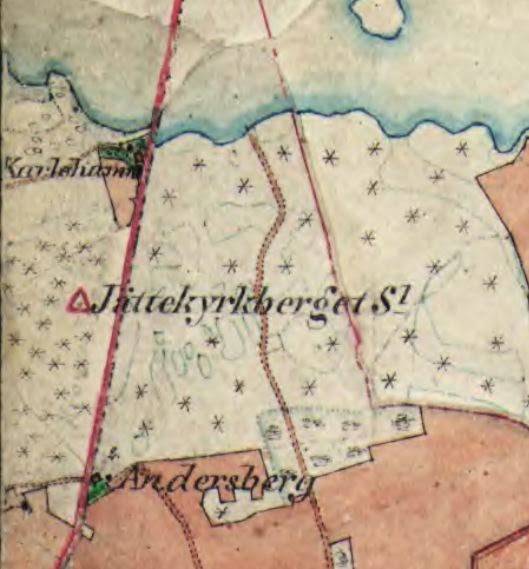
Anders' brother, Karl had rented a piece of land on the other side of Jättekyrkan and built a home, Karlshamn for his family on the other side of Jättekyrkan, by the shore of Lake Storsjön.


Anders [Fors] built a new house on the site of Näsbystugan and renamed the place Andersberg.


On the pictures we can see Andersberg ... and also "Lilla stugan" - presumably Näsbystugan.


The area of Sweden that Claes has written about is southwest of Stockholm. Follow the link to see a map of the general area. The size of the little cottage appears surprisingly tiny. At any time about five people were living in its close quarters. It appears to have a small attic or loft.

I also find it intriguing that Andersberg has never been renamed. It still bears the name that my great-great-great-grandfather, Anders Fors, gave it in about 1860.

Thank you for sharing your work, cousin.

Friday, July 11, 2014

A Twist in the DNA Journey -- Part Two

In the previous post we met "Sven", a new cousin from Sweden, identified through DNA testing. A few weeks after Sven and I connected, his father's DNA results had an unexpected match. Sven had no match and my Dad had no match.

The new match is for a woman of Chinese heritage who has moved from Taiwan to the USA. Let's call her "Lucy". How could Lucy from Taiwan share DNA with a man from Sweden at the 5th cousin to Distant Cousin level?

Let's expand the Ekstrom-Fors-Nyström family tree a bit.


Extending the family tree from the last post, we add Martin Nyström, a Swedish missionary to China. Martin, along with his wife and infant daughter, Ruth, disappeared in China during the Boxer Rebellion in 1900. Their story can be found on the website of the China Inland Mission. Martin's brother also was a missionary to China; however, he and his family escaped to safety.

Several European nations sent armies to protect their interests. It was a terrible time of chaos and violence in China. The Europeans raped and killed women and children, while the Boxers killed Europeans and Chinese Christians.

There are three possibilities for a Chinese woman to have enough Swedish heritage to be a match to the Nyström family:
  • The infant Ruth survived the slaughter and grew up to have her own family. 
  • Martin or his brother Fritiof fathered a child with a Chinese woman.
  • An unknown Swedish soldier, related to Sven's father, impregnated a Chinese woman.

What a mystery! With all the upheaval in China over the past 100 years, can this mystery ever be solved?

There is a bit of a DNA lesson in this story. Little Ruth and Sven's Dad were first cousins, but did not have the same grandmother. They were half-cousins. Instead of sharing 25 percent of their DNA, they would have shared closer to 12 percent. If "Lucy" is a Nyström descendant, her percentage of matching DNA would be similarly decreased. The Family Tree DNA estimate of 5th cousin (or further) makes a bit more sense when we consider that reduction. Rather than 5th cousin, a better estimate would be half-first-cousin 3 times removed.

Who would have thought that a simple genealogical DNA test could crack open a door that was thought closed over a century ago!

Wednesday, July 9, 2014

A Twist in the DNA Journey -- Part One

It's been a while since I've shared much about my genealogical DNA journey, but the past couple of months have been fascinating.

This post is for you if:

  • You are a cousin in my Ekstrom - Fors family.
  • You are a cousin in my Nyström family.
  • You are on your own genealogical DNA journey or thinking about it.
  • You are debating who in your family should be next to have a DNA test.

A New Contact


On May 7, 2014, an email arrived from a man who lives in Stockholm, Sweden. I will call this new cousin "Sven":
My name is "Sven" and if I get it right we are 4th cousins 1R! I got the result today from FTDNA regarding my father's Family Finder.
Eric Carlsson Nyström and his wife Brita Christina Olofsdotter were my great great great grandparents on my fathers side.
My great great grandfather Carl Erik Nyström was brother of your great great great grandfather Anders Fors. I guess Anders took on the name Fors ...


The Family Grows


We have a friendly new cousin in Sweden with a good command of English. He has shared some photos and a map which will be in a later post. Part two will add more family information and a twist, so stay tuned.

Here's a graphical representation of our relationships and the DNA matching results. In part two of this series, the family tree will be expanded.


Lessons in DNA

  1. Test the oldest generation. This match emphasizes what the DNA gurus teach. Sven and I both have results on file at FTDNA, but he and I have no DNA match. Fortunately, both of us took the step of having our fathers tested, also. Our fathers are in their 80s and we gathered that DNA while we could. For $99 each, we made this priceless connection.
  2. Post your tree (GEDCOM) to your DNA testing website. I had posted my Dad's tree and Sven was able to see immediately where the connection was in our trees. He could follow the generations to calculate the relationship of 4th cousin to Dad and then once removed to me. We didn't have to ping-pong email to find the connection.
  3. Work the closest matches first. Sven's Dad has a fairly close match to my Dad. FTDNA proposed a 2nd to 4th cousin match. Sven also has a match, but it was 4th to remote cousin. It might have been weeks or months before Sven worked through his own matches to the page where my Dad showed up. By working that closer match, Sven connected much more quickly.
  4. Don't expect new ancestor information from every match. I've done a lot of Swedish research and have not added much information since connecting with Sven. He has augmented some of my knowledge and vice versa. The more complete your tree is, the easier it is to connect. You may be able to share bits and pieces with your new cousin(s) that will eventually lead to new findings.
  5. Keep track of the matching DNA. I've added the following matching information to my files. When my Dad's kit has another match on any of these DNA segments, I'll know what family that match connects to.

Next time: The Nyström DNA takes a strange turn.
 

Tuesday, May 27, 2014

52 Ancestors in 52 Weeks: #21 Matilda Vilhelmina Viberg

My great-great-grandmother, Matilda Vilhelmina Viberg, was a member of the last generation of my family to live their entire life in Sweden. She watched her children move between Sweden and America and I doubt that she ever met most of her American grandchildren.


Quick drop page from Vogue digital kit, Club Scrap

Matilda was born in 1843 in the parish of Eskilstuna (Fors), Södermanland, Sweden, to Johanna Olofsdotter and Pehr Eric Jonsson Viberg. She was the eighth of eleven children born to the couple, with four more younger half-siblings making a total of fifteen children in the family. Three of those siblings died young.

At age 21 she married a railroad worker, Erik Edvard Fors, in Vårdinge. The Fors family moved often, following the railroad.  Having moved often myself, I understand how frequent moves leads a child to have a curiosity about other places and a willingness to pull up stakes and move.

Matilda and Erik had six children: three daughters and three sons. The youngest, Hildemar Wilhelm Fors, lived less than a month. The remaining five must have saddened her with their wanderlust.

The three girls were Agnes, Ester and Gerda. Each of them spent time in America. Only my great-grandmother Agnes stayed and made it her home. Son Anton also made his way to a new home in America. Ester's son, Carl Lagerholm later made a permanent move to America.

One son, Arvid Edvard Fors, has evaded my research. I'd like to know if he came to America or stayed in Sweden. He was born on August 23, 1873, in the parish of Vårdinge, Stockholm, Sweden. He went to the city of Stockholm in 1890, where I have so far lost him.

Matilda and Erik moved to the Södermanland parish of Frustuna after his retirement. Matilda died there on August 11, 1922,  at the age of 79. 

Tuesday, April 22, 2014

52 Ancestors in 52 Weeks: #16 Erik Edward Fors

My great-great-grandfather Erik Edward Fors was a railroad man in Sweden. Not being an expert with the language, I can't determine his exact job. He was either a Line Master or Station Master. Either way, he was in management. Rather than staying close to his birthplace, he and his family moved around quite a bit, most likely due to his position with the railroad.


Template and elements from Orient Express kit, ClubScrap, September, 2011

Erik Edward Fors was born in the parish of Björnlunda in Södermanland on July 11, 1840. His father, Anders had adopted the Fors surname before his birth and Erik kept the name. His mother, Catherina Andersdotter, had come from Vårdinge parish in Stockholm.

Erik was working for the railroad when he married Matilda Wilhelmina Viberg in Vårdinge parish on July 10, 1864. They lived in Södertälje parish in Stockholm, where their eldest child was born. Four children were born in the Vårdinge parish and one was born in Nyköping parish in Södermanland. They lost one daughter in infancy, but the other five children lived to adulthood.

The couple lived in several parishes in Stockholm, Södermanland and Östergötland. Erik retired to Frustuna parish in Södermanland, where he died on April 17, 1927.

Friday, December 6, 2013

A Hat Trick - Point One

This weekend I have three tips for the price of one:
  • Never ignore evidence
  • Consider unusual sources for unusual problems
  • Even professionals get it wrong sometimes -- by accident or on purpose

This three-part case study revisits Sweden, but the lessons apply anywhere.

My great-great-grandmother Matilda, pictured below with her husband and three of her children, was the granddaughter of Swedish soldier Jonas Flink. You've seen that name before, as his family holds lots of lessons. And please take a moment to glance up at the blog header. The beautiful young bride was the granddaughter of Matilda and was my great-aunt.


Generations digital kit from ClubScrap


The Professional Gets it Wrong


A professional Swedish researcher, Brigitta, dishonored the memory of the Soldier Jonas Flink. This series of posts is intended to restore his honor within the family and to serve as breadcrumbs for my unknown distant cousins.

One of my grandfather's cousins, Roy Fors, paid Brigitta to send him family information. She charged $60 per family in 1992. It's interesting that she was doing a fixed-price job. That leads to a desire to finish a job, rather than extend it. Yet I can understand her pricing method.

Swedish church records follow a family through births, marriages, deaths and moves. There are some gaps that can change what should be a simple lookup into a hunt. Brigitta was working with microfilm, no doubt, which made a detailed search much harder. Today those records are online, though not indexed.

Roy shared parts of her findings with the rest of the family. I received a copy of a copy in 2004. By then I was experienced in working the Swedish records and I was shocked that Brigitta did not source her work. If she had given sources to Roy, they didn't reach me, but I doubt she shared them.

If a researcher won't provide sources, do not hire them!


So part of tip three is to insist that if you pay someone for research, they owe you, at a minimum, sources for the results. Copies of records would be wonderful, too, copyright permitting.

Without sources in the family group sheets I received, they became only a point of reference for me. I set out to check the information, but soon put them away and dismissed them from my mind as I did my own research.

How and When did Jonas Flink Die?


That research hit a bump at Jonas Flink. I've spent a lot of time trying to figure out when and where he died. After breaking through to find his 1807 death, I pulled Brigitta's file to see what she had found. Her conclusion was different. I checked the data she provided and was appalled.


Brigitta gave an outright false statement about the death of Jonas Flink. I believe she made that choice as a speedy way to complete the families of Jonas and collect her fee. She seized on the death of another soldier named Jonas, who was beheaded after killing another man.

Unfortunately, she made the claim shortly before an infamous soldier by the name of Flink went on a shooting spree. For the family members who had received Brigitta's conclusion, the two men are now forever linked as murderers.

Disproving the Professional


Let's quickly disprove Brigitta's conclusion by looking at the church records for Stora Malm parish in Södermanland.

The death record in book F:1 for Soldier Jonas Stålt, age 31 on the 13th of November, 1805, is clearly not for a man named Jonas Flink.


Did both men exist? Let's rule out a name change. Jonas Stålt is listed as Soldier 18 in the 1803-1807 clerical survey, book AI:10A. It's interesting to notice that there is no cross in the death (Död) column or by the name for Jonas. The minister merely struck him from the book with no extra notations.


Two pages later we find Soldier 22, Jonas Flink. The cross in the death column confirms he died between 1803 and 1807. There is no other notation about his death and he does not appear in the death book. Note that his age is one year different than the other Jonas.


At first I thought Brigitta just made an honest mistake. However, through careful examination of all the evidence, I believe there was an intentional misstatement.

Tomorrow, examining the evidence.

Sunday, March 31, 2013

Sentimental Sunday


Today I just want to vent a bit. Do you ever get emotional about the records you are researching? I do.


I get frustrated at the census takers and clerks who scrawled. A few choice words might even pass my lips. Like this one. Where did she go from Halleby?


I ooh and ahh over beautifully written records. How about this writer? I wish my handwriting were as beautiful.

As I research the records for a family, I get to know them. I know where they lived and about their extended family and friends. Sometimes I do the happy dance.

But there is one group of records that always leave me feeling bittersweet -- the Swedish church records of the 18th and 19th centuries. They are comprehensive, as long as the parish clerk was diligent. I can follow my ancestors and their families from home to home, parish to parish, birth to death.

What breaks my heart, over and over, is the high infant mortality rate. I'm happily rolling along and then bam! A baby or young child dies and I feel the sorrow.

I'm sure that other countries experienced the same loss, especially during the years the crops failed. I know it's not unique to Sweden.

I've spent quite a bit of time in the Swedish records over the past couple of weeks, especially using the more recent records from a free weekend with ArkivDigital. I decided to follow one of my great-grandfather's brothers who changed his name. As I traced forward, I saw the children dying until only one child remained, a daughter who married. My heart was saddened when she and her first baby died within a day of each other.

Of my great-grandfather and his six siblings, there are only descendants left today from my great-grandfather. I believe that our branch survived only because he came to America with his wife and children.

I leave you with a look at one of these wonderful, yet heart-wrenching records. Dad Carl Lagerholm works on the railroad, I believe as an engineer. Mom Ester Fors is a housewife. We see their birthdates and parishes, their marriage date and the parish from which they came, with the arrival date. And we see the wee one with the little cross in front of his name, with the dates of his birth and death. Erik's birth date is wrong, as it has a transcription error. The birth and death records revealed that he was born in 1890 and died at two days old.


Carl and Ester did have more children, including a son who joined his aunts and uncles in America.

I have more work to do in the Swedish records. That means more sad times ahead as I look for the remnants of my family.