Showing posts with label Genealogy. Show all posts

Sunday, October 12, 2014

Using a Timeline to Untangle Your Roots

Sorting out people with the same name is one of the challenges the family historian faces. Aunts and uncles, brothers and sisters, nieces and nephews and cousins, oh, my! Sometimes the sorting is simple and other times complex. The proliferation of bad information on the internet has made the task much more difficult.

To sort out the David Maddoxes in Pickaway County, Ohio, I used a timeline, which is a tool suggested by professional geneaogists. In this exercise, I listed by date each piece of evidence that I had found and a few assumptions.

When building a timeline, an important concept is to ignore the spelling on the records. Most spelling before 1900 was phonetic: the clerk wrote what he heard. Capture all documents that you think may apply. Try to ignore the online noise, except to find clues. Look for more evidence than the census. Only one third of my collected evidence consisted of census records.

The goal was to answer two questions.
  • Who served in the Civil War?
  • Who bought land in 1847?

I started with the 1850 census, which listed three individuals named David Maddux/Maddox. I assigned each one a number, based on birth order:
  • David Maddox/Maddux #1 was the brother of my 3rd great-grandfather. 
  • David Maddox #3 was the brother of my 2nd great-grandfather and the nephew of #1.
  • David Maddox/Maddux #2 is unknown, but likely was a distant cousin of the other two men.

I then assigned a person to each document where it was clear to whom it applied. This document applies to David #2, this one to David #1, etc. At the end, I rearranged and color-coded the list to group the documents by the person they pertained to. It then became easier to assign the unclear documents to the right David. Most of the fuzzy documents don't give an age, so have to be examined in the larger context. I also searched out and found other evidence to add facts and build the proof case.

At the end of the exercise, it was obvious that David #2 and David #3 served in the Civil War, while David #1 did not. David #1 is the only one of the three who was old enough to have purchased land in 1847. I also checked the 1840 census to see if there was an earlier David, but there was not a good candidate.

Here's the latest timeline for the three men.

# Date Recorded Name Location [OH assumed] Record Age Event
1 08 Oct 1847 David O P Maddox Monroe Twp, Pickaway Deed DV22-393 [21] 38.5 acres purchased from Lazarus Maddox
1 20 Sep 1850 David Maddox Monroe Twp, Pickaway 1850 Census 24 Owned land $500, with Elizabeth age 52 land $900
1 31 Jan 1852 David Madox Monroe Twp, Pickaway Deed DV27-435 Sold 1/8 part of land of Lazarus Maddox [deceased] to Joseph Madox
1 23 Jun 1853 David Maddox Pickaway County Marriage [27] Maria Tammadge [Talmadge], bride
1 02 Jun 1853 David P Madox Monroe Twp, Pickaway Deed DV28-126 Joseph W Madox sold to David P Madox - 5/8 of Lazarus' land
1 25 Feb 1854 David P Maddox Monroe Twp, Pickaway Deed DV29-004 With wife Mary Maria, sold 5/8 of Lazarus' land to John A Maddox
1 est 1855 D P Maddox Pickaway County School roll Parent of Jas Talmage
1 09 Apr 1856 D P Maddox Pickaway County Deed DV31-472 With wife, final land sale in Pickaway (bought from Bolin, sold to Kendrick)
1 25 Aug 1860 David P Madux Pleasant Twp, Madison 1860 Census 24 Wife Mary M age 27, land 890, Rebecca J 6, John W 4, Orpha 1
1 02 Jan 1862 D P Maddux Pickaway County Tombstone, wife of D P Mary M Maddox death, buried Yankeetown Cemetery
1 04 Dec 1862 David Maddux Madison County Marriage [36] Mary [Watson] Moler, bride
1 01 Jul 1863 David Maddix Fairfield Twp, Madison Civil War Draft 35 Class II registration
1 18 Jul 1870 David Maddux Fairfield Twp, Madison 1870 Census 43 Wife Mary 32, Rebecca 16, John 14, Arthur  (Orpha) 11, Daniel Moler 10
1 25 Sep 1872 Madison County Marriage Rebecca J Maddux marriage to Albert A Gray
1 6 Jul 1880 David Maddux Fairfield Twp, Madison 1880 Census 54 Wife Mary 52, no children
1 2 Jun 1900 David Maddux Fairfield Twp, Madison 1900 Census 73 Birth Sep 1826, widower, boarding with William Knowles age 84
1 31 Jul 1907 David Perry Maddux Columbus, Franklin Death Certificate 80 Birth 30 Sep 1826, son of Lazarus and Elizabeth, informant Rebecca Gray
2 31 Oct 1850 David Matux Perry Twp, Pickaway 1850 Census 13 With [Asa] Collins 40 and Mary 37, William 11
2 28 Nov 1858 David Maddux Pickaway County Marriage [21] [Mary] Elizabeth Timmons, bride
2 12 July 1860 David Maddox Monroe Twp, Pickaway 1860 Census 22 Wife Mary E age 21, no land, no children
2 10 Oct 1862 David Maddux Camp Chase, Columbus Civil War Enlistment 25 Enlisted in Company G of 113 Ohio Volunteer Infantry
2 18 May 1865 David Maddux Civil War Discharge Discharged early from unit
2 David Maddux Date and place of death would be in pension files
2 17 Nov 1866 David Maddox Civil War Pension Widow Mary E Maddox files on David Maddox, 113 OVI Co G
2 23 Jun 1870 Monroe Twp, Pickaway 1870 Census Elizabeth Maddux (servant) 30, Mary 9, living with George Timmons 63
2 10 Nov 1872 Pickaway County Marriage Mary Elizabeth Timmons Maddux wed to Robert Spencer Leach
2 9 Jun 1873 David Maddox Pickaway County Guardianship Robert S Leach guardianship of Mary E Maddux, age 12
2 30 Jun 1873 David Maddox Civil War Pension Minor child by guardian Robert S Leach on David Maddox, 113 OVI Co G
2 14 Jun 1880 Monroe Twp, Pickaway 1880 Census Mary E Leach 40, spouse R.S. 34, Mary Maddux 19
2 4 Nov 1880 Pickaway County Marriage Mary Elizabeth Maddux marriage to William J Porter
2 01 Jun 1890 David Maddux, dec'd Monroe Twp, Pickaway 1890 Veteran Census Mary E Leach, widow of David Maddux
2 27 Jun 1900 Monroe Twp, Pickaway 1900 Census Mary E Leach 62, spouse R.S. 54, grandson CW Porter b. Dec 1882
3 20 Sep 1850 David Maddox Monroe Twp, Pickaway 1850 Census 7 With William 27 and Nancy 26, Lewis age 4, Willliam infant
3 15 Aug 1860 David Mattock Scott County, IL 1860 Census 16 With William 41 and Nancy 39, Lewis 15, Wm 11, George 8, Joseph A 4
3 13 Aug 1862 David Maddox Exeter, Scott County, IL Civil War Enlistment 19 Enlisted in 129 Illinois Infantry, Co F, Nativity Pickaway, Ohio
3 15 May 1864 David Maddox Resaca, Georgia Service File Wounded in side
3 20 Nov 1864 David Maddox Madison, Georgia Service File Taken prisoner and paroled, never discharged, no further records

Saturday, July 12, 2014

A Peek at Our Swedish Heritage

This post is for you if:

  • You are a cousin in my Ekstrom - Fors family.
  • You are a cousin in my Nyström family.
  • You are curious about Swedish dwellings.

Our Ancestral Homes


I've never been to Sweden, though it's on my bucket list. It's hard to visualize how and where our ancestors lived their lives. Our cousin, Claes Nyström, has been researching the homes of our ancestors and has his own vacation cottage not too far from the area where the Nyström and Fors families lived.

Swedish farmers in the 1800s had varying degrees of wealth, from small tenant farmers to large land-holders. Eric Carlsson Nyström (1772-1857) was a crofter and a tailor. At his death, he had no debts, so he was apparently wise with his scarce assets.

Claes' Findings


Claes writes:

I finally found Näsbystugan which I have been searching for and haven't found on a map. Eric Carlsson married Brita Stina Olsdotter in 1807 and moved into Näsbostugan, later known as Näsbystugan, together with her parents already living there. They stayed there all their life until they died at, by that time, very high ages. Eric died at 85 and Brita Stina at 91.

Their son Anders [Fors] came back to Björnlunda from Wårdinge in 1860, back to Näsbystugan, with his family. Brita Stina was widowed since 3 years back 


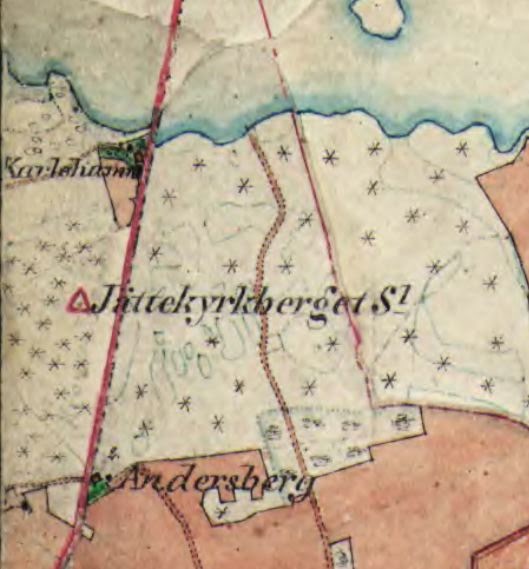
Anders' brother, Karl had rented a piece of land on the other side of Jättekyrkan and built a home, Karlshamn for his family on the other side of Jättekyrkan, by the shore of Lake Storsjön.


Anders [Fors] built a new house on the site of Näsbystugan and renamed the place Andersberg.


On the pictures we can see Andersberg ... and also "Lilla stugan" - presumably Näsbystugan.


The area of Sweden that Claes has written about is southwest of Stockholm. Follow the link to see a map of the general area. The size of the little cottage appears surprisingly tiny. At any time about five people were living in its close quarters. It appears to have a small attic or loft.

I also find it intriguing that Andersberg has never been renamed. It still bears the name that my great-great-great-grandfather, Anders Fors, gave it in about 1860.

Thank you for sharing your work, cousin.

Friday, July 11, 2014

A Twist in the DNA Journey -- Part Two

In the previous post we met "Sven", a new cousin from Sweden, identified through DNA testing. A few weeks after Sven and I connected, his father's DNA results had an unexpected match. Sven had no match and my Dad had no match.

The new match is for a woman of Chinese heritage who has moved from Taiwan to the USA. Let's call her "Lucy". How could Lucy from Taiwan share DNA with a man from Sweden at the 5th cousin to Distant Cousin level?

Let's expand the Ekstrom-Fors-Nyström family tree a bit.


Extending the family tree from the last post, we add Martin Nyström, a Swedish missionary to China. Martin, along with his wife and infant daughter, Ruth, disappeared in China during the Boxer Rebellion in 1900. Their story can be found on the website of the China Inland Mission. Martin's brother also was a missionary to China; however, he and his family escaped to safety.

Several European nations sent armies to protect their interests. It was a terrible time of chaos and violence in China. The Europeans raped and killed women and children, while the Boxers killed Europeans and Chinese Christians.

There are three possibilities for a Chinese woman to have enough Swedish heritage to be a match to the Nyström family:
  • The infant Ruth survived the slaughter and grew up to have her own family. 
  • Martin or his brother Fritiof fathered a child with a Chinese woman.
  • An unknown Swedish soldier, related to Sven's father, impregnated a Chinese woman.

What a mystery! With all the upheaval in China over the past 100 years, can this mystery ever be solved?

There is a bit of a DNA lesson in this story. Little Ruth and Sven's Dad were first cousins, but did not have the same grandmother. They were half-cousins. Instead of sharing 25 percent of their DNA, they would have shared closer to 12 percent. If "Lucy" is a Nyström descendant, her percentage of matching DNA would be similarly decreased. The Family Tree DNA estimate of 5th cousin (or further) makes a bit more sense when we consider that reduction. Rather than 5th cousin, a better estimate would be half-first-cousin 3 times removed.

Who would have thought that a simple genealogical DNA test could crack open a door that was thought closed over a century ago!

Wednesday, July 9, 2014

A Twist in the DNA Journey -- Part One

It's been a while since I've shared much about my genealogical DNA journey, but the past couple of months have been fascinating.

This post is for you if:

  • You are a cousin in my Ekstrom - Fors family.
  • You are a cousin in my Nyström family.
  • You are on your own genealogical DNA journey or thinking about it.
  • You are debating who in your family should be next to have a DNA test.

A New Contact


On May 7, 2014, an email arrived from a man who lives in Stockholm, Sweden. I will call this new cousin "Sven":
My name is "Sven" and if I get it right we are 4th cousins 1R! I got the result today from FTDNA regarding my father's Family Finder.
Eric Carlsson Nyström and his wife Brita Christina Olofsdotter were my great great great grandparents on my fathers side.
My great great grandfather Carl Erik Nyström was brother of your great great great grandfather Anders Fors. I guess Anders took on the name Fors ...


The Family Grows


We have a friendly new cousin in Sweden with a good command of English. He has shared some photos and a map which will be in a later post. Part two will add more family information and a twist, so stay tuned.

Here's a graphical representation of our relationships and the DNA matching results. In part two of this series, the family tree will be expanded.


Lessons in DNA

  1. Test the oldest generation. This match emphasizes what the DNA gurus teach. Sven and I both have results on file at FTDNA, but he and I have no DNA match. Fortunately, both of us took the step of having our fathers tested, also. Our fathers are in their 80s and we gathered that DNA while we could. For $99 each, we made this priceless connection.
  2. Post your tree (GEDCOM) to your DNA testing website. I had posted my Dad's tree and Sven was able to see immediately where the connection was in our trees. He could follow the generations to calculate the relationship of 4th cousin to Dad and then once removed to me. We didn't have to ping-pong email to find the connection.
  3. Work the closest matches first. Sven's Dad has a fairly close match to my Dad. FTDNA proposed a 2nd to 4th cousin match. Sven also has a match, but it was 4th to remote cousin. It might have been weeks or months before Sven worked through his own matches to the page where my Dad showed up. By working that closer match, Sven connected much more quickly.
  4. Don't expect new ancestor information from every match. I've done a lot of Swedish research and have not added much information since connecting with Sven. He has augmented some of my knowledge and vice versa. The more complete your tree is, the easier it is to connect. You may be able to share bits and pieces with your new cousin(s) that will eventually lead to new findings.
  5. Keep track of the matching DNA. I've added the following matching information to my files. When my Dad's kit has another match on any of these DNA segments, I'll know what family that match connects to.

Next time: The Nyström DNA takes a strange turn.
 

Saturday, January 25, 2014

Gretna Green, American Style

Where's that marriage record?


You've searched everywhere you can think of and you can't find the marriage record for those family members. Based on the time and place where they lived, you know there must have been a license. But you're stuck! Today I'm going to suggest six places to look for a marriage record, including the nearest Gretna Green.

Don't head for your favorite map site just yet. If I told you that I live in Timbuktu, you wouldn't look at a map, but rather you would understand that I live away from the action.

Gretna Green is a place name that is used to express the concept of a place to elope or have a quickie wedding. Use your favorite search engine to read about the origin of the term -- it's really quite a fascinating look at marriage customs in Scotland and England.

When you're looking for an elusive marriage record, you need to understand the customs and laws of the time and place. Those laws may cause a couple to marry somewhere unexpected.

Six Places to Look


When searching for a marriage record, remember to also search jurisdictions surrounding each of these places:
  1. The bride's place of residence.
  2. The bride's parents place of residence.
  3. The groom's place of residence.
  4. The groom's parents place of residence.
  5. The nearest Gretna Green. Also, Nevada in recent history.
  6. Destination wedding spots. This is a new and difficult category.

Here are a few examples from my own family:
  • For Eastern Arizona and Southern Colorado, look in New Mexico
  • For Southern Michigan and Eastern Illinois, including Chicago, look in Indiana
  • For Washington, D.C., look in Maryland, Virginia counties and also Virginia independent cities
Figuring out where the nearest Gretna Green may have been is the hardest part of going to step five. Consider asking the local historical society or genealogical society whether there was a popular Gretna Green used by people in the area.

Having thought for a while about this post, I realized that I need to take my own advice.

I have an ancestral couple who married in the early 1800s and I can't find any record. He was born in Delaware, she was born in Maryland and the only known child was also born in Maryland. I assume the marriage took place on the Delmarva Peninsula.

Where have I forgotten to look? If you said Virginia, you are correct!

Sunday, December 8, 2013

A Hat Trick - Point Three

This weekend I have three tips for the price of one:

  •     Never ignore evidence
  •     Consider unusual sources for unusual problems
  •     Even professionals get it wrong sometimes -- by accident or on purpose

Having looked at the evidence ignored by a professional researcher, we now turn to using unusual sources to find a death date in Sweden. The normal sources are the church death records and the clerical surveys. But the death of Soldier Jonas Flink is not found in the church records of  Stora Malm parish in Södermanland.

In addition to Stora Malm, I checked the death records in the home parish of his wife and a handful of surrounding parishes. No matter what country you are researching, remember that people did travel and births and deaths may have occurred in an unexpected jurisdiction.

At this point, I'd exhausted all the record types on Ancestry.

The website ArkivDigital has available some other record types that are less used in Swedish research. The next stop is the military records. Not all still exist, but let's look at what is available for the county of Södermanland. For 1806 and 1807 there's a single book with muster rolls (volume 151).

Soldier 22, Jonas Flink, age 32, representing Klicksta Rote, was listed on a muster roll dated June 20, 1807. He was married, had served for 9 years and was 6 feet and 0 inches tall.


Is this the right Jonas Flink? Since military names are assigned to soldiers, there may have been more than one Jonas Flink among the hundreds of soldiers in the Södermanland army. The age was certainly right and there is a Klicksta in Stora Malm parish.

Is there a church record that tied Jonas Flink to Klicksta? Yes, one such record exists. The godparents of daughter Brita Kajsa were from Klicksta, as seen in this 1801 birth and christening record from book C:5.


The soldier number and rote (area served) are tied together, and we know that soldier 22 from Stora Malm represented Klicksta. We have now narrowed down the death date for Jonas Flink to the second half of 1807: after the muster roll of June 20th, but by the end of the year.

ArkivDigital also has estate inventories (probates). I saw a statistic somewhere that only about 25 percent of the Swedish estate inventories have been preserved. But it's always worth a try to check a record set that is not complete.

To find a probate for Stora Malm, we first have to know the court that covers the parish: that's Oppunda. The inventory (bouppteckning) can be done anytime after death and most of the books are not indexed, so there are no shortcuts. Finding nothing in the 1807 book, we find the probate of Jonas Flink in the 1808-1809 book (FII:8).


We can now state that Jonas Flink died on the 23rd of August, 1807. We don't know, though, how and where he died. I'm continuing to look for those parts of the story.

Research into that time frame does reveal that the Swedish Army was heavily involved in the Napoleonic Wars. Stralsund in Swedish Pomerania was under siege through most of 1807, ending with a loss to the French on the 24th of August. 

By taking the time to research and understand the unusual Swedish records, we can now say with confidence that Jonas Flink (1775-1807) was an ordinary soldier. He was not a murderer, as portrayed by a researcher who was more interested in the paycheck than in the truth.

One last question: how do we find out about the less common genealogical sources?

There are so many resources available on the internet today. A wonderful place to start is Cyndi's List, where you can find links to thousands of resources for genealogy.

I hate to suggest adding to a paper collection, but if you find there is an outstanding reference book for an area difficult to research, buy that book, even if it's paper and not an e-book.  This is especially true for research in a foreign language. As Americans, we can't expect our knowledge of America to  carry us through research in any other country.

I've nearly worn out my favorite Swedish reference book. Cradled in Sweden has long been considered as the definitive work on Swedish research and it's been close by my side through every step of my Swedish research. I've also bought maps and an English-Swedish dictionary.

It's through researching how to research that we learn about the unusual sources that might otherwise elude us.

Saturday, December 7, 2013

A Hat Trick - Point Two

This weekend I have three tips for the price of one:
  •     Never ignore evidence
  •     Consider unusual sources for unusual problems
  •     Even professionals get it wrong sometimes -- by accident or on purpose

Yesterday I showed how a professional misstated the death of the Swedish soldier Jonas Flink. She set his death date in November, 1805, while the correct date was in 1807.

Today, let's look at one tiny bit of evidence that she missed or ignored in the church records for Stora Malm parish in Södermanland

Returning to the 1803-1807 clerical survey, book AI:10A, let me show you the entire two-page spread for Jonas Flink and his family. It's very easy to skip over the various codes that the priests used. The same is true of American census records. Yet there are often very useful tidbits of evidence to be found by looking at every column and every page of a record.

On the first page, we see the names and birthdates for the family. The birth parish should be listed, but this minister (or clerk) did not complete the entries. The marriage column (Gift) is also not filled in. Brita's moving in year is entered, along with the parish from which she came. Of course, we see the cross in the death column for Jonas. But what are all the mysterious marks in the narrow columns?


If you're puzzled about a record, take the time to learn about unclear information. Whether in a physical book or online, there may be an explanation or legend somewhere in the book or online.

Inside the front cover of this book is found a Latin legend for the mysterious marks that measure each person's ability to read, to understand and interpret the Catechism, and to understand other aspects of the Lutheran faith.


The marks mean: bad, something, simply, well, and absolutely nothing. Thank goodness my ancestors weren't in that last category.

Moving to the second page of the record, we'll find a single piece of evidence too strong to ignore. Recall that Jonas Flink is on the first line of the pages. He could not have died in 1805 based on the little letter e in the 1806 column. But exactly what does that letter e mean?


The minister recorded when each parishioner partook of communion (Nattvarden) during the year. There is a list near the front of the book that lists the dates that communion was offered in the parish.

I certainly can't read every word, but I can tell that b was Candlemas (February 2) and g was Trinity Sunday. Working through the other Holy Days between those two days, I can derive that e was the code for the first Sunday after Easter in 1806.


Jonas Flink took communion one week after Easter in 1806, which fell on the 6th of April. There is no further contact with the minister, based on the church records. He does not appear in the clerical survey books that start in 1808. This evidence pinpoints his death as after April 13, 1806, and before 1808.

Ignoring this evidence seems to me to have been impossible for a professional researcher. As an experienced amateur, it certainly is obvious to me that one little letter is critical evidence. We can't ignore it. So where is the death record?

Tomorrow, using uncommon records to solve this uncommon problem.

Friday, December 6, 2013

A Hat Trick - Point One

This weekend I have three tips for the price of one:
  • Never ignore evidence
  • Consider unusual sources for unusual problems
  • Even professionals get it wrong sometimes -- by accident or on purpose

This three-part case study revisits Sweden, but the lessons apply anywhere.

My great-great-grandmother Matilda, pictured below with her husband and three of her children, was the granddaughter of Swedish soldier Jonas Flink. You've seen that name before, as his family holds lots of lessons. And please take a moment to glance up at the blog header. The beautiful young bride was the granddaughter of Matilda and was my great-aunt.


Generations digital kit from ClubScrap


The Professional Gets it Wrong


A professional Swedish researcher, Brigitta, dishonored the memory of the Soldier Jonas Flink. This series of posts is intended to restore his honor within the family and to serve as breadcrumbs for my unknown distant cousins.

One of my grandfather's cousins, Roy Fors, paid Brigitta to send him family information. She charged $60 per family in 1992. It's interesting that she was doing a fixed-price job. That leads to a desire to finish a job, rather than extend it. Yet I can understand her pricing method.

Swedish church records follow a family through births, marriages, deaths and moves. There are some gaps that can change what should be a simple lookup into a hunt. Brigitta was working with microfilm, no doubt, which made a detailed search much harder. Today those records are online, though not indexed.

Roy shared parts of her findings with the rest of the family. I received a copy of a copy in 2004. By then I was experienced in working the Swedish records and I was shocked that Brigitta did not source her work. If she had given sources to Roy, they didn't reach me, but I doubt she shared them.

If a researcher won't provide sources, do not hire them!


So part of tip three is to insist that if you pay someone for research, they owe you, at a minimum, sources for the results. Copies of records would be wonderful, too, copyright permitting.

Without sources in the family group sheets I received, they became only a point of reference for me. I set out to check the information, but soon put them away and dismissed them from my mind as I did my own research.

How and When did Jonas Flink Die?


That research hit a bump at Jonas Flink. I've spent a lot of time trying to figure out when and where he died. After breaking through to find his 1807 death, I pulled Brigitta's file to see what she had found. Her conclusion was different. I checked the data she provided and was appalled.


Brigitta gave an outright false statement about the death of Jonas Flink. I believe she made that choice as a speedy way to complete the families of Jonas and collect her fee. She seized on the death of another soldier named Jonas, who was beheaded after killing another man.

Unfortunately, she made the claim shortly before an infamous soldier by the name of Flink went on a shooting spree. For the family members who had received Brigitta's conclusion, the two men are now forever linked as murderers.

Disproving the Professional


Let's quickly disprove Brigitta's conclusion by looking at the church records for Stora Malm parish in Södermanland.

The death record in book F:1 for Soldier Jonas Stålt, age 31 on the 13th of November, 1805, is clearly not for a man named Jonas Flink.


Did both men exist? Let's rule out a name change. Jonas Stålt is listed as Soldier 18 in the 1803-1807 clerical survey, book AI:10A. It's interesting to notice that there is no cross in the death (Död) column or by the name for Jonas. The minister merely struck him from the book with no extra notations.


Two pages later we find Soldier 22, Jonas Flink. The cross in the death column confirms he died between 1803 and 1807. There is no other notation about his death and he does not appear in the death book. Note that his age is one year different than the other Jonas.


At first I thought Brigitta just made an honest mistake. However, through careful examination of all the evidence, I believe there was an intentional misstatement.

Tomorrow, examining the evidence.

Sunday, October 6, 2013

Double the Fun with Double Cousins

Do you have any double cousins in your family tree? They are absolutely worth identifying and tracing forward.

I've got three places where double cousins appear in my tree that I know of, two of which are in my direct line. In one branch the parallel line has disappeared, but the other two are still going strong. If you look up at my header photos, part of the Maddox/Lake double cousins are at the far left, while the Allee/Lucas double cousins are in the very large family group. That just struck me rather funny, since I'm not writing about any of them today.

Double cousins are where siblings from one family marry siblings from a second family, with the resulting children being first cousins on both mother's and father's lines and having the same four grandparents. The cousins are often very close and share many of their family stories, which come down the line to their descendants.

Here's an example from my favorite confusing family, the Alexanders, who intermarried with the Maynards. There were more children in each and every one of these branches, but I just want to show the relationships.


My ancestor, Mollydine Alexander, was a double cousin to Patience Alexander and her siblings, as well as to John Maynard and his full siblings. It's called a double cousin because, for example, Molly was a cousin to Patience on the Alexander side as well as on the Maynard side.

In genealogy, the descendants of these double cousins are great partners when working on the brick walls. In the DNA world, it's very exciting to match with one. Double cousins share about as much DNA as a half-sibling, so it amps up the match potential.

I had reached out to Lenora, one of the descendants from this tree, to see if she had done a DNA test. I was hoping she would help my second cousin and me sort out some of our match information. Her email bounced, and so I lost her since our last contact several years ago.

But I'm doing the happy dance anyway. While exploring the new tools at Family Tree DNA, I found a match who is a descendant of Patience Alexander. Charlotte and I are fourth cousins who share those four people at the top of the tree. Although she's not doing genealogy, her willingness to contribute to the DNA pool will help me sort out my own matches.

The orange shows all the bits of our matching DNA at the 1cM level and above. The challenge will be to assign each of those areas to the right surname.


And I've updated my DNA fan chart recently -- you can see Charlotte's red marks in the right center. That's far closer in time than being outside the fan and will be of far more use than the distant cousins.


Double cousins are double the DNA, double the research opportunities -- and double the genealogy fun!

Sunday, September 22, 2013

Digging for Courthouse Treasure

Ever since I learned, though this newspaper clipping, that our Maddox family legend about a murder was true, I wanted to find out the story behind the legend. As I researched the story, I decided that I wanted to write a fictionalized account as a book.


Unfortunately, there's a gaping hole in the court records. The murder case dragged on for years, with each session of the circuit court continuing the case until the next session. Suddenly, at the end of 1874, the case file just stops without telling what happened.

One of the men had left the state. But were either of the two remaining men convicted of murder? Were they acquitted? Did the state drop the charges? Inquiring minds want to know.

In August, I returned for my third visit to the scene of the trial in Scott County, Illinois. The opportunity to do so was a big part of rescheduling my Illinois research trip to add three days. Priority number one was to find the missing puzzle piece in the courthouse.

Many of the old records are housed in a special vault. It's lined with brick, protected by a double metal door and is dark and musty. Disturbing the old books raised dust and mold, which made me sneeze and sent one allergic worker to an early lunch.

On previous visits, I thought that my cousin Lorna and I had covered everything of interest, but there just had to be more. I dug more deeply into the deed books and, when I was done, had found no new information pertinent to the murder. I had collected some other notes about family members, so it had been time well spent.

I walked the narrow aisles of the small vault, just looking at the record sets. What about mortgages? I knew I hadn't looked at them. I found where the family had signed multiple promissory notes to their lawyers, using the farm as collateral. I knew the lawyers had forced foreclosure, but now I saw the details of how the finances worked for the trial: who was owed how much and why.

But what else? I still needed to know the verdict or verdicts. I was tired and hungry, but I knew the answer had to be somewhere in this courthouse. There were some very narrow books at floor level near the back of the vault. What were they? In desperation I pulled my small flashlight from my purse and shone it on the spines.

Paydirt! 


The books were Court Dockets, labelled by year. I looked for 1874 and 1875, but couldn't find exactly what I wanted. Some books were even blocked by other shelves. But I did find a couple of books for the right time frame. I'm sorry to say that in my excitement, I don't recall exactly which book showed what, but I do believe the 1874 answer was written in a book labelled as either 1873 or 1875.

I've shown you a court docket entry before, so I won't show you this one. I do have to keep a little bit of mystery about the end of the story. But the point of this post is that obscure record sets can flesh out the stories of our ancestors. You have to be willing to dig deep and not just look online and in the library.

Court dockets aren't exciting or sexy. It's just names of plaintiffs and defendants, dates, case dispositions, court costs, etc. This docket gave me three lines: the date the jury was seated to try the main defendant, the date the jury returned and their verdict, and the disposition of the case against the remaining co-defendant.

Someday dockets might be digitized and indexed, but don't hold your breath. I think they'll be near the bottom of the priority list. I'm sure that the Scott County record keepers thought they were useless, thus placing some in such a way as to be inaccessible. However, this is the third time I've found dockets to be informative: once for a divorce and twice for criminal cases.

What Next?


So now that I have the final piece of the murder mystery, I can write the book. But should I? As books disappear from shelves and stores, it seems I wouldn't want to publish in paper form. And I'm not much good at writing fiction. It's probably more challenge than I want to tackle.

My thinking now is to write a series of biographical sketches on the key players and their extended families. I can "publish" the sketches via Ancestry and/or Family Search and can compile them as a PDF book to share with family. This approach is more in keeping with the way we share and research today and yet can be the sort of research book that has helped me along my own journey to find the story behind the family legend.
 

Friday, September 6, 2013

What's a Traveler to Do?

I'm home from my genealogy trip to Illinois and Indiana and finally getting back to normal. I had to replace a broken phone and a weary car in the past week, too. Four days of research followed by three days of conference left me overwhelmed with papers and information. Where to start? Day one, I suppose.

A last-minute itinerary change added three research days to the start of the trip, but the first one was Sunday. That got me thinking about how to benefit from field research on a Sunday during a genealogy trip. The courthouse is closed. Many libraries, archives and genealogy societies are also closed on Sunday.

So here are some other ideas:
  • Find an ancestral home or farm
  • Find an ancestral neighborhood
  • Visit a church your ancestors attended
  • Eat where the locals eat and start a conversation
  • Buy and read the local newspaper
  • Visit ancestral cemeteries
  • Look in the phone book for relatives and call them
  • Check nearby cities for open libraries

Some indirect choices:
  • Make Sunday a travel day
  • Take care of yourself -- massage, laundry, extra sleep, exercise
  • Review and organize files, whether paper or on the computer
  • Research on the internet, focusing on the local area
  • Be a genealogy angel and take cemetery photos for websites such as FindAGrave

My Sunday turned into a lucky day. I discovered that the St. Louis County Library genealogy department houses the book collection of the National Genealogical Society. Since my new itinerary had me flying into that city on Saturday evening, I delayed my travel to Illinois and spent four hours Sunday afternoon in the library, doing Kentucky research. After closing time, a two-hour drive took me to the next stop in Jacksonville, Illinois.

Oh, yes, I also slept in, went shopping, had Starbucks, organized thoughts, and even did a little laundry. It was a pleasant Sunday, indeed.