Showing posts with label Pickaway County OH. Show all posts

Sunday, June 10, 2018

He Bought the Farm: 52 Ancestors


In the previous post, land records positively identified the eight children of an Ohio farmer. However, the parents of the farmer, Lazarus Maddox, are not as easy to identify. A male Maddox descendant of Lazarus has graciously agreed to take a Y-DNA test, which should help identify his family. One of the puzzles for his descendants is whether there is a meaning to the Pickaway County farm that Lazarus bought.

Lazarus Maddox was born about 1787, probably in Kentucky. The first known record for him in Ohio was his service in the War of 1812, along with men from Pickaway County and Ross County, under the command Captain Robert Bradshaw. Some of the  names of his fellow soldiers are names that appear in other records associated with the Maddox family. Familiar names include Hayes, Knoles, Alkire, Baker, Webb, Wilson, Boggs, Burbridge and McAlister.


Marriage book 1, page 82, shows that on November 3, 1816, Elizabeth Greaton married Lazarus Maddox. The marriage was celebrated by Joseph Hays, a minister of the Methodist Episcopal Church. Elizabeth's father, David Greaton, gave consent and Lazarus signed an affidavit that he was over 21. Interestingly, the legal paperwork was dated November 5, 1816. It is possible that the minister reported the wrong date to the county clerk.


Starting in 1822, Lazarus appears on the Pickaway County tax rolls, paying tax on land. But the farm of interest didn't exist yet.

In 1823, Lazarus joined a survey crew, acting as a chain carrier for survey 12346. In the DAR abstract of surveys, it is the only place his name appears. The survey was being done for a man named John L. Wilson.

Generally the chain carriers were young men who happened to live in the area. Lazarus was in his mid-30s. Why would he join the crew? In 1821, Lazarus had been sued for a debt of $51. He swore to the court that he had no money and no way to get any. Did he take the work of the chain carrier just to earn some cash?

In 1841, Lazarus bought that exact farm from John Wilson. Why that farm? What is the connection? Did he just like the land after he worked on the survey, or is there a family connection?

In 1830, Lazarus had words with a neighbor, Timothy Wale, who had set fire to Lazarus' stable. There is a court case about the words spoken, but not one about the destroyed stable. I wonder what they argued about!

Lazarus and Elizabeth had eight children. Their exact birth order is not fully known. The children were:
  • Clarissa (1818-1903, married Knoles)
  • John
  • William (about 1820-1869, my line)
  • Eliza Ellen (1820s-1840s, married Long)
  • David (1826-1907)
  • Joseph
  • Mary (1834-1907, married Neff)
  • Susannah (1837-1917, married Alkire)

Lazarus died in March, 1850, of dyspepsia (indigestion). The information given to the census taker was that he was 63 years of age at death and had been born in Kentucky. As he did not provide the information, it may not be correct. His burial location is unknown, but may have been at the nearby Methodist Church cemetery or on the Hayes farm where his grandson was buried. If there was a marker, none is found today.

And so ends the story of a Pickaway County, Ohio farmer, until the day that DNA adds another chapter.

Saturday, May 19, 2018

The Elusive Deed


You're thinking "Not land records again!"

Yes, land records!

If you have ancestors who were land owners, the land records are an important resource. However, they are not always simple. Metes and bounds deeds continue to challenge me. It took me twelve years to find one elusive deed.

You don't want to make the same mistakes I did, right?

First, here are 14 quick tips and then I'll take you through a long tale of my steps and my errors.
  1. Deeds can be wrong.
  2. Indexes can be wrong.
  3. The in-book index and the master index book may not have the same information.
  4. Use the tract index if one exists. 
  5. Read every single deed for the property and time frame.
  6. Get photocopies of all pertinent deeds, not notes or abstracts or transcripts. Consider photocopies of the indexes if cost permits.
  7. Know every number and name that might identify the property: patent, warrant, survey, township, range, section, addition, subdivision, lot, tax ID.
  8. Find a copy of the original recorded survey where possible, not an abstract.  
  9. The recorder/register office may have other resources. Ask for a tour.
  10. Collect maps, both those relevant to the time being searched and a current map from County Engineering or the office that is mapping the land.
  11. Court cases can trigger deeds. If you find one, look for a copy of the court case.
  12. The tax assessor knows more than you think.
  13. The local genealogical society may hold or know of special resources. Ask for advice.
  14. Early census records can lead to invalid assumptions.

The Twelve Year Quest


My goal was to identify all the children of an old farmer who died just before the 1850 census. The probate did not list the heirs and did not mention disposition of the land. I was working from brief notes jotted by a distant cousin.

First, did she even have the right family? My ancestor (the murder victim) had sold some land, but was it his father's land? Neither man was listed in the grantee index as buying the land in question. After reviewing the deeds for the land the old farmer purchased, I discovered the grantee index was wrong. It listed the 90 acres that he purchased in 1841 with a number that matched not one single thing that was in the deed. If I had not looked at each deed, and had just looked at the index, I would not have seen the connection. I wish my cousin had provided copies or even a note about the index error. I also didn't understand why the maps and deeds had different numbers. I wouldn't learn that for several years.

Working from her notes, I quickly found where each of seven children had sold a one-eighth undivided part of the land within the family. Some of them sold part of 90 acres while others sold part of 50 acres or part of 55 acres. How much land did the old farmer really hold at his death? He had sold 13.75 acres and 38.5 acres from the same tract of land. To this day I don't know the answer, but the deeds with 90 acres were definitely in error.

In 1860, the sibling who owned it sold his 7/8 undivided part of the farm outside the family. The eighth sibling was still unidentified. I began to follow the land as it passed from owner to owner. In 1869, 3/4 of an acre was set aside for a school lot. I failed to read the deeds for the school lot. This was another error.

One of the deeds made no sense. After being lost to foreclosure in 1863, the 7/8 part of the land was auctioned. Yet in 1881, the owner's widow signed a quit claim and dower release for the 7/8 part in exchange for a sum of cash. Had she not lost her rights in the foreclosure? Apparently there was a need to create a clean title through a quit claim.

Unfortunately, this quit claim led me astray. I presumed the missing 1/8 was still missing in 1881. It wasn't. But it took several more years and a couple more courthouse visits to find the missing piece.

Fast forward a few years to year eleven of the search. Technology had advanced and the genealogical society had moved. The society had been in cramped quarters and accessing much of the collection had been a problem. However, I delayed checking out the new larger facility and talking to the staff. This was another error.

Based on the census records from 1820 to 1840, I had concluded that the eighth child was a daughter, born 1820-1825 and married after the 1840 census. I had listed all the young women of the surname who had married between 1840 and 1850. I returned to the recorder's office and checked the deed index and deeds using the husbands' surnames. No luck. The conclusion, based on the 1840 census, was wrong.

Next I decided to start with the present and work the deeds backwards in time. Who owned the property now? The recorder didn't know, so sent me to the tax office. What was the tax ID? I had no clue, so the tax office sent me to engineering to get the parcel number from the current maps.

Engineering was an amazing resource. Hanging on racks around the office were many large maps of the county. The staffer asked for the survey number. I had no clue, as all the early deeds had been written based on the military warrant number. My copy of a D.A.R. survey abstract had the warrant number, but not the survey number. I had never looked for the original survey. That was another error.

She pulled out a copy of a ledger that cross-indexed the surveys and warrants. I was stunned when I saw the survey number matched the number on the landowner maps. Why had I never seen that cross-reference index? She told me where in the recorder's office I could find copies of the original survey book and of the cross-reference ledger. These books were stored above my eye-level and I didn't know they were there! Had I ever had a tour of the recorder's office? I should have asked.

Having found the survey number, she pulled out a lovely color-coded map of the area that included the property. She made me a color copy, zoomed in on the farm. Since she had no way to charge for the copies, she just gave me the copy!


Survey 12346 (green boundary), Tax Parcel 376-01, Part of Military Warrant 6498. Map as of 2014.


With map in hand, it was back to the tax office. They gave me not only the name of the current owner, but also the deed book and page number where the owner's purchase had been recorded.

The newer deeds each listed the previous deed, so it was fairly quick to follow the deeds back to 1881. The land was being transferred as a whole parcel, so the missing 1/8 had been sold to an owner at some point. Why couldn't I find it?

I went through the survey book and bought copies of each survey of interest. I also wrote down warrant to survey cross-references. Notice that, in the survey, the number 12346 is written inside the plat diagram. When D.A.R. abstracted the written information, they missed documenting the survey number, which is vital information.


Survey 12456 for Military Warrant 6498, in 1823


In the final hours of my visit to the county, I went to see the new genealogical society facility. It was now a wonderful research library. The volunteers had indexed many of the holdings. The staffer on duty took me on a tour and showed me the storage area where the volunteers were cataloging and indexing old court records, which was a collection in which I was interested. But that would be another visit. In the meantime, I purchased, on CD, an index to the marriage consents and affidavits. I also purchased some printed indexes.

When I returned home, I reviewed my purchases. There, in the marriage consents index, I found the answer. The missing daughter had married in 1839 and her father, the old farmer, had signed a consent. I should have included earlier marriages in my search. I sent off for a copy of the consent for my files. If I had found that consent during the visit, I could have concluded the deed search that trip.

A year later, in year twelve of the search, I returned to the county. First stop was the recorder's office. With the new clue, I found a handful of deeds. But there was still a missing link. Why couldn't I find it?

There were two more road blocks to remove. One deed was indexed incorrectly. It covered two parcels of land and only one of the parcels was in the index -- the other parcel. And lastly, the consolidation of the land into one owner was only understood by reading a court case.

The eighth daughter had died, leaving two children. In the sale of the school lot to the Board of Education, those two children had been two of the grantors, each owning a 1/16 part. Had I read that deed years ago, the puzzle would have been solved.

Although I had the genealogical answer, I wanted to understand how the land was consolidated. The answer was in the court cases held by and indexed by the genealogical society.

The son had a guardianship that referred to him as an imbecile. In 1874, his father petitioned the court to partition the land. This may have been the best legal way to deal with the 1/16 fractional ownership by his handicapped son. The daughter had already sold her 1/16 to her father. The appraisers determined that the partition could not be done without damage to the property and so the entirety of the land was ordered sold at auction. The 7/8 owner bought the entire parcel at the sheriff's sale. Reading the deed alone didn't clarify the ownership. In fact, it made no sense to me. Only by a combination of the court case and the deed could I understand the puzzling transaction.

Along the way I collected some landowner maps that I share here for cousins, along with my own index of the transactions. I am also happy to share scans of the deeds and the court case with any cousin who asks.


1844


1858


1871

Click on image below to see a larger version.


Deed Index for part of Military Warrant 6498, Pickaway County, Ohio, 1841-1881

Please use the contact form to send me a message. Include your email address to get a copy of the index in Excel format and copies of deeds and court records in a pdf format.

Thursday, March 29, 2018

March to the Sea: 52 Ancestors


War changes the world.

If there had been no Civil War, how would life have differed for the Maddox family of Scott County, Illinois? What would have happened if David Maddox had not died and Lewis Maddox had not served?

David Maddox was the eldest son of William Maddox and Nancy Jane Webb. He was born about 1843, making him about 18 at the start of the war in 1861. There had been an older brother, John, who died before his second birthday. Therefore David was the oldest and, no doubt, the leader of his younger siblings.

David was born in Pickaway County, Ohio, moving with his family to Scott County, Illinois, when he was about 10 years old. He enlisted for three years on August 13, 1862, in Company F, 129th Illinois Infantry. The company muster roll tells us that he was 19 years old, 5 foot 7 inches tall, dark complected, with dark hair and blue eyes. He was a farmer and supposedly married, though no marriage record has been found.

The Illinois Adjutant General's Report gives a brief history of the regiment, which spent the early years of the war first in Kentucky and then in Tennessee. In May of 1864, the regiment joined Sherman's army and began the march to Atlanta.

David was wounded in the side at the Battle of Resaca, Georgia, on May 15, 1864. He recovered and stayed with the regiment as they fought the Atlanta campaign and occupied the city. On November 15, Sherman's army began the famous march to the sea. The army was large and the soldiers had to scour the countryside for food. It was probably on one of these expeditions that David was captured near Madison, Georgia, by some Confederate soldiers on November 20, 1864.

His captors took his weapons and then turned him loose with an agreement known as parole. David had to agree to not resume fighting. His absence was noted as desertion in the company records. However, the final notation in the muster roll was that he had been a prisoner since that date. It also states that no discharge was furnished.


There is no further record of David. By the time of his father's death in 1869, he was not living. It is probable that he died trying to make his way home from Georgia to Illinois.

The loss of David as the eldest brother and leader forever changed the dynamics of the Maddox family.

Friday, February 23, 2018

Where's the Proof: 52 Ancestors


This game of Clue starts in a Wichita attic in 1949.

The first topic of discussion between cousins old and new in one branch of my family is whether any proof of our Native American ancestry has been found. We have a strong family legend and a rumor that there was proof, last seen in 1949 by my grandmother's first cousin. This blog post is shameless cousin bait to see if someday, someone, somewhere knows what that proof is and where it is now.

Where do you share your knowledge, your private proofs, in a way that you know will persist?

One of the challenges of blogging and of the many family history sites is that web sites come and go.

I would lean toward Family Search as the one web site that will exist in perpetuity. It's not a commercial site, but rather a church-sponsored site. However, the ability for anyone to edit the master tree does make for a mess. I shudder each time I look at my family branches in that tree.

Ancestry and MyHeritage and similar sites are commercial. They could cease operation at any time and all the data could just vanish.

WikiTree was non-commercial and may still be. Someone has to pay for and support it. It also is at risk of vanishing. And of course comments posted to this blog are moderated by me. When I leave this earth, the blog may remain, but no new comments would be visible to anyone.

So if you have private proofs for any part of your family tree (or mine), please share them online somehow. Please place a copy, or the originals, with a local archive. Your family will be grateful.

Who Has the Proof? Spelling Doesn't Count!

Here are the surnames involved in this puzzle. If you've arrived at this post from a web search, take a moment to look at the list because you may be distracted by spelling later.
  • Maddix, Maddox, Maddux
  • Greaton, Guaton, Gratan, Gratton (many variations)
  • Knoles, Knowles
  • Long, Neff, Alkire
  • Davis, Schroeder

This branch of my family has as the current root couple Lazarus Maddox and Elizabeth Greaton of Pickaway County, Ohio. Due to an unclear name in the marriage book, her name was listed as Elizabeth Guaton in an important Ohio marriage index. Her father signed a marriage consent for her with the signature David Greaton, so that is the spelling that I use.

They had eight children, four sons and four daughters. The daughters married men named Knoles, Long, Neff and Alkire. The proofs for this family are in the Pickaway County land and marriage records at the courthouse and at the Pickaway County Historical and Genealogical Library.

The supposed proof of the Maddox family Native American ancestry was found in the Wichita, Kansas, attic of their great-grandson, William Aaron Maddix (Wid Maddix), at the time of his death in 1949. Wid's ancestral story was told in the post telling how he got the nickname Wid. But it is to his descendants and siblings that we need to look to find the private proofs. So today I'm describing what I know of Wid's extended family.

Wid Maddix had two younger brothers and four children. Four of those six branches have died out, leaving two branches that may hold the answer.

Brother Pearl Edwin Maddix married Jeannette Moore in 1903. They had one son, Edwin, and soon divorced. Pearl moved away and Jeannette remarried to Bret Hart. Young Edwin took the Hart name. He died in Texas, without issue. Pearl died before Wid. It seems unlikely that any family documents would have come to this branch.

Brother Gerald Embry Maddix married twice and appears to have had two children, based on census records. He died in Barton County, Kansas, in 1952. There is a slim possibility that this branch holds the family documents.

Son Harold Thomas Maddix never married and left no known issue. He died in Kansas in 1978.

Son Ralph Ellis Maddix married, but had no children, He died in Orange County, California, in 1988.

Daughter Grace Evelyn Maddix never married. She was very likely to have taken the proof. She lived and worked in the Washington D.C. area, so might have deposited documents in one of the many archives in that area. After retirement, Grace returned to Kansas, dying there in 1986. So Kansas archives also might hold the documents. Her burial arrangements were made by a nephew, Tom Davis, which leads to the most likely branch.

Daughter Edna Lucile Maddix married twice, first to Elbert W Davis. They had two children: Patricia A Davis and Thomas A Davis, both of whom are now deceased. Lucile second married Preston E Diehm, but there were no children from that marriage.

Patricia Davis married Virgil D Schroeder and had at least one son.

Thomas Davis retired as a Lieutenant from the Wichita Police Department. His marital history is unclear. His 2016 obituary lists two sons: Roy T Davis and Michael W Davis. Three grandchildren are also listed.

So the question goes to my distant Davis, Schroeder and Maddix cousins: do you know where the proof is of the Maddox (Maddix) family Native American ancestry?

Sunday, September 11, 2016

Mary's Misleading Obituary


Printed and online obituaries can be full of wonderful family information. Unfortunately, they often contain errors, also.

Mary Maddox Neff's 1907 obituary is a good example of the types of mistakes that you might see. Taking the information in the obituary as entirely true could lead to bad assumptions and missed records.

Deconstructing the obituary, there were 19 facts.
  • Two were incorrect. 
  • One was unknown. 
  • Five were unknown, but probably true. 
  • One other key fact was missing. 
The overall analysis is 80 percent true and probably true. That's not too bad -- unless you were depending on the 20 percent of information that isn't true.

Always take obituaries as clues, rather than absolute truth.


For anyone researching this family, the analysis and obituary follow.

Fact Content Truth
Marriage Date 1851 * False
Number Children Four ** False
Child Name James ** Unknown
Child Name Christina ** MISSING
Birth County Pickaway County Probable
Burial Acasto, MO Probable
Church Member of Methodist Church Probable
Funeral M.E. Church in Mt Sterling, IA Probable
Spouse Birth 1831 Probable
Birth State Ohio True
Birth Year 1834 True
Child Location Ft Madison, IA (Cantril) True
Child Location Pueblo, CO (Schafer) True
Child Name Absolom True
Child Name Mrs George Schafer True
Child Name Mrs T N Cantril True
Name Mrs Mary Neff True
Spouse George Neff True
Spouse Death October 6, 1897 True
Survivors 2 children and 2 grandchildren True

*The Neff marriage was celebrated in Pickaway County, Ohio, on February 1, 1852. Reference book 4-255.
**The 1900 census showed that Mary had 5 children, 2 of whom were living. James was never on the census, but most likely would have been born between 1860 and 1863. Child Christina was the eldest in the census and was entirely omitted in the obituary in both child count and list of names.


Fort Madison (Iowa) Weekly Democrat, 11 September 1907, Page 2, Column 3

Thursday, July 21, 2016

Mary's FAN Club


In the last post, I was debating whether I was following the right family in my search for Mary Maddox Neff. However, Mary's FAN club was reinforcing my theory. Did you know that all of our ancestors have FAN clubs that may help us advance our research?

Elizabeth Shown Mills pioneered the acronym FAN club to stand for Friends, Associates and Neighbors. I prefer F to stand for Family.

Mary isn't my ancestor, but is actually in the FAN club of her brother, my ancestor. Researching all of the siblings is part of my research efforts. I've found that the more I learn about a family, the more I can learn about my ancestor. With today's DNA matching, broad family trees are even more important to facilitate connections.

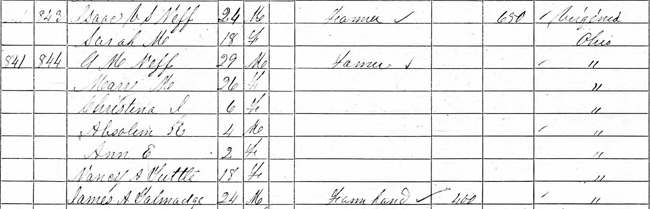
Because I know a lot about the Maddox family, I noticed a very important clue in the 1860 census. The farmhand that was living in Mary's household was related to Mary through the marriage of yet another brother. It could have been coincidence, but it turned out that this clue helped keep me focused on the right family.

Learn about your ancestor's Family, Friends, Associates and Neighbors. Sometimes you can't find your ancestor, but you might find a member of their FAN club to lead you to the poorly written or badly indexed record of your ancestor.


Specific to researchers of the Maddox and Neff families of Pickaway County, Ohio, here's another look at the 1860 census for George M and Mary Maddox Neff.


Notice the farmhand, James A Talmadge. Mary's brother David married Mary Mariah Tammadge, the older sister of James. The spelling of the name varied between Tammadge and Talmadge, depending on the record. Based on the 1850 census, the two were siblings, children of Henry Talmadge.

Tuesday, July 19, 2016

Mary's Husband Served His Country


Continuing with search strategies, let's learn more about Mary. Today's tip is to collect every military record (and every record of any type) you can find on your subject and their immediate family. Each record provides different clues.

I was still looking for what happened to Mary Maddox Neff of Pickaway County, Ohio, after the 1860 census. I'd been looking for Mary for over 10 years, so knew more than names, but not enough. Some of the questions I pondered were:
  • Had I located the right family in the 1860 census? The names George and Mary Neff were not a unique combination.
  • Was she married to the George M Neff who served in Company G, 113th Infantry Regiment, Ohio, during the Civil War?
  • Did her George possibly die during or after the War?
  • If George died, did Mary remarry?
  • Did George or Mary collect a Civil War pension?
My next step was to research George M. Neff, the Civil War soldier.

Military records can be a gold mine of information and should always be collected when available. Pension files are frequently rich in genealogical information. By learning the available records, you'll know what to look for. I wanted to find any Civil War pensions for this couple.

Remember to use Ancestry Categories and Family Search Collections to go straight to military records. Fold 3, which is another Ancestry-owned site, has some military records that are not available elsewhere.

Searching on George M Neff who served from Ohio gives a reasonable number of Civil War records to review, but there were no pension files.


One of the problems with filters is that not every record set is tied to dates and locations. You can miss a record by setting the wrong filter. Experiment with filters to see what is returned with different settings.

In this case, limiting the Military service location to exactly Ohio was the wrong strategy. I had to change that filter to be broad, rather than exact. That basically removed the filter, but would prioritize Ohio records, if the location had been used.


By removing the Ohio limitation, there are 59 pension files of possible interest. These images are only index cards, but they are good clues. Clicking into the pensions, then adding a spouse with the name Mary prioritizes the search results.


The very first result happens to be the Ohio soldier I'm looking for, but the pension was filed from Iowa, an unexpected location. Here are some new clues. Now I know that the soldier George M Neff was indeed married to a woman named Mary. I still have to determine if it is the right Mary. Did my couple move to Iowa?


The card from Ancestry is hard to read. What could I learn at Fold 3? Is the complete pension file available? Remember to use every site you can to collect records. Fold 3 had a different view, but not the complete file.


What do these cards reveal? 

George M Neff applied for a pension from Iowa on May 22, 1890, and he was approved. He died on October 6, 1897. His widow, Mary M Neff applied in October, 1897, for a widow's pension and she was approved. Her death date is not recorded in the index, but would be in her pension file.

The Civil War pension index cards were the breakthrough in my search for Mary.


Monday, July 18, 2016

Correcting Mary's Family


Yesterday my friend Elizabeth shared her tale of search woe in the comments. She found the elusive census record after trying every trick she had. And I found my Mary Maddox Neff after trying a number of tricks, too. Having found those difficult records, we really need to leave breadcrumbs for the next searcher.

Ancestry and some other sites give us the ability to add corrections or additional information for some, but not all, of the information in a record. When we finish our happy dance, we need to take a few minutes to provide that correction. Our children, grandchildren, nieces, nephews and cousins will appreciate the help when they are searching.

Today I'll show you how to view Ancestry corrections and how to make them yourself. I hope you already do that and can just ignore this post.

Let's return to Absalom Neff, born in Ohio, indexed in the 1870 census. Here are the two results.


Notice the pencil after Absolam Loff who is living in Van Buren County, Iowa. That shows that there is a correction or edit to the record that was indexed by Ancestry. Otherwise I'd be wondering how Loff related to Neff. I have to click into View Record (not the image) to see the correction and who made it.


The record was indexed by an Ancestry transcriber as Absolam Loff. Under that name the brackets show the correction (or additional information) is the name Absolam Neff. Click that name to see information about the correction.


I contributed this correction to the name, stating it was a transcription error. I see the trash can only because this is my correction and I can choose to delete it.

Truth be told, the record is nearly impossible to read. Thank goodness for Absalom!


When adding a correction, we can go beyond errors and add some clarifications. I had already added the surname correction, but I could certainly add clarity on the first names. These initials are not at all helpful. Let's fix up his older sister. Still in the text view for Absalom, I clicked on C J Loff, which is one line up.


From this page, I clicked on View/Add alternate info. It brought up a corrections window just like the one for Absalom, above.


I then clicked on the button "ADD YOUR OWN". Now I can add information for Christina.


In this case, I want to add a variation of her name. I use the drop down arrows to see my choices and variation was the best fit. I have to type in the name as it should be. The explanation is optional, but as this is not a transcription error, adding a brief explanation helps the Ancestry reviewer as well as future researchers.

After clicking on "SUBMIT ALTERNATE", one more window comes up because I changed her surname.


I am asked whether to apply the surname change to everyone in the household. You'll want to choose wisely between APPLY and Close when making such a change. When I first submitted the Neff surname last year as a transcription error, I used APPLY, as that specific transcription error does apply to everyone in the household.

In this case, I did not need to repeat the surname change and the information I added is specific to Christina. I clicked on Close.

I can see the corrections that I just made, but no one else can see them until they have been reviewed and accepted by someone at Ancestry. Here's a final look at how Christina's corrections appear.


Today I added a first name for each person in the household, except Absalom. I added brief additional information from the 1880 census and from George's military records to explain the variations for George M, Ann Elizabeth and Laura.

Mary and her family are now all corrected and augmented in the 1870 census index. I'll share more search strategy the next time.

Sunday, July 17, 2016

Mary Had a Little ... Child


Today I have another tip to help speed up searching for online genealogy records.

In yesterday's tip, I was searching for Mary Maddox Neff and used Ancestry Categories and Family Search Collections to focus the search.

Today I've narrowed the Ancestry search by filters, which is a topic for another day. Unfortunately even searching for Mary Neff, born in Ohio, there are over 100 results in the 1870 federal census, according to Ancestry.

I could add a birth year, but this family tended to be sloppy on ages. That's actually a common issue, but I would include it in the filtering to start. It wasn't helping with Mary.


What else do I know about Mary to help narrow the search? The 1860 census of Pickaway County, Ohio, shows her family members.


I know her husband is George M. How many results are there in the 1870 census for George Neff, born in Ohio?


A count of 44 is more workable. But what about the children? Ann is a very common name, but there are two other children.


The tip of the day is to search with the less common names in the family. Just because Mary Maddox Neff is the person I am searching for, I should not limit myself to searching for her name. This strategy works on Family Search as well as Ancestry and on many other sites.

Mary's children's names are the ones to search. Absalom is the obvious choice with two matches. Remember that names were fluid before birth certificates. If I were named Absalom, I would definitely drop that name at some point. He might have already started using another name by the age of 14.

Christina is also a good name to try. Since Christina was 6 in 1860, she would be about 16 in 1870, which is of marriageable age. She might be gone from the household, but it is worth looking at each of the four matches. 

I didn't find the family with this tip, though today you would do so. One of the two matches on Absalom is correct, but only because I submitted a correction after digging up the record.

Saturday, July 16, 2016

All About Mary


Every once in a while someone asks me how I found some information. That question came to me again recently and I wrote a rather lengthy reply to a newbie. My methods are not special, but they are deliberate. Today I share my single biggest secret.

A columnist -- online or paper -- once wrote that Ancestry is a scam. I wouldn't go that far, but it is important to know what they want from you: your data first and your money second. If you depend on their online service to store your family tree, they have achieved the first and are also doing well at keeping their hand in your pocket.

Web sites, not just Ancestry, want you to spend long periods of time on their sites. The longer you stay, the more ads you will see and the more money you will spend. So how do you spend less time at Ancestry and find more of what you are looking for? The strategy I'll show you also works for Family Search.

Where's Mary?


Last year I was searching for a woman named Mary Maddox Neff. I had last found her with her husband and children in the 1860 census in Pickaway County, Ohio. What happened to Mary Neff after 1860? Let's search both Ancestry and Family Search for this fairly common name.

Focus on Ancestry Categories


First let's do a wide-open search on Ancestry.


If you have not changed your default results method, this would be the view you get. 986 thousand results to dig through. I'd be on the Ancestry site the rest of my life looking for that 1870 census. Ka-ching!

Narrow the collection to United States only, since that is where Mary should be.


Now it's only 864 thousand results. I could continue to refine the filters, but there is a very fast way to focus. Choose Categories instead of Records at the top right. That's the trick. It's that simple.


Notice that the matching result count went up to over one million. That's strange, but now I don't care because I am not going to look at those matches. Having selected Categories, now my results will always return as Categories and I don't have to switch it unless I'm feeling masochistic.

Next I have to think about what I need to find. In this case I want the 1870 census. So I would click into the line that says "See all 114,048 results" that is under Census & Voter Lists. The 1870 census will be in that list and I will select that census and start working with filters to find what I want.

The downside to this method is that you have to think about the records you need to search. The upside is you will get to know the record types and be able to get to what you want much more quickly. So in the long run there is no real downside. And Ancestry may not keep you spending money quite so long.

Focus on Family Search Collections


Family Search works in a similar way. First the wide-open search returns 61 thousand results. Even on a free site, that's far too many records to look at.


On Family Search, click on the word Collections at the top of the results to break the results down by
type.


Again, looking for the 1870 census, I need to click on "Show All 101" after the heading that says Census & Lists.

I didn't find Mary Neff in the 1870 census by these methods alone, but that's a tale for another day.

Monday, November 24, 2014

52 Ancestors in 52 Weeks: #45 William W Maddox, The Victim at Mauvaisterre Creek

1869, near Merritt, Illinois


November 24, 1869, 2 PM

A gunshot rang out, echoing across the barren fields of Scott County. William Maddox, 49, was mortally wounded by his son, Lewis. Both men had been drinking.

Murder at Mauvaisterre Creek


How did an ordinary farmer come to kill his father, have his name splashed on newspapers all over the midwestern United States and fuel family legends that persist to this day? Did the jury make the right decision? There are no surviving transcripts of the trial, but we can read the evidence presented to the grand jury.

As each family member is introduced, bear in mind that there is a family history of alcoholism, especially in the 19th century. Our Native American heritage left our ancestors unable to metabolize alcohol. My great-grandmother, niece of Lewis, claimed to have one-eighth Native American blood. That would have made Lewis one-quarter and William, the victim, as much as one-half. There is no proof to date of these claims; however, the oral tradition lives on in several diverse branches of the Maddox family.

Meet the Victim


William W Maddox was born in Ohio, about 1820, to Lazarus Maddox and Elizabeth Greaton (Gratton) of Pickaway County. He was either the first or second son, with an older sister and a total of seven siblings. The family owned and worked small farms of 75 to 90 acres.

William married Nancy Jane Webb on February 21, 1840, in Pickaway County. He worked as a farm laborer, according to the 1850 census. They were the parents of at least seven children: John, David, Lewis, William H, George S, Joseph Allen and Margaret. John and Margaret died young, while David, a soldier, died near the end of the Civil War. Gaps in the birth years indicate a possibility of two other children who would have died young.


Image credits: GZitzmann custom sketch, Scrap Girls template, elements by Mommyish for Digital Scrapper


In about 1853, after the birth of George, the family moved to Scott County, Illinois. The Maddox family moved near the Greaton/Gratton family members of William's mother. They had settled in the area some 20 years before. William had been charged with assault in Pickaway County shortly before the move out of Ohio. Did he move as a way to avoid the consequences?

William bought land adjoining a deep bend of Mauvaisterre Creek. The agricultural supplement to the 1860 census shows that some 75 acres had been improved, with another 85 acres yet to be planted. By the time of his 1869 death, William owned 270 acres, much of it in fields of wheat, oats, rye, corn and barley. He also produced wool. As well as sheep, the family also kept pigs, cows and bees. There were likely chickens, though they are not shown in any record.

William and his sons had been industrious. He had tripled his father's peak of 90 acres and his sons wanted some of the land to start their own family farms. The boys wanted to receive their portion as a birthright, but William agreed only to lease half the tillable land to sons Lewis and William H. Witness statements reveal that Lewis and his father had been arguing about the land on the day of the murder.

After he was shot by Lewis, William needed someone to care for him. His treatment of his family had been abusive, based on the family stories. His assault charge adds weight to that legend. The family faced a problem. If William died, Lewis could be charged. Thus the family had every reason to keep him alive, though wanting him dead.

The hired hand, Samuel Coleman, must have been trusted by everyone, as he tended William throughout the agonizing days of his decline. William W Maddox died on December 1, 1869. His burial place is unknown, though it is likely on or near the family farm.

Be sure to follow the story at another blog, Murder at Mauvaisterre Creek, where the evidence will be explored.

Thursday, October 30, 2014

52 Ancestors in 52 Weeks: #41 Lewis Maddox, The Killer at Mauvaisterre Creek

1874, Winchester, Illinois


In the Scott County Circuit Court, October Term, A.D. 1874
The People of Illinois vs 
Lewis Maddox and Wm Maddox etal
Indict. for Murder

Oct 30th. Jury sworn to try issue, against Lewis Maddox, defendant arraigned and pleads not guilty.

Murder at Mauvaisterre Creek


How did an ordinary farmer come to kill his father, have his name splashed on newspapers all over the midwestern United States and fuel family legends that persist to this day? Did the jury make the right decision? There are no surviving transcripts of the trial, but we can read the evidence presented to the grand jury.

As each family member is introduced, bear in mind that there is a family history of alcoholism, especially in the 19th century. Our Native American heritage left our ancestors unable to metabolize alcohol. My great-grandmother, niece of Lewis, claimed to have one-eighth Native American blood. That would have made Lewis one-quarter and his father, the victim, as much as one-half. There is no proof to date of these claims; however, the oral tradition lives on in several diverse branches of the Maddox family.

Meet the Killer


Lewis (Louis) Maddox was born in Pickaway County, Ohio, in December, 1846, to William Maddox and Nancy Jane Webb. His oldest brother, John, had died as a toddler. The next oldest brother was David and several siblings followed Lewis. This birth order made Lewis a middle child, while the death of John left behind the enduring promise of a perfect child that his living siblings could never achieve.

In about 1853, the family moved to Scott County, Illinois, living on a 270-acre farm adjoining a deep bend of Mauvaisterre Creek. Lewis worked on the farm and attended school, according to the 1860 census.

As a middle child, Lewis likely would have lived and died an obscure farmer, if not for the Civil War. When his older brother David enlisted at age 19, Lewis tagged along. He claimed his age as 18, though in the summer of 1862, he would have been only 15. If his birth was actually in 1845, which is possible, he would have been 16. Nonetheless, he was underage. Did he want the enlistment bounty money, the excitement of war or just to escape the drudgery of the farm?

The muster roll for Company F, 129th Illinois Infantry, shows that Lewis was 5 foot 6 inches, with black eyes, dark hair and a dark complexion. Later documentation shows him as taller, so he had not yet had his final growth spurt. No man is ever prepared for the horrors of war, but a 15-year-old is even less so.

The 129th served first in Kentucky and Tennessee, engaging in skirmishes and protecting the railroad. Lewis was medically discharged on July 22, 1863, having served less than one year. He had chronic diarrhea, likely dysentery, which was the most common disease suffered by troops on both sides of the conflict. He also claimed to have fallen from a railroad trestle onto rocks, injuring himself internally. He was sent to a hospital in Gallatin, Tennessee, where he was observed having convulsions on a daily basis. Did he suffer a concussion? He was discharged from the Army with a certificate of disability.

Lewis returned home to heal, then enlisted in Company B, 133rd Illinois Infantry, for a period of 100 days in 1864. That time was spent guarding prisoners at Rock Island, Illinois. David, staying with the 129th, marched south with General Sherman's Army as it swept through the South, burning Atlanta and making the march to the sea and Savannah, Georgia.

David died during or shortly after the war. With David's death, Lewis moved from a middle child to become the eldest of four brothers. I think that he was uncomfortable with being in the leadership role. He seemed to be a follower, rather than a leader.

Lewis and his next youngest brother, William H. Maddox, together leased land from their father and began farming for themselves. Lewis applied for a marriage license with Melissa Boss on September 14, 1867. There is no indication that this license was used.

Lewis married Ellen Taylor on September 22, 1869, and their brief union was blessed with one son. John Alexander Maddox was born on July 18, 1870. His mother died while he was young.

Lewis and his father argued often about partitioning the farm. Lewis and young William wanted their birthright. William the elder did not agree. Fueled by alcohol, their arguments turned bitter on the day of the shooting.

The rest of Lewis' story will be told after the evidence is presented. Lewis Maddox died in 1915 and is buried in a remote cemetery in Brown County, Illinois, with a military marker.


Quick drop page from Recollection by Joanne Brisebois Designs for Digital Scrapper, 2011

Sunday, October 12, 2014

Using a Timeline to Untangle Your Roots

Sorting out people with the same name is one of the challenges the family historian faces. Aunts and uncles, brothers and sisters, nieces and nephews and cousins, oh, my! Sometimes the sorting is simple and other times complex. The proliferation of bad information on the internet has made the task much more difficult.

To sort out the David Maddoxes in Pickaway County, Ohio, I used a timeline, which is a tool suggested by professional geneaogists. In this exercise, I listed by date each piece of evidence that I had found and a few assumptions.

When building a timeline, an important concept is to ignore the spelling on the records. Most spelling before 1900 was phonetic: the clerk wrote what he heard. Capture all documents that you think may apply. Try to ignore the online noise, except to find clues. Look for more evidence than the census. Only one third of my collected evidence consisted of census records.

The goal was to answer two questions.
  • Who served in the Civil War?
  • Who bought land in 1847?

I started with the 1850 census, which listed three individuals named David Maddux/Maddox. I assigned each one a number, based on birth order:
  • David Maddox/Maddux #1 was the brother of my 3rd great-grandfather. 
  • David Maddox #3 was the brother of my 2nd great-grandfather and the nephew of #1.
  • David Maddox/Maddux #2 is unknown, but likely was a distant cousin of the other two men.

I then assigned a person to each document where it was clear to whom it applied. This document applies to David #2, this one to David #1, etc. At the end, I rearranged and color-coded the list to group the documents by the person they pertained to. It then became easier to assign the unclear documents to the right David. Most of the fuzzy documents don't give an age, so have to be examined in the larger context. I also searched out and found other evidence to add facts and build the proof case.

At the end of the exercise, it was obvious that David #2 and David #3 served in the Civil War, while David #1 did not. David #1 is the only one of the three who was old enough to have purchased land in 1847. I also checked the 1840 census to see if there was an earlier David, but there was not a good candidate.

Here's the latest timeline for the three men.

# Date Recorded Name Location [OH assumed] Record Age Event
1 08 Oct 1847 David O P Maddox Monroe Twp, Pickaway Deed DV22-393 [21] 38.5 acres purchased from Lazarus Maddox
1 20 Sep 1850 David Maddox Monroe Twp, Pickaway 1850 Census 24 Owned land $500, with Elizabeth age 52 land $900
1 31 Jan 1852 David Madox Monroe Twp, Pickaway Deed DV27-435 Sold 1/8 part of land of Lazarus Maddox [deceased] to Joseph Madox
1 23 Jun 1853 David Maddox Pickaway County Marriage [27] Maria Tammadge [Talmadge], bride
1 02 Jun 1853 David P Madox Monroe Twp, Pickaway Deed DV28-126 Joseph W Madox sold to David P Madox - 5/8 of Lazarus' land
1 25 Feb 1854 David P Maddox Monroe Twp, Pickaway Deed DV29-004 With wife Mary Maria, sold 5/8 of Lazarus' land to John A Maddox
1 est 1855 D P Maddox Pickaway County School roll Parent of Jas Talmage
1 09 Apr 1856 D P Maddox Pickaway County Deed DV31-472 With wife, final land sale in Pickaway (bought from Bolin, sold to Kendrick)
1 25 Aug 1860 David P Madux Pleasant Twp, Madison 1860 Census 24 Wife Mary M age 27, land 890, Rebecca J 6, John W 4, Orpha 1
1 02 Jan 1862 D P Maddux Pickaway County Tombstone, wife of D P Mary M Maddox death, buried Yankeetown Cemetery
1 04 Dec 1862 David Maddux Madison County Marriage [36] Mary [Watson] Moler, bride
1 01 Jul 1863 David Maddix Fairfield Twp, Madison Civil War Draft 35 Class II registration
1 18 Jul 1870 David Maddux Fairfield Twp, Madison 1870 Census 43 Wife Mary 32, Rebecca 16, John 14, Arthur  (Orpha) 11, Daniel Moler 10
1 25 Sep 1872 Madison County Marriage Rebecca J Maddux marriage to Albert A Gray
1 6 Jul 1880 David Maddux Fairfield Twp, Madison 1880 Census 54 Wife Mary 52, no children
1 2 Jun 1900 David Maddux Fairfield Twp, Madison 1900 Census 73 Birth Sep 1826, widower, boarding with William Knowles age 84
1 31 Jul 1907 David Perry Maddux Columbus, Franklin Death Certificate 80 Birth 30 Sep 1826, son of Lazarus and Elizabeth, informant Rebecca Gray
2 31 Oct 1850 David Matux Perry Twp, Pickaway 1850 Census 13 With [Asa] Collins 40 and Mary 37, William 11
2 28 Nov 1858 David Maddux Pickaway County Marriage [21] [Mary] Elizabeth Timmons, bride
2 12 July 1860 David Maddox Monroe Twp, Pickaway 1860 Census 22 Wife Mary E age 21, no land, no children
2 10 Oct 1862 David Maddux Camp Chase, Columbus Civil War Enlistment 25 Enlisted in Company G of 113 Ohio Volunteer Infantry
2 18 May 1865 David Maddux Civil War Discharge Discharged early from unit
2 David Maddux Date and place of death would be in pension files
2 17 Nov 1866 David Maddox Civil War Pension Widow Mary E Maddox files on David Maddox, 113 OVI Co G
2 23 Jun 1870 Monroe Twp, Pickaway 1870 Census Elizabeth Maddux (servant) 30, Mary 9, living with George Timmons 63
2 10 Nov 1872 Pickaway County Marriage Mary Elizabeth Timmons Maddux wed to Robert Spencer Leach
2 9 Jun 1873 David Maddox Pickaway County Guardianship Robert S Leach guardianship of Mary E Maddux, age 12
2 30 Jun 1873 David Maddox Civil War Pension Minor child by guardian Robert S Leach on David Maddox, 113 OVI Co G
2 14 Jun 1880 Monroe Twp, Pickaway 1880 Census Mary E Leach 40, spouse R.S. 34, Mary Maddux 19
2 4 Nov 1880 Pickaway County Marriage Mary Elizabeth Maddux marriage to William J Porter
2 01 Jun 1890 David Maddux, dec'd Monroe Twp, Pickaway 1890 Veteran Census Mary E Leach, widow of David Maddux
2 27 Jun 1900 Monroe Twp, Pickaway 1900 Census Mary E Leach 62, spouse R.S. 54, grandson CW Porter b. Dec 1882
3 20 Sep 1850 David Maddox Monroe Twp, Pickaway 1850 Census 7 With William 27 and Nancy 26, Lewis age 4, Willliam infant
3 15 Aug 1860 David Mattock Scott County, IL 1860 Census 16 With William 41 and Nancy 39, Lewis 15, Wm 11, George 8, Joseph A 4
3 13 Aug 1862 David Maddox Exeter, Scott County, IL Civil War Enlistment 19 Enlisted in 129 Illinois Infantry, Co F, Nativity Pickaway, Ohio
3 15 May 1864 David Maddox Resaca, Georgia Service File Wounded in side
3 20 Nov 1864 David Maddox Madison, Georgia Service File Taken prisoner and paroled, never discharged, no further records