Showing posts with label Vossler. Show all posts

Saturday, October 25, 2014

52 Ancestors in 52 Weeks: #40 Elizabeth Childers Wilson Vossler


Elizabeth M. Childers was the fourth of ten children born in the area of Blount County, Alabama, to Kezziah D. Fry and James Childers, a farmer and sometime Justice of the Peace.


Template and components from Comfort Zone, ClubScrap

Born about 1834, Elizabeth married the farmer John N. Wilson on December 13, 1853. He was the father of 7 children and had 5 more with Elizabeth. The Wilsons relocated to Searcy County, Arkansas, about 1858. 

When the rumblings of war began in 1860, John Wilson joined an Arkansas Peace Society, also known as the Yellow Rag Boys. Along with others, he refused to enlist in the Confederate forces, but was forced to serve on pain of death. After making his way home partway through the war, he was bushwacked, likely by Confederate sympathizers. His teenage son escaped the attack and watched as his father was hanged.

The Wilson boy ran from Arkansas, joined another traveler and ended up in Illinois. Seeing a place of peace and plenty, he returned to Arkansas for his family. Elizabeth Wilson sold the farm for Confederate dollars and took her young sons to Illinois. The Wilson family legends are silent on the the intervening time before her marriage to George Vossler. How did she survive with small children and worthless money? Did she regret selling the farm?

George Vossler and Elizabeth Childers married in Macon County, Illinois, on October 30, 1866, and are last found in the 1870 census. Wilson legend says they went to Missouri and disappeared. The youngest Wilson boys were placed into the guardianship of their elder siblings in Searcy County in January of 1875. The two Vossler children next turn up in the Chicago city directories in the early 1890s.

Elizabeth's story is still unfinished. I want to know where she went and what happened to her. I am waiting for the day the right records come online. Then I can close the chapter for myself and all our collateral relatives.

The Childers family photo is an image of a daguerreotype scanned from
"Just a Branch" of the Cox, Yarborough and Childress Families.
Author Nelda Cox Eastman (deceased), Grand Prairie, Texas.
Courtesy of Suzy Burt, an editor of Blackburn and Fry family association newsletter.
 

Tuesday, July 29, 2014

52 Ancestors in 52 Weeks: #30 Walter McFarlane, A Reluctant Farmer


The challenge of life on a farm in 1885 is hard enough for me to grasp, but to my grandchildren it would seem like the dark ages. Imagine no cell phone, no computer, no electricity, no gas and no running water. The nearest phone was likely miles away. The outhouse might have an old mail order catalog, not soft toilet paper. Water would be carried from the nearest source and wood chopped for heating and cooking. There were no big red tractors, no big green harvesters, no cars or pickups. Candles and lanterns were the source of indoor lighting.

The more family members could share the work, the better. Fields needed to be plowed, sown and harvested. Crops had to be taken to market. A garden provided food and some of the yield would need to be canned for use throughout the year. Animals had to be fed, watered and cared for. Some had to be slaughtered for food. Fences, wagons and tools required repair. Meals had to be prepared and dishes washed. Laundry, sewing and cleaning were constant tasks.

Just thinking about the amount of work is overwhelming. My great-grandfather, Walter McFarlane, must certainly have been overwhelmed when he inherited the Wisconsin family farm at the tender age of 21. Within the past three years the rest of his family had died: first his older brother, then his father, Joseph, and finally his mother. Unfortunately, Walter despised farming, according to family legend. But was it the work he hated or was it the solitude?

Suddenly he was all alone and grieving his family. He would have been exhausted trying to do everything that needed to be done. Did he hire a field hand or household help? Could he even have afforded to do so? Did he have time to go courting and find a wife? If so, he was not successful.

Walter's mother, Margareth Mitchell McFarlane died in October of 1885. In February of 1888, Walter sold the Monroe County farm. He had farmed on his own for less than 30 months when he threw in the towel.

Walter was born on July 20, 1864, so was not yet 24 when he walked away from the farm to make a new life. The next few years are a mystery to me. By 1896, Walter was living in Chicago and working as a motorman on the city's streetcars.  How did a Wisconsin farmer become a Chicago motorman? That seems like quite a change.

On April 07, 1897, he married Mary Ellen Vossler in a ceremony performed by the pastor of a Presbyterian Church. Mary Ellen's brother, John Vossler, worked with Walter on the streetcars and roomed in the same boarding house as Walter. It's possible that Mary Ellen also lived there. The couple certainly met through John or their living situation.


Quick drop page from Full Circle, ClubScrap

Walter and Mary Ellen had two daughters: Ruth in 1898 and Margaret in 1900. Their comfortable life came to an end between 1904 and 1905. Walter was injured at work and was left brain-damaged. After healing, he was able to do only menial work. He briefly returned to farming in Bartlett, Illinois. He also worked in a factory and was a night watchman at the historic Rosehill Cemetery in Chicago.

Walter McFarlane died in Chicago on August 21, 1922, and was buried in an unmarked grave at Rosehill Cemetery.

Tuesday, May 6, 2014

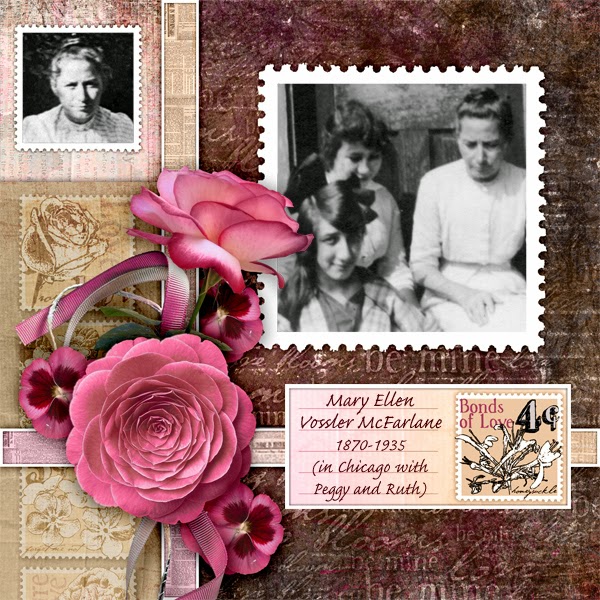
52 Ancestors in 52 Weeks: #18 Mary Ellen Vossler McFarlane

My great-grandmother has left me with three big questions:
  1. What was her nickname?
  2. Where was she raised?
  3. By whom was she raised?

Quick drop page from Love Blooms, ClubScrap

Mary Ellen Vossler was born March 22, 1870, near Decatur, Illinois. She had one older brother, John, and five older half-brothers. Little is known about her father, George Vosseler. He was an immigrant from the German principality of Wuerttemberg.

Mary's mother was Elizabeth Childers, who was born about 1833, in Bristow Cove, Alabama, and was the widow of John Wilson. By 1875, Elizabeth and George were dead or missing. McFarlane family legend reports that Mary was then raised by a childless aunt and uncle in far southern Illinois.

Mary Ellen married Walter McFarlane on April 7, 1897, in Chicago. They had two daughters: Ruth Dorothy McFarlane and Margaret Elizabeth "Peggy" McFarlane. Mary lived as a typical Chicago housewife. As she grew older, she was crippled by rheumatoid arthritis. She was remembered as being loving and kind with her grandchildren during the years she cared for them. She died on October 23, 1935, in Chicago, and is buried in an unmarked grave in Ridgewood Cemetery in Des Plaines.

Family legend reports that Mary's nickname was "Molly". However it is more likely to be "Polly", a common nickname for Mary. If she was raised by German relatives, might she instead have been called Marie? She is nowhere to be found in the 1880 census under any of these names. I've searched for many years and never found her. If that elusive census record comes to light, it should solve all three questions and put the mystery of Mary Ellen to rest.

Tuesday, January 21, 2014

52 Ancestors in 52 Weeks: #3 George Vossler

Amy Johnson Crow is doing a wonderful service to the genealogy and blogging communities by compiling a weekly list of the many 52 Ancestor blog postings. Amy reports that connections have already been made between readers and it's barely week three.

When faced with a brick wall ancestor, making a connection may break down that wall. So I'm going to share some of my brick walls this year. I'll start with one that is familiar to my steady readers.

If you're as tired of George as I am, pop over to Amy's blog and see if you can find a connection of your own. Or check out this heritage scrapbook page showcasing only records -- no photos.


Quick page from Count the Ways, Joanne Brisebois for Scrapper's Guide (now Digital Scrapper), Feb, 2012

A handful of records are the only evidence that my great-great-grandfather ever existed. George Vossler or Vosseler or Vosseller is one of those ancestors who suddenly appears full-grown and then suddenly disappears. I have only the following records for George :
  • 1862 Marriage to Elizabeth Breitwacher/Breitweiser/Breitsprecher, Macon County, Illinois
  • 1864 Naturalization, Macon County, Illinois
  • 1866 Marriage to Elizabeth M Childers Wilson, Macon County, Illinois
  • 1870 Census, Decatur Township, Macon County, Illinois
  • 1875 Newspaper articles, Decatur, Macon County, Illinois

In the 1870 census, George Fassler is listed as 60 years old, born in Wuerttemberg. His two young children are John, age 2, and Mary, 4 months. The 1875 articles about the children finding gold refer to George as an old German tenant farmer with poor English skills.

His stepsons, the children of Elizabeth Childers Wilson, passed down a family legend that George and Elizabeth went to Missouri and disappeared. The Wilson boys went to relatives in Arkansas in January, 1875. John and Mary Ellen supposedly were taken in by family in southern Illinois, but I can't find them in the census of 1880.

If this sounds like your family members, please leave a comment or send me an email! Also, please check the tag cloud for other posts on this family.

When I visited Macon County, I was unable to accomplish the tasks I had planned. Next steps are to contact the genealogical society and arrange for some research hours. Record sets to look at include naturalization, school records, guardianship and probate.

Monday, May 20, 2013

Mappy Monday -- Location Counts

When researching an ancestor, knowing where they lived can be important to identifying both them and other family members. Maps are a wonderful tool for location, when they can be found. I had a find in a series of 1875 newspaper articles, but needed to use a map to see if my ancestor was the man identified.

Was George Fostler, an old German tenant farmer who found gold, my ancestor, George Vossler? Combing through three newspaper articles, here are the clues:

  • Published July, 1875
  • Old German tenant on farm
  • 3.5 miles west of Decatur, IL
  • Has boys
  • Lives on the Springfield Road
    • Lives on 88 acres purchased by Kepler from Martin Forstmyer
    • Limited ability to speak English
    •  Mention of John Hostetler


    Where did George Vossler live during the 1870 census, five years previously? We see that George Fossler is living next door to John Hostetler, both in Decatur Township, Macon County, Illinois. He has several young boys in his household and he was born in Wuerttemberg. Already, without a map, it seems like the same man. Having all these clues, I needed a map, which fortunately I already had collected. The newspaper told me where to look, something I had never known before.


    This Decatur Township map is from 1874, about four years after the census and one year before the newspaper article. This map was available on microfilm from the LDS Family History Centers and recently showed up on an old map website, also.


    The regular layout of square miles in Illinois makes it easy to see that 3 and a half miles west of downtown (the black area) is near the west edge of Decatur Township. Working with the full-sized map, I looked along the road to Springfield and was easily able to find M. Forstmeyer, with 87 acres next to J. Hostetler. Israel Gring was above Hostetler on the 1870 census and the map shows some of his property on the other side of Hostetler.


    All clues taken together led me to the conclusion that George Vossler had indeed been misspelled as Fostler, similar to the misspelling on the 1870 census. The map validated that my assumption was correct.

    These old landowner maps are a wonderful resource. Be sure to look for them as you research farmers and landowners in your family.

    Wednesday, March 20, 2013

    Wedding Wednesday -- Looking for Elizabeth

    I'd like to learn more about one of the mysterious women named Elizabeth in my family tree. She married my great-great-grandfather four years before he married my great-great-grandmother.

    The Illinois marriage index tells us:
    • Elizabeth BREISWATER married on March 30, 1862 in Macon County, Illinois, to George VOSSLAR

    The Macon marriage register appears a bit different:
    • Elizabeth BREITWACHER married on March 30, 1862 in Macon County, Illinois, to George VOSSALER

    I believe the correct version is:
    • Elizabeth BREITWIESER married on March 30, 1862 in Macon County, Illinois, to George VOSSLER

    Was Elizabeth married before? Was this her maiden name or a married name? Did she have children in this marriage or a previous one? Do I have some cousins descended from this Elizabeth? I'd love to hear from someone who knows.

    Monday, February 6, 2012

    52 Weeks of Abundant Genealogy, Week 5, Life Experiences

    The idea of blogging about my genealogy, as well as sharing layouts, grabbed hold of me while watching the live feed from RootsTech 2012. I really need a great source of prompts to give me direction -- otherwise I'd be wandering randomly. I missed the first four weeks and am overdue for week 5, but better late than never. The prompts are coming from Amy Coffin at WeTree and are published at Geneabloggers.

    Week 5 prompt is:
    • Sometimes the challenges in life provide the best learning experiences. Can you find an example of this in your own family tree? Which brick wall ancestor are you most thankful for, and how did that person shape your family history experience?
    There is one ancestor whose life experiences must have been overwhelming, yet she persevered. She's no longer a brick wall, but I have not finished finding her story. She is the Elizabeth whose name I proudly bear.

    Elizabeth Childers Wilson Vossler 
    The Value of Collateral

    Club Scrap Generations digital kit
    Looking for Elizabeth

    To find Elizabeth, I had to collaborate with many members of my extended family. To push back each generation required me to look sideways for assistance, using contemporary collateral lines. I could not have found her by myself or by pushing straight back. Nor would I have any of these photos without the help of others.

    The story begins with my paternal grandmother, Ruth Dorothy McFarlane and her sister Margaret Elizabeth McFarlane. My grandparents died very young, leaving my father and his siblings orphaned. Aunt Peggy stepped in to provide as much guidance as she could, though the children went to boarding school. The gaps in family knowledge are vast, compared to the rich storehouse that came from my mother's family.

    I toyed around with genealogy for several years before getting serious about finding my roots. When my maternal grandfather died, it struck me how much history was being lost from his generation. I immediately delved into his widow's family, as I knew my time with her would be limited.

    Dad was jealous, so I worked a bit on his ancestry as well. My father and uncle weren't even sure of their grandmother's name, so my first stop for this line was the census. This was an early mistake. I needed to talk to other relatives, but did not. After all, they all knew the same facts, right?

    One day in 1999, my father asked what I had learned about his grandmother. I was stuck. I knew her name was Mary E. and that in each census from 1900 to 1920, she knew that she was born in Illinois and her father in Germany, but her mother's birthplace was USA.  There were several candidates in the Illinois death index, but I didn't know which one to start with. 

    Dad walked away and thought about it for a while. He then asked if I had talked to my Uncle C. Embarrassed, I admitted to omitting that step. I failed to consider that the children had spent time with different relatives over the years and that indeed they each would have different pieces of family history. Today I understand that even close siblings may have absorbed their experiences differently.

    Dad explained that while the rest of the family had been overseas with their father at his death, Uncle C had been in Chicago with his paternal grandmother. To her fell the task of telling little C that his father and maternal grandmother had died within a day of each other. Sure enough, there was the name in the death index: McFarlane Mary Ellen 1935-10-23 Chicago.

    If I had talked to Uncle C, I would have saved a year of fumbling. 

    I sent off to the Illinois archive for the death certificate, but when it arrived, my hopes were crushed. Her father's name was given as George Vossler of Germany. Her mother's information was all marked unknown. Her birthplace read only Illinois. Now what? 

    Mary Ellen Vossler was born in March, 1870. Maybe she would be in the 1880 census soundex of children under 10, and she should certainly appear in the 1870 census with her parents. Several more months passed. On each trip to the Family History Center in Mesa, AZ, I would spend some time with the census indexes. I tried every spelling variation I could think of. I asked a German friend how she might pronounce Vossler and she suggested Fusler. Still I could not find George Vossler in the indexes.

    Among the available records at the FHC, I found two marriages in Decatur, IL, for George Vossler. Was I looking at my ancestor? I was stuck again until Easter of 2000. Uncle C was hosting two other uncles and his wife invited me to dinner. You bet I went!

    Uncle David had a clue for me.

    While discussing the puzzle, my Uncle David gave me another piece of the puzzle. Mary Ellen had also been orphaned at a young age. She went by the nickname Mollie and she claimed to have been raised by a childless aunt and uncle in far southern Illinois. Aunt K knew where Mollie's grave was and that it was unmarked. I then broadened my search to all Vossler families in southern Illinois. The wall held.

    There was one more person who had information. In 1969, my younger brother, a mere child, had interviewed our older relatives in the Chicago area. He had drawn out a family tree, but it was in storage while he was overseas. He promised to retrieve it when he came home to Arizona later in the year. The wait felt interminable, but it was worth it. There on his tree was something no one else remembered.

    Mary Ellen Vossler McFarlane had an older brother named John Vossler.

    His death certificate again showed mother's information unknown, but his birthplace said Decatur, IL. The informant had been his sister, Mary McFarlane. Hallelujah! I researched every Macon County record I could find, but other than two marriage records, there was silence.

    Computerized indexes were the key.

    While at the FGS 2000 conference in Salt Lake City, I bought a wonderful CD that provided a searchable Illinois 1870 census index. I filtered and sorted and combed through it and finally found the family. George FASSLER from Wurttemberg with wife Elizabeth from Alabama, and children John and Mary. But who were these other children? Three boys named Wilson were in the household: Sylvester (14) born in Alabama, and Henry (10) and George (8), both born in Arkansas. Next door was Joel Wilson (12), also born in Alabama.


    Elizabeth Vossler was married before.

    Oh, my! How would I find a Wilson needle in an Arkansas haystack in 1860? Or would they have been in Alabama? I knew that Sylvester Wilson would be the only unique name that would lead me to the right family. I did some methodical searching of the census index and microfilm and found the John Wilson family in Searcy County, AR. There were even more Wilson children, older than Sylvester. I added them to my files. Armed with the childrens' names, I headed for the various forums then available. 

    Linda Cates posted about Sylvester Wilson.

    Linda was a descendant of an older Wilson son, and was looking for missing information on the family, leaning on the name of Sylvester Wilson, also known as Vess. We both were leveraging this common collateral line with an unusual name. Had she not left this information readily available, would I have broken through?

    From her postings, I was able to find the records showing that Elizabeth Childers had married widower John Wilson in Blount County, AL. Linda and I met in 2001, and shared our research. I was able to connect with other Childers descendants. I also connected with Suzy Burt, a researcher who was involved with a family association that published a book on another collateral line, Our Blackburn Branch.

    Without my collateral relatives, and those of my ancestors, I would have been stuck far longer than the couple of years this quest required. Coming early in my research, I truly learned to appreciate the value of collateral.

    Elizabeth's Story
    Courage in Adversity

    Elizabeth Childers was born about 1834 in Blount County, Alabama. She married John N Wilson on December 10, 1853. He was the father of 7 children and had 5 more with Elizabeth. 

    When the rumblings of war began in 1860, John joined an Arkansas Peace Society, also known as the Yellow Rag Boys. Along with others, he refused to enlist in the Confederate forces, but was forced to serve on pain of death. After making his way home partway through the war, he was bushwacked, likely by Confederate sympathizers. His teenage son escaped the attack and watched as his father was hanged.

    The Wilson boy ran from Arkansas, joined another traveler and ended up in Illinois. Seeing a place of peace and plenty, he returned to Arkansas for his family. Elizabeth Wilson sold the farm for Confederate dollars and took her young sons to Illinois. The Wilson family legends are silent on the the intervening time before her marriage to George Vossler. How did she survive with small children and worthless money? Did she regret selling the farm, her only collateral?

    George Vossler and Elizabeth Childers married in Macon County, IL, on October 30, 1866, and are last seen in the 1870 census. Wilson legend says they went to Missouri and disappeared. The youngest Wilson boys were placed into the guardianship of their elder siblings in Searcy County in January of 1875. The two Vossler children next turn up in the Chicago city directories in the early 1890s. 

    Elizabeth's story is still unfinished. I want to know where she went and what happened to her. I am waiting for the day the right records come online. Then I can close the chapter for myself and all our collateral relatives.

    Where Did the Photos Come From?

    Uncle C and his wife have a number of family photos in their keeping. I took my portable scanner to their home one day and Aunt K took the photos out of frames and out of albums and allowed me to scan them. The two photos at the bottom of the layout are from their collection.

    The photo at the top left is scanned from the book, Our Blackburn Branch.

    The photo at the top right is an image of an early daguerreotype. The image was placed in a booklet about the Cox family that was in the keeping of Suzy Burt. Since the lines were not hers, Suzy sent the booklet to me. After scanning the relevant parts of the booklet, I passed it along to a Childers-Cox descendant. 

    Only through collateral lines was I able to acquire these scans.