Showing posts with label Gedmatch. Show all posts
Showing posts with label Gedmatch. Show all posts
Thursday, July 18, 2019
DNA and The Butterfly Effect
Would law enforcement be able to use genetic databases like GedMatch to solve crimes if Ancestry had provided a chromosome browser to their customers?
The CEO of Ancestry this week cautioned that consumers need to be careful about the companies with whom we share our DNA. She pointed out that Ancestry has the highest standards around privacy and does not cooperate with law enforcement.
I almost fell off my chair laughing. In another post I'll explain how Ancestry reduced privacy options recently in a way that has me highly concerned and caused me to unlink several DNA tests from my tree.
The CEO's statement made me think also about cause and effect.
If Ancestry had provided a chromosome browser, they would have been able to serve their customers who want hard science in addition to warm fuzzy feelings. We would not have needed to turn to GedMatch and other companies for this service.
Additionally, if Ancestry had accepted DNA uploads from other companies, they could have provided cross-company matching and captured a larger share of the market. Instead they ceded this market to GedMatch and now to other companies.
I did a (non-scientific) check of my top 3000 matches on GedMatch. A full 50 percent of my matches were from Ancestry. And my family and I have better privacy on GedMatch than on Ancestry, which is a story for another day.
My opinion is that Ancestry's choices have been an important cause of the growth of GedMatch. I'm personally on the fence about law enforcement using genetic databases. However, I also think Ancestry needs to own its part in the situation, rather than denigrate companies that fill gaps in Ancestry's DNA offering.
So I ponder if the Golden State Killer was caught thanks to a long-ago decision made by Ancestry. Was it cause and effect?

Sunday, July 14, 2019
The Case of the Missing DNA
A recent inquiry from a DNA match sent me into the mysteries of AncestryDNA matching. I was appalled at what I learned.
In the field of data science, we use the term "single source of truth." You would expect that DNA matching would be consistent across all the different testing companies, so any and all of them would be a valid source of truth. Not so. If you skip the story, please take a moment to look below at the explanatory graphic.
It started with a routine email from a gentleman I'll call Lou. He found our match on Family Tree DNA and asked if it was possible we were related through a particular surname. He closed by telling me he was of African-American descent.
Knowing the challenges faced by African-Americans who are researching their roots, I gave the email far more attention than I would have if it had been from a Caucasian match.
Lou and I had no shared matches on FTDNA, so I turned to Ancestry, where I have identified many cousins from that branch of my family. But there was a problem. Our match on Ancestry was only 8 cM (1 segment), where on FTDNA it was 27 cM (3 segments). How is that even possible?
Our FTDNA match includes a couple of short segments. Eliminating them leaves our FTDNA match at 19.9 cM (1 segment), still more than double what AncestryDNA showed. We exchanged some emails to discuss the source of the data.
- Lou had uploaded his AncestryDNA results to FTDNA, MyHeritage and GedMatch.
- Lou had tested with 23AndMe and uploaded that result to GedMatch.
- I had directly tested with FTDNA and MyHeritage, in addition to AncestryDNA.
- I had uploaded my AncestryDNA result to GedMatch.
All match combinations except AncestryDNA are in the range 17.8-19.9 cM, with one segment in the same approximate range in chromosome 12. Of course we can't see what AncestryDNA is suggesting.
 |
| Choose Your Source of Truth |
My brother's match to Lou is also in a similar range to these numbers. At Ancestry DNA, Lou's brothers and daughter have a stronger match to me than Lou does. However, none of them have uploaded to GedMatch, so we can't see the science behind the numbers. This particular chromosome range does appear to fall in or near an ISOGG-documented slight pile-up area.
So this leaves the possibility that AncestryDNA has chosen to ignore some of the match due to pile-up. Wouldn't it be nice to be told that?
Does Ancestry have a computational error on my match with Lou, since Lou's daughter matches me more strongly than Lou matches me? Or does she match me in an entirely different way via her mother's lines?
What is the best source of truth? If you are using only AncestryDNA for your DNA matching, you are not seeing the whole truth. GedMatch is free. FTDNA is inexpensive. MyHeritage has some great tools. You can choose your source of truth.
Monday, January 18, 2016
Why Should I Use GEDMatch for My DNA?
Addie is an adoptee, looking for her birth parents. She tested her autosomal DNA with 23AndMe. Addie has a good match with some people who tested at FamilyTreeDNA and with some who tested at AncestryDNA. But there's a huge problem: how does she find those matches? Each company shows only matches from within their own customer base.
GEDMatch is the answer.
GEDMatch expands the playing field for all autosomal DNA testers and it provides the chromosome browser and triangulation tools that are missing from AncestryDNA. Fortunately for Addie, a number of her matches had uploaded their DNA results to GEDMatch.
My father, who tested at FTDNA, is second on Addie's match list at GEDMatch, while my brother, who tested at AncestryDNA, is first. Our first cousin is 13th, while my half-uncle and I don't match at all. Of course, there are many others on her match list. Several researchers now have a multi-way conversation going on to try and help with her search.
Along with the larger conversation, I have a one-on-one conversation going on with one man. We think that there is a relationship not only between his aunt Ethel and my dad, but also between my mom and Ethel. That is because my brother matches Ethel in other chromosome locations than my dad matches Ethel. If we were working only at AncestryDNA, we would never have known about that subtle nuance.
Jim Bartlett recently shared on his blog ten reasons to upload to GEDMatch (or FTDNA). Note that GEDMatch is entirely free, while FTDNA is not. In the comments on that blog post Jim explains just a bit about how to download and upload DNA results. Instructions are also available at GEDMatch once you register for an account.
The team at GEDMatch has made some changes since I last wrote about this fabulous website. The match list still shows the kit number, the Y-DNA haplogroup and MtDNA haplogroup and the matching segment totals, including matches on the X chromosome. The display of the email addresses and names of testers has been improved. One of the features that I most appreciate is the concise listing of matches. Both AncestryDNA and FTDNA require a lot of scrolling.
This is the top of my match list. My dad and daughter are 1 generation away from me, while my brother is 1.3 and other family members are 1.5 to 2 generations away. Beyond immediate family, the number of generations rapidly rises to 4 and beyond.
The first letter of the kit shows if the test was done at Ancestry (A), FTDNA (F) or 23AndMe (M).

17th on my match list is my third cousin once removed. When I click on the "A" in the Autosomal column, I can run the one-to-one chromosome comparison, with or without a graphical representation. I like to include the graphs, rather than numbers alone, because I can better visualize the match. Clicking on the X for an X-chromosome match works in a similar way.
I see that we have matching DNA on chromosomes 2, 4 and 18.

At the end of the compare are some statistics about the match.
Largest segment = 20.4 cM
Total of segments > 7 cM = 41.8 cM
Estimated number of generations to MRCA = 4.2
I can use this information as part of mapping my chromosomes to ancestors. These segments probably came from our shared Mooney/Alexander ancestors. We still need to verify them against other Mooney and Alexander descendants.
I've also shared about the ethnicity models at GEDMatch and how I can run my family's DNA through different ethnicity models, depending on their known ethnicity. The result is a pie chart with a legend.

GEDMatch does all this for free. I choose to donate to help support the site, so I do have access to some other tools. Fellow DNA testers -- readers and cousins -- come along for the ride and enjoy the new discoveries that await you at GEDMatch.
GEDMatch is the answer.
GEDMatch expands the playing field for all autosomal DNA testers and it provides the chromosome browser and triangulation tools that are missing from AncestryDNA. Fortunately for Addie, a number of her matches had uploaded their DNA results to GEDMatch.
My father, who tested at FTDNA, is second on Addie's match list at GEDMatch, while my brother, who tested at AncestryDNA, is first. Our first cousin is 13th, while my half-uncle and I don't match at all. Of course, there are many others on her match list. Several researchers now have a multi-way conversation going on to try and help with her search.
Along with the larger conversation, I have a one-on-one conversation going on with one man. We think that there is a relationship not only between his aunt Ethel and my dad, but also between my mom and Ethel. That is because my brother matches Ethel in other chromosome locations than my dad matches Ethel. If we were working only at AncestryDNA, we would never have known about that subtle nuance.
Jim Bartlett recently shared on his blog ten reasons to upload to GEDMatch (or FTDNA). Note that GEDMatch is entirely free, while FTDNA is not. In the comments on that blog post Jim explains just a bit about how to download and upload DNA results. Instructions are also available at GEDMatch once you register for an account.
The team at GEDMatch has made some changes since I last wrote about this fabulous website. The match list still shows the kit number, the Y-DNA haplogroup and MtDNA haplogroup and the matching segment totals, including matches on the X chromosome. The display of the email addresses and names of testers has been improved. One of the features that I most appreciate is the concise listing of matches. Both AncestryDNA and FTDNA require a lot of scrolling.
This is the top of my match list. My dad and daughter are 1 generation away from me, while my brother is 1.3 and other family members are 1.5 to 2 generations away. Beyond immediate family, the number of generations rapidly rises to 4 and beyond.
The first letter of the kit shows if the test was done at Ancestry (A), FTDNA (F) or 23AndMe (M).

17th on my match list is my third cousin once removed. When I click on the "A" in the Autosomal column, I can run the one-to-one chromosome comparison, with or without a graphical representation. I like to include the graphs, rather than numbers alone, because I can better visualize the match. Clicking on the X for an X-chromosome match works in a similar way.
I see that we have matching DNA on chromosomes 2, 4 and 18.

At the end of the compare are some statistics about the match.
Largest segment = 20.4 cM
Total of segments > 7 cM = 41.8 cM
Estimated number of generations to MRCA = 4.2
I can use this information as part of mapping my chromosomes to ancestors. These segments probably came from our shared Mooney/Alexander ancestors. We still need to verify them against other Mooney and Alexander descendants.
I've also shared about the ethnicity models at GEDMatch and how I can run my family's DNA through different ethnicity models, depending on their known ethnicity. The result is a pie chart with a legend.

GEDMatch does all this for free. I choose to donate to help support the site, so I do have access to some other tools. Fellow DNA testers -- readers and cousins -- come along for the ride and enjoy the new discoveries that await you at GEDMatch.
Wednesday, August 26, 2015
Fun with Ethnicity via DNA Results
A co-worker and I somehow wandered onto the topic of using DNA tests to learn about ethnicity. I've been surprised by the comparison of my own family's DNA results and had even planned to share these charts so that each family member could see at a glance how similar or different their profile is to the others of their generation.
Using the fabulous and free GedMatch website, I have access to DNA results from both Ancestry and FTDNA. As of this month, we now have access to results for ten immediate family members and four more distant, known cousins.
Take a look at this trio. Two are siblings and one is a first cousin. Each profile is different, which truly shows the randomness of inheritance from grandparents. Which two do you think are the siblings?

If you said one and two are the siblings, you are correct.
The above pie charts use one of the GedMatch Eurogenes models, which focus primarily on European ancestry. GedMatch offers a selection of ethnic models, which is handy when ethnicity is more diverse, as in the next set.
Here are four siblings, using an MDLP model. Siblings one and two are full siblings and they are half-siblings to three and four, who are full siblings. There are two sets of two, if that makes sense.
You can see that no two of these siblings have exactly the same ethnic profile. One and three have that yellow area. Three and four have a light blue area. Number one has a tiny slice of dark green, which four has in a larger proportion.

While we're looking at half-siblings, here is one more set, using the same Eurogenes model as the first three. One of these is a parent to siblings one and two at the top.
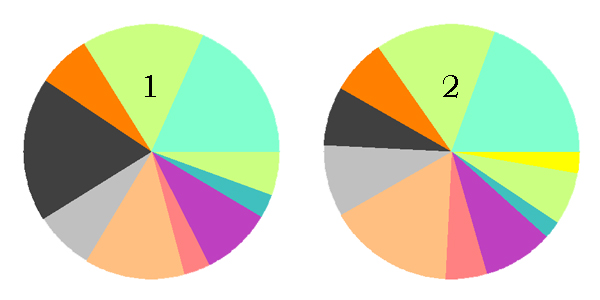
No, it's not number two. Number one (with no yellow) is the parent. The yellow of the children must have come from the other parent.
I don't have any science to share. I am advocating for testing everyone you can. As always, I believe that GedMatch is a fantastic resource. There you can connect with testers who used other labs and you too can experiment with ethnicity models.
Family, if your profile is here, drop me an email, text, or call, and I'll send you the legend that goes with your chart. And for the missing one of the ten, just ask.
Friday, August 8, 2014
Autosomal DNA Matching 102, Class Two
In a previous post, I wrote about watching out for randomness in DNA matches. A new cousin match has helped me find a simple example of how just one match can be misleading. It's so important to find multiple matches to validate a conclusion.
This randomness in matching is called Identical by State or IBS. Matches due to family relationships are Identical by Descent or IBD. There are other complications in matching, but this is intended as a simple explanation of IBS.
This new match is from my father's Fry/Derrick family. On GedMatch, I've run a one-to-one match against our new cousin, "Helen", with each of the kits I manage. The blue shows the small area of chromosome 3 where we each match Helen.

Notice the tiny red edges that I added on the second and third lines. Those bits are where there is a random match, IBS, that is not a relationship match or IBD. How did I know that?
Let's explore the numbers. You don't need math, just logic.

On top is my Dad, who is a fourth cousin once removed to Helen. For now I'll assume that his entire match is Identical by Descent or IBD.
For me, any matching fragments lower than 22134900 are not part of the Fry/Derrick match, as those fragments did not come from my Dad. They came from Mom. Any match fragments higher than 29810802 are also not valid, as they came from Mom, too.
The same logic applies to my daughter's match and my granddaughter's match. I can only pass on what I have -- I can't add Fry/Derrick DNA and pass that on.
My matching fragments end too high and my daughter's matching fragments start too low. So my red area on line two is just a random fragment at the high end. My daughter's red area on line three is a random fragment at the low end. Those little bits are Identical by State to Helen, not Identical by Descent.
We need other people who are not members of my direct family to confirm the numbers and help weed out any other IBS randomness in this match.
You might think that I'm selling DNA tests! Honestly, I'm not. I am sharing the little lessons that I'm learning from administering multiple kits. I'm advocating for testing as much as we can and for using every tool at our disposal. I'm anxious to add my brother's kit to the mix, as I expect there will be many more lessons to learn.
This randomness in matching is called Identical by State or IBS. Matches due to family relationships are Identical by Descent or IBD. There are other complications in matching, but this is intended as a simple explanation of IBS.
This new match is from my father's Fry/Derrick family. On GedMatch, I've run a one-to-one match against our new cousin, "Helen", with each of the kits I manage. The blue shows the small area of chromosome 3 where we each match Helen.
Let's explore the numbers. You don't need math, just logic.
On top is my Dad, who is a fourth cousin once removed to Helen. For now I'll assume that his entire match is Identical by Descent or IBD.
For me, any matching fragments lower than 22134900 are not part of the Fry/Derrick match, as those fragments did not come from my Dad. They came from Mom. Any match fragments higher than 29810802 are also not valid, as they came from Mom, too.
The same logic applies to my daughter's match and my granddaughter's match. I can only pass on what I have -- I can't add Fry/Derrick DNA and pass that on.
My matching fragments end too high and my daughter's matching fragments start too low. So my red area on line two is just a random fragment at the high end. My daughter's red area on line three is a random fragment at the low end. Those little bits are Identical by State to Helen, not Identical by Descent.
We need other people who are not members of my direct family to confirm the numbers and help weed out any other IBS randomness in this match.
You might think that I'm selling DNA tests! Honestly, I'm not. I am sharing the little lessons that I'm learning from administering multiple kits. I'm advocating for testing as much as we can and for using every tool at our disposal. I'm anxious to add my brother's kit to the mix, as I expect there will be many more lessons to learn.
Sunday, July 20, 2014
Autosomal DNA Matching 102
In the last post you met my cousin Mary, who has DNA tested at Ancestry and uploaded her results to the free GEDMatch site. We know our common ancestors, William and his wife. But I also mentioned a "gotcha".
Mary and I are related through my mother. Our matching DNA on chromosome 2 is from 74188298 to 105591639. But I can't assume that everyone who matches me in those segments are matches on my mother's side. It's so very important to look at chromosome matching in detail after you have identified a known relationship. GEDMatch is just one tool that will help do that.
Another good tool is DNAGedcom. It is a free site that works only with files from FTDNA and 23AndMe. Note that it cannot work with Ancestry files.
DNAGedcom will pull my DNA information and my matches right from my FTDNA account and will upload the files to the website. I can then run a report that will graphically show my matches for each chromosome. These graphics are far better than GEDMatch and FTDNA for seeing the shared segments.
Here's a part of my DNAGedcom report for chromosome 2. I can see the name and email address for each person who matches me at FTDNA. If they have put surnames on file, I can hover over their information to see those surnames. I can also hover to see the names of the people who match me in common with that person.
Mary is not on this report, as she has not uploaded her results to FTDNA. The large fuchsia line at the top is for my Dad. The yellow boxes show the areas where I have matching DNA with Mary.

Notice the top yellow box. I have matches that are up to 85044774 that match my Dad (fuchsia on the left), yet are in the range where I match Mary. Then there are several matches starting at 84408203 that do not match my Dad. Is the matching DNA random, or IBS (identical by state)? Or is there a real match?
Is part of my match with Mary IBS? I need more confirmed matches to know if the DNA matches are real or random. The point is to not make assumptions based on one match. Keep working with your matches to find more confirmed cousins and to build your knowledge of what your DNA reveals.
Mary and I are related through my mother. Our matching DNA on chromosome 2 is from 74188298 to 105591639. But I can't assume that everyone who matches me in those segments are matches on my mother's side. It's so very important to look at chromosome matching in detail after you have identified a known relationship. GEDMatch is just one tool that will help do that.
Another good tool is DNAGedcom. It is a free site that works only with files from FTDNA and 23AndMe. Note that it cannot work with Ancestry files.
DNAGedcom will pull my DNA information and my matches right from my FTDNA account and will upload the files to the website. I can then run a report that will graphically show my matches for each chromosome. These graphics are far better than GEDMatch and FTDNA for seeing the shared segments.
Here's a part of my DNAGedcom report for chromosome 2. I can see the name and email address for each person who matches me at FTDNA. If they have put surnames on file, I can hover over their information to see those surnames. I can also hover to see the names of the people who match me in common with that person.
Mary is not on this report, as she has not uploaded her results to FTDNA. The large fuchsia line at the top is for my Dad. The yellow boxes show the areas where I have matching DNA with Mary.
Notice the top yellow box. I have matches that are up to 85044774 that match my Dad (fuchsia on the left), yet are in the range where I match Mary. Then there are several matches starting at 84408203 that do not match my Dad. Is the matching DNA random, or IBS (identical by state)? Or is there a real match?
Is part of my match with Mary IBS? I need more confirmed matches to know if the DNA matches are real or random. The point is to not make assumptions based on one match. Keep working with your matches to find more confirmed cousins and to build your knowledge of what your DNA reveals.
Friday, July 18, 2014
Autosomal DNA Matching 101
A friend who is just embarking on the genealogical DNA journey says it's too complicated. I have to agree that it can be overwhelming.
The first thing that I suggest is to subscribe to the DNAeXplained blog by Roberta J Estes. Sometimes her posts pertain, sometimes they don't, but her work is a great resource.
After you subscribe to the blog, visit the publications section of Roberta's DNAeXplain.com website. Scroll down to the section titled Working with DNA and see what you might want to download and read.
You've ordered an autosomal test, but what will it do for you? The purpose of an autosomal DNA test is matching your DNA to that of cousins known and unknown. It can answer:
Unfortunately Ancestry only answers question 1 and hints at question 2. However, the genealogical community uses Ancestry more heavily than FamilyTreeDNA , so that's where more matching will take place. The Family Finder test at FTDNA answers all 4 questions. The free website GEDMatch also answers all 4 questions.
When your test is completed, you can download your results from Ancestry, FTDNA or 23AndMe, which I don't use. You really don't want to look at your results file -- it's big and has a lot of numbers and letters. But it's yours and you will want to get that download file to use at other websites now and in the future.
What can you do with your downloaded file?
GEDMatch is the free site where we all can meet, regardless of the original test company. I've chosen Ancestry for my brother's autosomal DNA test, knowing it gives me flexibility in handling the results.
I'll use my cousin Mary as an example of matching via Ancestry and GEDMatch. She and I both tested at Ancestry, which predicted that we were in the range of 4th cousin to 6th cousin with a 96% confidence factor. We also have a leaf that we have a common ancestor in our trees. We had already connected, so none of this was a surprise.

We both uploaded our Ancestry results to GEDMatch.
GEDMatch provides a list of matches, similar to Ancestry. It also includes matches who have tested with other companies.
I look in my match list for Mary (in yellow), make a note of her kit number, and click on a link to run a one-to-one match. The match process provides a very clear answer to how much DNA we share and what the segments are.

GEDMatch estimates 4.2 generations to our Most Recent Common Ancestor. Mary is my 3rd cousin, once removed. Our common ancestors, William and his wife, are 4 generations from her and 5 generations from me. Both Ancestry and GEDMatch have done well with their estimates.
GEDMatch gives us other tools, including the ability to see others who match both of us. Someone who matches us both on chromosome 2 between 74188298 and 105591639 is now known to be related to us in the lines of William or his wife or both. As we accumulate matches, we can refine our knowledge. There can be a "gotcha" here, which I'll cover next time.
As I write this post, GEDMatch is in the midst of a transition with many tools unavailable and new uploads not being accepted. I have every confidence that they will be back to provide for Ancestry users the missing tools.
FTDNA works in similar ways to GEDmatch, but the interface is prettier and comes at a price. Here we see a couple of my Dad's matches.

The top is his confirmed cousin from Sweden. The little green icon shows that there is a family tree (GEDCOM) loaded by that person. The estimated 2nd-4th cousin has been replaced by the actual relationship that we calculated and then manually set.
The bottom match has no tree, but has listed some of her surnames. I'd rather see a tree. That's so important to facilitate making the connection.
FTDNA provides graphical comparison of matches and allows me to download my matches, their email addresses and the chromosome matching segments, similar to those shown above. It also provides a tool to see who else matches both me and one or more of my matches. One of the downsides of FTDNA is that a lot of the participants have not provided a family tree.
The autosomal DNA test is another tool in your genealogical toolbox. You still have to figure out the connections.
I hope this post helps with some basic understanding. Next time: the magic of DNAGedcom.
- If you are taking the AncestryDNA test, focus on learning about autosomal DNA.
- If you are taking the Family Finder test at FamilyTreeDNA, it is also an autosomal DNA test.
- Ignore Y-DNA and mTDNA for now.
The first thing that I suggest is to subscribe to the DNAeXplained blog by Roberta J Estes. Sometimes her posts pertain, sometimes they don't, but her work is a great resource.
After you subscribe to the blog, visit the publications section of Roberta's DNAeXplain.com website. Scroll down to the section titled Working with DNA and see what you might want to download and read.
You've ordered an autosomal test, but what will it do for you? The purpose of an autosomal DNA test is matching your DNA to that of cousins known and unknown. It can answer:
- Who shares my DNA?
- How much DNA do we share?
- What segments do we share?
- Who else shares those segments?
Unfortunately Ancestry only answers question 1 and hints at question 2. However, the genealogical community uses Ancestry more heavily than FamilyTreeDNA , so that's where more matching will take place. The Family Finder test at FTDNA answers all 4 questions. The free website GEDMatch also answers all 4 questions.
When your test is completed, you can download your results from Ancestry, FTDNA or 23AndMe, which I don't use. You really don't want to look at your results file -- it's big and has a lot of numbers and letters. But it's yours and you will want to get that download file to use at other websites now and in the future.
What can you do with your downloaded file?
- GEDMatch levels the playing field for matching. It is a free site supported by donations and we who use it need to donate. Bear that potential cost in mind, as well as the possibility the site could vanish.
- An Ancestry test result can be uploaded to GEDMatch.
- GEDMatch accepts uploads from FTDNA.
- GEDMatch accepts uploads from 23AndMe.
- FTDNA accept uploads from Ancestry. It's $69 today to upload.
- FTDNA accepts uploads from 23AndMe, also $69 today.
- Ancestry will not accept an outside test result.
- DNAGedcom will accept uploads from FTDNA and from 23AndMe. More on this tool next time.
GEDMatch is the free site where we all can meet, regardless of the original test company. I've chosen Ancestry for my brother's autosomal DNA test, knowing it gives me flexibility in handling the results.
I'll use my cousin Mary as an example of matching via Ancestry and GEDMatch. She and I both tested at Ancestry, which predicted that we were in the range of 4th cousin to 6th cousin with a 96% confidence factor. We also have a leaf that we have a common ancestor in our trees. We had already connected, so none of this was a surprise.
We both uploaded our Ancestry results to GEDMatch.
GEDMatch provides a list of matches, similar to Ancestry. It also includes matches who have tested with other companies.

I look in my match list for Mary (in yellow), make a note of her kit number, and click on a link to run a one-to-one match. The match process provides a very clear answer to how much DNA we share and what the segments are.

GEDMatch estimates 4.2 generations to our Most Recent Common Ancestor. Mary is my 3rd cousin, once removed. Our common ancestors, William and his wife, are 4 generations from her and 5 generations from me. Both Ancestry and GEDMatch have done well with their estimates.
GEDMatch gives us other tools, including the ability to see others who match both of us. Someone who matches us both on chromosome 2 between 74188298 and 105591639 is now known to be related to us in the lines of William or his wife or both. As we accumulate matches, we can refine our knowledge. There can be a "gotcha" here, which I'll cover next time.
As I write this post, GEDMatch is in the midst of a transition with many tools unavailable and new uploads not being accepted. I have every confidence that they will be back to provide for Ancestry users the missing tools.
FTDNA works in similar ways to GEDmatch, but the interface is prettier and comes at a price. Here we see a couple of my Dad's matches.
The top is his confirmed cousin from Sweden. The little green icon shows that there is a family tree (GEDCOM) loaded by that person. The estimated 2nd-4th cousin has been replaced by the actual relationship that we calculated and then manually set.
The bottom match has no tree, but has listed some of her surnames. I'd rather see a tree. That's so important to facilitate making the connection.
FTDNA provides graphical comparison of matches and allows me to download my matches, their email addresses and the chromosome matching segments, similar to those shown above. It also provides a tool to see who else matches both me and one or more of my matches. One of the downsides of FTDNA is that a lot of the participants have not provided a family tree.
The autosomal DNA test is another tool in your genealogical toolbox. You still have to figure out the connections.
I hope this post helps with some basic understanding. Next time: the magic of DNAGedcom.
Tuesday, February 25, 2014
A Sticky DNA Puzzle
Have you read Roberta Estes' recent post on DNA generational inheritance? If not, I encourage you to do that. The numbers made my head spin and I didn't even try to follow the math and statistics. However, her points are extremely important for those of us working with DNA and genealogy.
What I took from it is that inheritance is not really 50-50 from each parent. And some DNA seems to stay together (clump) and pass nearly unchanged for many generations (sticky). And sometimes what looks like a match is merely randomness. That's known as IBS or identical by state.
Of course we already know that siblings share only about half of their DNA.What's surprising about her charts is the way we inherit all versus nothing of a parent's DNA segment, rather than having interspersed inheritance. So even if we expect a match with a certain individual, we might not see such a match. It doesn't prove there's no relationship.
I'm glad that Roberta wrote this post, as I'm dealing with matches of my own that appear to be both clumpy and sticky. I wrote before about a group of people with a significant match on chromosome 16. Unlike her example, we don't yet know the source of that DNA.
My contact, "John", and I theorized that the connection might be in our Weakley County, Tennessee, families. Another theory is that the clump belongs to a Williams ancestor. Both of these lines belong to my mother.
My Dad's DNA analysis threw a monkey wrench into the theory. Dad (not Mom) matches the group!

Notice how the sticky DNA (the blue area) did not pass from my daughter to my granddaughter. It entirely disappeared. That sudden disappearance makes me think this is a clump that passes nearly unchanged through many generations.
My Dad has a lot more holes in his tree than my Mom does, so finding the source of this DNA will likely fall to other members of the group. Sorry, team!
I got another surprise from Dad's DNA. My father's ancestry is largely Swedish, which would include ancestry from Finland and Norway. My mother has no known Scandinavian ancestry.
Working at GedMatch, I picked all my matches with email addresses ending in "se" and "fi". These are people who currently live in Sweden and Finland. I cross-matched those four people with my four kits, using the 3D chromosome browser tool.

Notice Ms. T matches me at a higher threshold (yellow) than the other matches. She also matches me on the X chromosome for an additional 8 cM. Yet she does not match my Dad at all. Nor does she match my daughter or granddaughter.
Also notice how the match totals fall within our family kits (red). It isn't exactly 50 percent in each generation, but it's close.
Another interesting item is that Mr O doesn't match to my daughter or granddaughter. Yet we think we're related through a particular ancestor from Hannäs, Sweden. The matching DNA vanished, just as the chromosome 16 clump did.
Back to Ms. T. I had always assumed she was a match on my Dad's side. Now I have to consider three options:
If Ms. T is an actual match, consider that the only way to identify that match was by testing my DNA. This shows how important it is to test everyone that you can. I'll be looking for more family volunteers soon!
What I took from it is that inheritance is not really 50-50 from each parent. And some DNA seems to stay together (clump) and pass nearly unchanged for many generations (sticky). And sometimes what looks like a match is merely randomness. That's known as IBS or identical by state.
Of course we already know that siblings share only about half of their DNA.What's surprising about her charts is the way we inherit all versus nothing of a parent's DNA segment, rather than having interspersed inheritance. So even if we expect a match with a certain individual, we might not see such a match. It doesn't prove there's no relationship.
My Sticky Clump
I'm glad that Roberta wrote this post, as I'm dealing with matches of my own that appear to be both clumpy and sticky. I wrote before about a group of people with a significant match on chromosome 16. Unlike her example, we don't yet know the source of that DNA.
My contact, "John", and I theorized that the connection might be in our Weakley County, Tennessee, families. Another theory is that the clump belongs to a Williams ancestor. Both of these lines belong to my mother.
Surprise Number 1
My Dad's DNA analysis threw a monkey wrench into the theory. Dad (not Mom) matches the group!
Notice how the sticky DNA (the blue area) did not pass from my daughter to my granddaughter. It entirely disappeared. That sudden disappearance makes me think this is a clump that passes nearly unchanged through many generations.
My Dad has a lot more holes in his tree than my Mom does, so finding the source of this DNA will likely fall to other members of the group. Sorry, team!
Surprise Number 2
I got another surprise from Dad's DNA. My father's ancestry is largely Swedish, which would include ancestry from Finland and Norway. My mother has no known Scandinavian ancestry.
Working at GedMatch, I picked all my matches with email addresses ending in "se" and "fi". These are people who currently live in Sweden and Finland. I cross-matched those four people with my four kits, using the 3D chromosome browser tool.
Notice Ms. T matches me at a higher threshold (yellow) than the other matches. She also matches me on the X chromosome for an additional 8 cM. Yet she does not match my Dad at all. Nor does she match my daughter or granddaughter.
Also notice how the match totals fall within our family kits (red). It isn't exactly 50 percent in each generation, but it's close.
Another interesting item is that Mr O doesn't match to my daughter or granddaughter. Yet we think we're related through a particular ancestor from Hannäs, Sweden. The matching DNA vanished, just as the chromosome 16 clump did.
Back to Ms. T. I had always assumed she was a match on my Dad's side. Now I have to consider three options:
- my Mom has Scandinavian ancestry
- Ms. T has ancestry from Germany or the British Isles
- the match is IBS (random) and not a real match
If Ms. T is an actual match, consider that the only way to identify that match was by testing my DNA. This shows how important it is to test everyone that you can. I'll be looking for more family volunteers soon!
Saturday, August 10, 2013
I Have Matches -- Now What
I just had a chat with someone who is right behind me on the DNA journey, but is feeling lost. So today I'll share some progress.
The tools at each DNA web site are different than the others, but the end goal is the same: connection with cousins. Ancestry is missing a key tool that can be found at GedMatch and at Family Tree DNA (FTDNA). That tool is the chromosome browser or chromosome comparison.
I was contacted by a gentleman that I'll call John. He is in my match list both at GedMatch and at FTDNA and he's been working with DNA for quite a while. I have part of my tree available at FTDNA and he had checked it out. His family and mine had intermarried in Weakley County, Tennessee, during the late 1800s. We don't see a common ancestor yet, though we know we must have one. But what does our DNA tell us?
Looking at GedMatch, he's near the top of my match list with an estimate of 4.2 generations to our common ancestor. His kit number is on the left and his email on the right. I've hidden both of those items. He and I don't have any X-chromosome (#23) DNA in common. But our Autosomal DNA (#1-22) has a fairly large matching area.

Let's do a chromosome review at both GedMatch and FTDNA.
GedMatch shows us, in blue, several areas where we have matches within different chromosomes. It's larger on the screen. This is just small so I can show more of the matching areas.

Here's the FTDNA match list, where John is the second one. He has an email address, a tree at FTDNA and I can add a note. Some of his his surnames are shown and I can also see which DNA tests he has done.

In the chromosome browser, I select John (in orange). This browser shows only the larger match. I was able to find several other people in my match list with a very similar matching pattern. The gray areas are not used in matching. At the top, I can download the matches to Excel so I can see the numbers.

OK, we have matching DNA. So what? My first question to John was what he knew about the source of that section of shared DNA.
John has worked with several of those matches over the past few months and they can't find the common ancestor. I'm new to the game, but I bring some new surnames to explore. We have a location to focus on, which John said they didn't have before. I also knew more about my family than John did and he taught me things about his family. Together, we have a clearer picture of how our families relate.
If John and I can find our common ancestor, everyone who matches us on that piece of DNA will suddenly know what they are looking for. We'll be able to say that segment came from our ancestor X. Anyone who matches that location in the future can be advised to look for their connection to ancestor X and their parents and siblings. Others may be able to help refine the source of the DNA as the mother of X or father of X.
The chromosome browsers are interesting, but useless by themselves. The payoff is when you find the connection to that common ancestor X.
What's the strategy? Work the closest matches first. Review trees. Send emails. Ask if they know about the common ancestor in the DNA segments where you match. When you find the common ancestor, document the DNA segments and look for others that match those segments. Then reach out to those others to let them know what you've found. And, of course, hope others will let you know when they unpuzzle a match.
I sent such an email the other day. I searched on a particular surname, found a match, found the common ancestor couple in his tree, then used the chromosome browser. I looked for others with a matching segment and emailed a woman to share what I found. I now have a list of 8 DNA segments that associate to two surnames. The largest is on chromosome 22 from 41311622 to 44012037. It's up to me to keep track of those numbers and the associated surnames. I'm looking for a way to do it, but Excel is what I'm using for now.
I hope that example is simple enough to follow. Let me know.
The tools at each DNA web site are different than the others, but the end goal is the same: connection with cousins. Ancestry is missing a key tool that can be found at GedMatch and at Family Tree DNA (FTDNA). That tool is the chromosome browser or chromosome comparison.
I was contacted by a gentleman that I'll call John. He is in my match list both at GedMatch and at FTDNA and he's been working with DNA for quite a while. I have part of my tree available at FTDNA and he had checked it out. His family and mine had intermarried in Weakley County, Tennessee, during the late 1800s. We don't see a common ancestor yet, though we know we must have one. But what does our DNA tell us?
Looking at GedMatch, he's near the top of my match list with an estimate of 4.2 generations to our common ancestor. His kit number is on the left and his email on the right. I've hidden both of those items. He and I don't have any X-chromosome (#23) DNA in common. But our Autosomal DNA (#1-22) has a fairly large matching area.

Let's do a chromosome review at both GedMatch and FTDNA.
GedMatch shows us, in blue, several areas where we have matches within different chromosomes. It's larger on the screen. This is just small so I can show more of the matching areas.


Here's the FTDNA match list, where John is the second one. He has an email address, a tree at FTDNA and I can add a note. Some of his his surnames are shown and I can also see which DNA tests he has done.

In the chromosome browser, I select John (in orange). This browser shows only the larger match. I was able to find several other people in my match list with a very similar matching pattern. The gray areas are not used in matching. At the top, I can download the matches to Excel so I can see the numbers.

OK, we have matching DNA. So what? My first question to John was what he knew about the source of that section of shared DNA.
John has worked with several of those matches over the past few months and they can't find the common ancestor. I'm new to the game, but I bring some new surnames to explore. We have a location to focus on, which John said they didn't have before. I also knew more about my family than John did and he taught me things about his family. Together, we have a clearer picture of how our families relate.
If John and I can find our common ancestor, everyone who matches us on that piece of DNA will suddenly know what they are looking for. We'll be able to say that segment came from our ancestor X. Anyone who matches that location in the future can be advised to look for their connection to ancestor X and their parents and siblings. Others may be able to help refine the source of the DNA as the mother of X or father of X.
The chromosome browsers are interesting, but useless by themselves. The payoff is when you find the connection to that common ancestor X.
What's the strategy? Work the closest matches first. Review trees. Send emails. Ask if they know about the common ancestor in the DNA segments where you match. When you find the common ancestor, document the DNA segments and look for others that match those segments. Then reach out to those others to let them know what you've found. And, of course, hope others will let you know when they unpuzzle a match.
I sent such an email the other day. I searched on a particular surname, found a match, found the common ancestor couple in his tree, then used the chromosome browser. I looked for others with a matching segment and emailed a woman to share what I found. I now have a list of 8 DNA segments that associate to two surnames. The largest is on chromosome 22 from 41311622 to 44012037. It's up to me to keep track of those numbers and the associated surnames. I'm looking for a way to do it, but Excel is what I'm using for now.
I hope that example is simple enough to follow. Let me know.
Tuesday, August 6, 2013
Ethnicity Through DNA -- Revisited
Earlier this year I shared my questionable ethnicity analysis as provided through AncestryDNA. The more I work with the DNA tools online, the more disappointed I am with Ancestry. So I paid to import my Ancestry DNA map into Family Tree DNA (FTDNA), as well as importing it into the free GedMatch website.
Of the various tools, I like what's currently available in GedMatch for ethnicity evaluation. For me, it has provided several ways to look at my ethnic background and to figure out for myself what fits. The best part is that it is free. As one of my friends says:
Free is in my price range!
First let's look at the AncestryDNA ethnic breakdown and then at one of the models from GedMatch.


Of the various tools, I like what's currently available in GedMatch for ethnicity evaluation. For me, it has provided several ways to look at my ethnic background and to figure out for myself what fits. The best part is that it is free. As one of my friends says:
Free is in my price range!
First let's look at the AncestryDNA ethnic breakdown and then at one of the models from GedMatch.


Quite a difference! GedMatch lets me put my DNA map through a number of ethnicity models where my DNA is compared with control samples from other countries. That's called admixture. There is no one admixture that tells me all I want to know. By looking at all of them, I found several that flagged my Native American ethnicity, as well as refining European and Asian roots.
Here's a look at a 13-ethnic group test that shows Native American. It doesn't analyze the various European areas in depth, as the 36-group test above did. Nor does the pie chart show the Native American or other small percentages.


All of this requires analysis and thought. It's not as simple as the Ancestry model pretends.
I'll be writing a lot more about DNA. If you're working with DNA genealogy, be sure to check out the DNA Explained blog for explanations, tips, tricks and forms. It's a great resource that I'm leaning on in my own journey to understanding DNA.
Subscribe to:
Posts (Atom)