Showing posts with label Maddox. Show all posts

Friday, September 7, 2018

A Favorite Photo: 52 Ancestors


One of my favorite photos is of my grandmother's older sister and her husband. I believe it was taken in celebration of their marriage, possibly on their wedding day.

Esstella "Stella" Margaret Crispen was born on October 28, 1899, near Meno, Oklahoma Territory. She was named for her two grandmothers. Her mother, Daisy Myrtle Maddox, was the daughter of Elizabeth Esstella Lake. Her father, Clark Earl Crispen, was the son of Nerinda Margaret Kerr.

Her father, a blacksmith by trade, was not cut out for farming. About 1907 he leased his Oklahoma farm to his brother-in-law and moved his family to Michigan, living first in Van Buren County. The family later moved to Coloma Township and eventually into the town of Benton Harbor.


Template and elements from Botanicals digital kit, ClubScrap, 2015


Henry L Pitcher was raised on a farm in Watervliet Township. How the couple met is not known to me, but most likely it was while the Crispen family was living in the Coloma area. The couple were married at the home of the pastor of the Watervliet First Methodist Church on November 12, 1918.

Henry first worked with his father on the farm. However, after his father died in 1928, he sold the farm, moved to Coloma Township and became a realtor. They had one child, Opal Kathleen Pitcher, born on November 19, 1919.

The couple had health issues which cut their lives far too short. Stella had scarlet fever as a child, which had weakened her heart. Henry struggled with arthritis. The hometown newspaper printed lovely obituaries at their passing.


The News-Palladium
Benton Harbor, Michigan
Thursday, August 28, 1952
Page 21
H. L. Pitcher, Coloma Realty Agent, Succumbs
     Coloma, Aug. 28 -- Henry L. Pitcher, 57, Coloma real estate man, died Wednesday noon at Mercy hospital, where he was admitted the previous day.
     Although Mr. Pitcher had suffered a serious arthritic condition for many years, he had remained cheerful in his work and had many friends in the community. He was a lifelong resident of the Coloma community, having been born on a farm north of Coloma on May [sic] 5, 1895.
     Mr. Pitcher is survived by his wife, Esstella; his mother, Mrs. Lydia Pitcher, who made her home with him and his wife; one daughter, Mrs. Donald Gearing, and a granddaughter, of Coloma. Also surviving are a brother, Jerome Pitcher, and a sister, Mrs. Clark Shimer both of Watervliet.
     Funeral services will be held Sunday at 2 p.m. at the Davidson funeral home, with the Rev. William Goltz of Hartford, former Coloma minister, officiating. Burial will be in the Watervliet City cemetery.


The News-Palladium
Benton Harbor, Michigan
Tuesday, March 15, 1955
Page 13
Mrs. Esstella Pitcher
     Coloma, March 15 -- Mrs. Esstella M Pitcher, 55, died Monday night at Mercy hospital, Benton Harbor, where she had been a patient 12 days. She had been in ill health many years.
     Born Oct. 28, 1899 in Meno Okla., Mrs. Pitcher had lived in the Coloma vicinity since she was eight years old. She was married to Henry Pitcher Nov. 12 1918, in Coloma. He died in August, 1952.
     Mrs Pitcher is survived by a daughter, Mrs. Donald (Opal) Gearing, and a granddaughter, Joyce Kepil, of Coloma, her mother, Mrs. Daisy O'Neil, of Tucson, Ariz., two sisters, Mrs. Fayette Allee, of Tucson, and Mrs. Leonard Scherrer, of Pasadena, Calif., and two nieces living in the west.
     A nephew, Earl Knapp, lives in Benton Harbor.
     Mrs. Pitcher's body is at the Davidson funeral home. Funeral arrangements are incomplete.

Stella Crispen Pitcher and Henry Pitcher are buried together in the Watervliet Cemetery.

Tuesday, August 21, 2018

On Top of the Blue Ridge


Did your ancestors migrate through the beautiful Shenandoah Valley along the Great Warrior Trail? For many years the valley was a major route for migration and travel between Pennsylvania and North Carolina. This 1751 map shows dramatically how the mountains in Virginia limited westward migration and controlled the direction of travel. Today Interstate 81 parallels the old trails.


Map from Library of Congress

Some of your ancestors, like Thomas Jefferson and like some of mine, may have chosen to live in the Shenandoah Valley or surrounding mountains. Whenever I drive through that area, the beauty awes me and I understand their choice.


Soon, for the first time in his life, my younger brother will spend a few days in the magnificence of the lower Shenandoah. If you are a cousin, do read on to see if one of our shared ancestors lived in this beautiful area. Someday you might even wish to follow the trail yourself.

So, brother, this post is for you!


Near the orange marker at Glen Wilton, John Derrick owned land and it was the area where he died about 1790. It is also where he married Anna Maria Dunkelberger. Here Philip Fry married Maria Magdalena Derrick in 1781. The Fry family migrated on to Tennessee and Alabama. Philip had 25 children and many of our DNA matches are from this line in my father's ancestry.

Switching to my mother's family, the dark red marker is in Pocahontas County, West Virginia, formerly Greenbrier County. Members of the Greaton family were taxed in this area. David Greaton moved on to Ohio and Illinois. His daughter Elizabeth married Lazarus Maddox in Ohio in 1816.

Also in Greenbrier County, John Kelly was born about 1779. He moved on to Tennessee where his  great-granddaughter married Benjamin Franklin Pryor.

The dark pink marker is at the community of Hanging Rock. In this area a large group of Swiss Anabaptists made their home near the end of the 1700s. Today this group is known as Church of the Brethren. Our ancestors and relatives who settled here included members of the following families: Peffley, Rettinger, Gerst/Garst, Bosseck, Graybill, Borndragar, Mangus, and many more. My ancestors moved on to Indiana and Kansas, but many family members stayed in Virginia.

Lastly the purple marker sits near the stunning Blue Ridge Parkway. Nicholas Allee in 1797 was granted 38 acres that adjoined land he already owned. The land is partially described as
... Lying and being in the County's of Montgomery, and Franklin, the greater part thereof, in the County of Montgomery on the dividing Ridge, including the heads of Daniel's Run, the waters of Black water, and bounded ... top of said ridge ...
What amazes me about this grant is that it specifically mentions the Blue Ridge (dividing ridge) and lists the watercourses in a way that the land can be identified within a few miles. The counties no longer have a common line, as Floyd County was carved out of Montgomery County in 1831. The creek named Daniel's Run no longer appears to begin at the Blue Ridge, but its probable course can be seen on topographical maps. Using Deed Mapper software to determine the shape of the property and researching the watercourses,  I believe that it included land that today is part of the Blue Ridge Parkway, including milepost 144.8, the Pine Spur Overlook. I'm looking forward to visiting this site and seeing what my ancestors saw. 

Nicholas Allee died in 1808 and his descendants moved on to Kentucky, Missouri, Alabama, Arkansas and Texas. His legacy lives on in hundreds of descendants and his land enchants thousands of visitors to the Blue Ridge each year.

Sunday, June 10, 2018

He Bought the Farm: 52 Ancestors


In the previous post, land records positively identified the eight children of an Ohio farmer. However, the parents of the farmer, Lazarus Maddox, are not as easy to identify. A male Maddox descendant of Lazarus has graciously agreed to take a Y-DNA test, which should help identify his family. One of the puzzles for his descendants is whether there is a meaning to the Pickaway County farm that Lazarus bought.

Lazarus Maddox was born about 1787, probably in Kentucky. The first known record for him in Ohio was his service in the War of 1812, along with men from Pickaway County and Ross County, under the command Captain Robert Bradshaw. Some of the  names of his fellow soldiers are names that appear in other records associated with the Maddox family. Familiar names include Hayes, Knoles, Alkire, Baker, Webb, Wilson, Boggs, Burbridge and McAlister.


Marriage book 1, page 82, shows that on November 3, 1816, Elizabeth Greaton married Lazarus Maddox. The marriage was celebrated by Joseph Hays, a minister of the Methodist Episcopal Church. Elizabeth's father, David Greaton, gave consent and Lazarus signed an affidavit that he was over 21. Interestingly, the legal paperwork was dated November 5, 1816. It is possible that the minister reported the wrong date to the county clerk.


Starting in 1822, Lazarus appears on the Pickaway County tax rolls, paying tax on land. But the farm of interest didn't exist yet.

In 1823, Lazarus joined a survey crew, acting as a chain carrier for survey 12346. In the DAR abstract of surveys, it is the only place his name appears. The survey was being done for a man named John L. Wilson.

Generally the chain carriers were young men who happened to live in the area. Lazarus was in his mid-30s. Why would he join the crew? In 1821, Lazarus had been sued for a debt of $51. He swore to the court that he had no money and no way to get any. Did he take the work of the chain carrier just to earn some cash?

In 1841, Lazarus bought that exact farm from John Wilson. Why that farm? What is the connection? Did he just like the land after he worked on the survey, or is there a family connection?

In 1830, Lazarus had words with a neighbor, Timothy Wale, who had set fire to Lazarus' stable. There is a court case about the words spoken, but not one about the destroyed stable. I wonder what they argued about!

Lazarus and Elizabeth had eight children. Their exact birth order is not fully known. The children were:
  • Clarissa (1818-1903, married Knoles)
  • John
  • William (about 1820-1869, my line)
  • Eliza Ellen (1820s-1840s, married Long)
  • David (1826-1907)
  • Joseph
  • Mary (1834-1907, married Neff)
  • Susannah (1837-1917, married Alkire)

Lazarus died in March, 1850, of dyspepsia (indigestion). The information given to the census taker was that he was 63 years of age at death and had been born in Kentucky. As he did not provide the information, it may not be correct. His burial location is unknown, but may have been at the nearby Methodist Church cemetery or on the Hayes farm where his grandson was buried. If there was a marker, none is found today.

And so ends the story of a Pickaway County, Ohio farmer, until the day that DNA adds another chapter.

Sunday, April 29, 2018

After the Flood: 52 Ancestors


In 1928, one of the deadliest hurricanes in American history devastated the area around Lake Okeechobee, Florida. Hundreds of people died from the storm surge that flooded the farms south and north of the lake. One of the results of the disaster was the construction of flood control channels, gates and levees around the lake. Nearly ten years later, a young man lost his life when he drowned at the Chosen Locks near Belle Glade, near the southern tip of the lake. Without the flood control changes, would that family tragedy have occurred?

NOAA has provided a map of the devastated area that can be found at Wikipedia (the county lines on the east side of the lake are not drawn correctly). The areas circled by the blue lines were flooded by the storm surge.


By NOAA - From http://www.srh.noaa.gov/mfl/newpage/Okeechobee.htm.,
Public Domain, https://commons.wikimedia.org/w/index.php?curid=358954


I write often about the Lake family and the Maddox family, but rarely both families, as with today's story from the Tyner family of Florida.

Dottie May Maddox, born in Kansas on August 5, 1881, was the second child of Elizabeth Lake and Joseph Allen Maddox. Dottie married John Newton Tyner on February 9, 1899, in Garfield County, Oklahoma. The Tyners farmed in both Oklahoma and Florida throughout their marriage. They had ten children, the seventh being Ruth Elizabeth Tyner, born October 22, 1914 near Goltry, Oklahoma.


Dottie May Maddox and John Newton Tyner with seven children, about 1915

Because the family split their time between Florida and Oklahoma, records for the family members can be found in both states, as well as Kansas and Arkansas. However, Florida seemed to be preferred by the children when it came time to marry and raise families. Ruth was certainly no exception.

On May 2, 1931, Ruth Tyner married John Edward Winne in West Palm Beach. On December 12, 1933, just a few days after the birth of their second child, Ruth died. Young John, only 20, was left with two young children. Five years later, the children were orphaned when John drowned in Lake Okeechobee. The children were raised by their widowed grandmother, Dottie Maddox Tyner.

Newspapers tell the story of the tragedy that took John Winne's life.

Source Unknown, Clipping in possession of cousin Lori N.
FATHER SEES SON DROWN IN CANAL,  Belle Glade Man Falls From Lock at Chosen
     Belle Glade, FLA, Jan. 28--John Edward Winnie [sic], 25, lost his life late today when he fell from the Chosen locks after opening the flood gates.  Ross Winnie, his father, was near the scene and dragged his son from the water.
     Winnie was born in Fort Lauderdale and has spent most of his life in or near Belle Glade.  His wife died four [sic] years ago.  He is survived by a daughter, Gertrude, 6, and a son, Milton [sic] 4; also his parents, Mr. and Mrs. Ross Winnie, two sisters, Miss Dorthea Winnie and Miss Mary Winnie and three brothers, Ross, Jr., Herman, and Milton.
    The Everglades Funeral Home, Pahokee, Fla., is in charge and burial will be at the Mayaca Cemetery Sunday.


Palm Beach Post, 30 January 1938, page 2
JOHN EDWARD WINNIE
     PAHOKEE--Funeral services for John Edward Winnie [sic], 25, of Chosen, who drowned at 4:30 o'clock Friday afternoon after falling from the flood gate at the mouth of the Hillsborough Canal, will be held this afternoon at 2 o'clock at the Everglades Funeral Home.  The Rev. J. O. Jameson of the Methodist Church in Belle Glade, will officiate.  Burial will be at the Port Mayaca Cemetery.
     He was the son of Mr. and Mrs. Ross W. Winnie, a prominent Everglades family of Chosen, who survive him.  Other survivors include his children, Fred and Gertrude, of Chosen; two brothers, Wilton Winnie, Pensacola and H. C. Winnie, Chosen; and two sisters, Mary and Dorothy Winnie, Chosen.
     According to attaches of the Everglades Funeral Home here, upon falling he apparently was knocked unconscious when his head hit an obstruction.
(Remainder omitted)


Ruth and John were buried together in the Port Mayaca Cemetery, a site where many victims of the 1928 hurricane were also laid to rest.

Ironically, in another water-related tragedy for the Winne family, son Frederick Wilton Winne drowned in 1970, in the St. Johns River near Jacksonville, Florida. He was only 36 years old.

Sunday, April 1, 2018

Where the Blacktop Ends: 52 Ancestors


One of the fun experiences during a genealogy field trip is visiting the homestead where your ancestors lived. Visiting with a local guide enriches the experience, as they can add so much context that otherwise you would never know. For this week's prompt -- Homestead -- I'm dusting off one of those wonderful visits.

Barb Dahman of the then Morgan County Genealogical Society took my cousin and me on a tour of Scott County, Illinois, including a visit to the Maddox farm. She had talked to the current owner in advance of the tour, so she was able to tell us all about the farm as we drove through in 2003. A couple of years later, in a family history writing seminar, I wrote the following paragraphs about my impressions.
If you follow Merritt Blacktop Road west from Merritt and turn north on Turkey Farm Road, you will find yourself sliding on dirt and gravel. Of course, the turkey farm at the top of Maddox Hill has long been abandoned, Maddox Pond next to Mauvaisterre Creek holds no water and the Maddox farm and the Maddox family have disappeared, absorbed into neighboring farms and into the soil of Scott County. As you descend the steep hill to the creek, a fine brown cloud will rise up and surround you with the smell and taste of the rich Illinois farmland.

In summer, you will find wild roses blooming red, wrapping round the broken gatepost north of the creek, to mark the old entrance to the farm. No trace remains of the house and barn, their bones carried away long ago by scavengers. The house is now found only as a dot on the surveyor's plat in the foreclosure file at the Winchester courthouse. Weeds and brush have reclaimed the apple orchards that once climbed the hill north of the house. Much of the long forty acres that once comprised the widow's portion  is now overgrown, occupied only by snakes and other wild creatures.


South of the house site, a few fertile acres sprout corn on land that has been repeatedly flooded by the creek. It was here that the pond ebbed and flowed before the creek was dammed upstream at Jacksonville. The banks of the creek and the adjacent bottom land are a dark red-brown, in contrast to the lighter brown of the surrounding land. The covered bridge that once spanned the creek has been torn away and dragged downstream, leaving only a concrete and timber crossing barely wide enough for one car.


Across Turkey Farm Road to the east, two hundred acres that once were farmed by the Maddox family are now covered in soybeans, guarded by a large sign that announces this is private property. The owners have built a large house in the midst of the soybeans and you will wonder if the wood from the Maddox farm has burned in their fireplace. They will tell you they don't know anyone named Maddox. Yet they will also tell you, over 125 years after the Maddox family moved north to the next county, to drive down past Maddox Pond and climb up Maddox Hill to get back onto the blacktop road.

Nancy Jane Webb Maddox was the widow that asked for the long 40 acres on the west side when the farm went to foreclosure. That request resulted in a survey that shows the layout of the farm in 1876.


Nancy was born in Maryland about 1821. Her mother, Nancy Townson (Townsend?) died young and Nancy and her father, Elijah Webb, moved to Ohio by 1830.

Nancy married William W Maddox on February 21, 1840, in Pickaway County, Ohio. She had at least seven children: John, David, Louis (Lewis), William, George, Joseph Allen and Margaret. Only three of those are known to have descendants: Louis, George and Allen. Each of those three gave her one grandchild prior to her death.

After William's death in 1869, Nancy had to keep the farm running. She also had to raise the money to bail out and defend Louis and William, who were charged with killing their father. The family mortgaged the farm, but lost most of it to foreclosure, due to inability to pay their legal bills.

Nancy became the fifth wife of Joseph Pease in Brown County on September 15, 1878. Tragically, she died of pneumonia in Versailles Township just a few months later, on February 4, 1879. She was buried in the Lavina Henry Cemetery in Versailles Township.

Thursday, March 29, 2018

March to the Sea: 52 Ancestors


War changes the world.

If there had been no Civil War, how would life have differed for the Maddox family of Scott County, Illinois? What would have happened if David Maddox had not died and Lewis Maddox had not served?

David Maddox was the eldest son of William Maddox and Nancy Jane Webb. He was born about 1843, making him about 18 at the start of the war in 1861. There had been an older brother, John, who died before his second birthday. Therefore David was the oldest and, no doubt, the leader of his younger siblings.

David was born in Pickaway County, Ohio, moving with his family to Scott County, Illinois, when he was about 10 years old. He enlisted for three years on August 13, 1862, in Company F, 129th Illinois Infantry. The company muster roll tells us that he was 19 years old, 5 foot 7 inches tall, dark complected, with dark hair and blue eyes. He was a farmer and supposedly married, though no marriage record has been found.

The Illinois Adjutant General's Report gives a brief history of the regiment, which spent the early years of the war first in Kentucky and then in Tennessee. In May of 1864, the regiment joined Sherman's army and began the march to Atlanta.

David was wounded in the side at the Battle of Resaca, Georgia, on May 15, 1864. He recovered and stayed with the regiment as they fought the Atlanta campaign and occupied the city. On November 15, Sherman's army began the famous march to the sea. The army was large and the soldiers had to scour the countryside for food. It was probably on one of these expeditions that David was captured near Madison, Georgia, by some Confederate soldiers on November 20, 1864.

His captors took his weapons and then turned him loose with an agreement known as parole. David had to agree to not resume fighting. His absence was noted as desertion in the company records. However, the final notation in the muster roll was that he had been a prisoner since that date. It also states that no discharge was furnished.


There is no further record of David. By the time of his father's death in 1869, he was not living. It is probable that he died trying to make his way home from Georgia to Illinois.

The loss of David as the eldest brother and leader forever changed the dynamics of the Maddox family.

Friday, February 23, 2018

Where's the Proof: 52 Ancestors


This game of Clue starts in a Wichita attic in 1949.

The first topic of discussion between cousins old and new in one branch of my family is whether any proof of our Native American ancestry has been found. We have a strong family legend and a rumor that there was proof, last seen in 1949 by my grandmother's first cousin. This blog post is shameless cousin bait to see if someday, someone, somewhere knows what that proof is and where it is now.

Where do you share your knowledge, your private proofs, in a way that you know will persist?

One of the challenges of blogging and of the many family history sites is that web sites come and go.

I would lean toward Family Search as the one web site that will exist in perpetuity. It's not a commercial site, but rather a church-sponsored site. However, the ability for anyone to edit the master tree does make for a mess. I shudder each time I look at my family branches in that tree.

Ancestry and MyHeritage and similar sites are commercial. They could cease operation at any time and all the data could just vanish.

WikiTree was non-commercial and may still be. Someone has to pay for and support it. It also is at risk of vanishing. And of course comments posted to this blog are moderated by me. When I leave this earth, the blog may remain, but no new comments would be visible to anyone.

So if you have private proofs for any part of your family tree (or mine), please share them online somehow. Please place a copy, or the originals, with a local archive. Your family will be grateful.

Who Has the Proof? Spelling Doesn't Count!

Here are the surnames involved in this puzzle. If you've arrived at this post from a web search, take a moment to look at the list because you may be distracted by spelling later.
  • Maddix, Maddox, Maddux
  • Greaton, Guaton, Gratan, Gratton (many variations)
  • Knoles, Knowles
  • Long, Neff, Alkire
  • Davis, Schroeder

This branch of my family has as the current root couple Lazarus Maddox and Elizabeth Greaton of Pickaway County, Ohio. Due to an unclear name in the marriage book, her name was listed as Elizabeth Guaton in an important Ohio marriage index. Her father signed a marriage consent for her with the signature David Greaton, so that is the spelling that I use.

They had eight children, four sons and four daughters. The daughters married men named Knoles, Long, Neff and Alkire. The proofs for this family are in the Pickaway County land and marriage records at the courthouse and at the Pickaway County Historical and Genealogical Library.

The supposed proof of the Maddox family Native American ancestry was found in the Wichita, Kansas, attic of their great-grandson, William Aaron Maddix (Wid Maddix), at the time of his death in 1949. Wid's ancestral story was told in the post telling how he got the nickname Wid. But it is to his descendants and siblings that we need to look to find the private proofs. So today I'm describing what I know of Wid's extended family.

Wid Maddix had two younger brothers and four children. Four of those six branches have died out, leaving two branches that may hold the answer.

Brother Pearl Edwin Maddix married Jeannette Moore in 1903. They had one son, Edwin, and soon divorced. Pearl moved away and Jeannette remarried to Bret Hart. Young Edwin took the Hart name. He died in Texas, without issue. Pearl died before Wid. It seems unlikely that any family documents would have come to this branch.

Brother Gerald Embry Maddix married twice and appears to have had two children, based on census records. He died in Barton County, Kansas, in 1952. There is a slim possibility that this branch holds the family documents.

Son Harold Thomas Maddix never married and left no known issue. He died in Kansas in 1978.

Son Ralph Ellis Maddix married, but had no children, He died in Orange County, California, in 1988.

Daughter Grace Evelyn Maddix never married. She was very likely to have taken the proof. She lived and worked in the Washington D.C. area, so might have deposited documents in one of the many archives in that area. After retirement, Grace returned to Kansas, dying there in 1986. So Kansas archives also might hold the documents. Her burial arrangements were made by a nephew, Tom Davis, which leads to the most likely branch.

Daughter Edna Lucile Maddix married twice, first to Elbert W Davis. They had two children: Patricia A Davis and Thomas A Davis, both of whom are now deceased. Lucile second married Preston E Diehm, but there were no children from that marriage.

Patricia Davis married Virgil D Schroeder and had at least one son.

Thomas Davis retired as a Lieutenant from the Wichita Police Department. His marital history is unclear. His 2016 obituary lists two sons: Roy T Davis and Michael W Davis. Three grandchildren are also listed.

So the question goes to my distant Davis, Schroeder and Maddix cousins: do you know where the proof is of the Maddox (Maddix) family Native American ancestry?

Friday, January 13, 2017

Locating Mary's Grandfather


Have you ever thought about doing the genealogy of a place, as well as genealogy of a family. Think about the political map of Europe and the many changes over the centuries. Though an ancestor may have lived in one village throughout their life, the name of the country or duchy where they lived may have changed several times. Understanding boundary changes are essential to finding the records of our ancestors.

Mary's grandfather presents a perfect storm of the challenges in location research in early Virginia records. Fortunately, as of this writing, there is a wonderful resource for United States boundary changes at a website named MapOfUS.org. On this site you will find historical county formation maps for the contiguous 48 states. The maps use a program named AniMap, which is available for purchase from The GoldBug. I've owned a copy for many years and use it often. The Virginia images I show here are from AniMap, with a bit of coloring added by me.

The story starts with Mary Maddox Neff's mother, Elizabeth Greaton, who was born in Virginia about 1798. Her father, David Greaton, signed her marriage consent in Pickaway County, Ohio, in 1816. He filed a lawsuit there in 1810, so was no longer living in Virginia by that date. Yet Virginia location research cannot just stop in 1810, as you'll see.

What did Virginia look like in 1798? AniMap shows the combined Virginia and West Virginia, as it was a single state in 1798. Fortunately the western boundaries of Virginia had been set, so there is a western limit to this particular Virginia research.


The name David Greaton is fairly unusual and fortunately shows up in a few online records. Remember that online records are the tip of the iceberg. There may be many other records and other men, but the online records at least provide one place to start looking in the challenge to locate the man who is my ancestor.

David appears in the tax roll of Greenbrier County in 1785. We'll be focused on the blue area for this research. Greenbrier County is very large, so in reality, he could have been living anywhere in that county. Fortunately there is another clue that helps focus the search.


Since David must have reached at least 18, and likely 21, by 1785, he would have been born no later than 1767. If he was born in this area of Virginia (at this point unknown) where might his family have lived?

Have you seen the name Botetourt (pronounced Bot-a-tot) County? Oh, my, one of the big historical counties of western Virginia. It was carved out in 1770, so he could not have been born there. Let's go back further.


In 1761, Augusta was the mother county for all of western Virginia, with no boundary except the Pacific ocean and, realistically, the mountains.


Are you following so far? The Greaton research would start in Greenbrier and potentially track backwards through Botetourt and Augusta, as well as other counties. I will need to create a list in reverse county formation order before going on a field trip.

Now let's move forward in time. The name David Greaton (Grattan) appears in a head-of-household list in Bath County in 1791 and a marriage record is found in Bath County in 1792.


See the blue area? That small section of Bath County came from Greenbrier County. It is certainly possible that there was more than one David Greaton or that there was just one who moved. However, it is most likely that there was only one at that time and that he lived in the section of Greenbrier that became Bath. So research needs to include Bath and in fact will start there.

That area of land didn't stay in Bath County. In 1821, it was absorbed into Pocahontas County. Why would that matter? David Greaton was long gone by 1821, first to Ohio and then to Illinois.


The reasons to care about Pocahontas County are church records, cemeteries and possibly probate records. Assuming the Greaton family attended church within that area, that church is now in Pocahontas. If a sibling or parent died after that county change, the probate could be there. I would ignore Pocahontas at my own peril. Add that to the research list.

There are still more changes after 1821 that I need to be aware of. What happened in 1861? That's right, Virginia seceded from the Union and became the capital of the Confederate States of America. All those counties changed the nation to which they belonged.

And, of course, 1863 brought the next big change. 50 counties left Virginia and the Confederacy, forming the state of West Virginia and rejoining the Union.


The research list got a bit more complex. Greenbrier and Pocahontas are now in West Virginia. Archives will primarily be in Charleston, West Virginia, with some records in Richmond, Virginia. Due to the 1863 change, it is likely that county information will be found in federal records of both the Union and the Confederacy.

Bath, Botetourt and Augusta are in Virginia with archives in Richmond.

For anyone doing Virginia research, there is one more potential twist, though it doesn't affect this exercise. Here's a fairly modern map. All the yellow areas are independent cities that are no longer part of counties.


As you research your ancestors, whether in the USA or elsewhere, remember that understanding the genealogy of location is a critical part of  your search.

Saturday, January 7, 2017

Mary's Iceberg


Only a tiny fraction of all genealogical records are available online. That was the assertion of one of the speakers that I heard at FGS 2016 this past summer. And that makes sense. 

This series has been focused on online search strategies to flush out hidden records. However, collecting all the available records for a family goes beyond searching names in online collections.

How do you locate offline collections in the US? And how do you decide what collections are of value?

Start with the Family Search Wiki for locations that are of interest. Check out Cyndi's List, USGenWeb and other sites that describe resources. Look at websites for genealogical societies, historical societies, libraries, churches and archives. State and local government websites often list holdings. Remember to check the NUCMC, the National Union Catalog of Manuscript Collections.

Also use your favorite search engine to search the entire internet. You never know what will turn up in an internet search. I located a collection of family letters in a university archive by simply doing a Google search.

I've shared with you just a few of the records that I have for Mary Maddox Neff and her family, but there are many others under the tip of the iceberg. I've been collecting Maddox family records for over 14 years.

Many online "records" are actually indexes to complete records. Each of those underlying records has to be evaluated, in addition to other offline collections. I had to analyze the cost and value of each record. Only you can do the value analysis for your own findings.

Here are some of the costs I've paid for copies (plus postage or travel costs):
  • Mary's obituary from genealogical society: $4
  • Marriage consent for Mary's mother from genealogical society: $1
  • Tax rolls for Mary's father from genealogical society: 25 cents/page
  • Probate for Mary's father from genealogical society: 25 cents/page
  • Death certificate for Mary's brother from state archives: 25 cents 
  • Obituary for Mary's great-grandnephew from library: $7
  • Deeds signed by Mary and siblings from county courthouse: $2/page
  • Probate for Mary's brother from county courthouse: $1/page
  • Criminal court case for Mary's nephew from county courthouse: $1/page
  • Marriage license for Mary's aunt from county courthouse: $12

What about the Civil War pension files for Mary and her husband, George M. Neff? We've seen index cards in two online collections, but the pension files themselves have not been microfilmed. Copies of the original pension files from NARA cost $75 for the first 100 pages and may take a year to be be copied and made available. It's a huge gamble with a huge price tag. If the files contain Mary's Bible records, the cost might be worth it. To George and Mary's descendants, it certainly might be worth it. For me, $150 is not cost effective.

You can see that copies from record collections managed by societies and archives can be much more reasonable to purchase than copies of records held in government collections. Reach out to local societies. They often have family files and indexes that you can use at their facility or that they will use to do lookups at a minimal cost to you.

Field trips are a favorite strategy for me to visit societies and courthouses. But if a field trip isn't in your plans, you can borrow microfilm of some records at your local Family History Center or through OCLC.

Record collections are somewhat random. You'll never know what's available until you look for the offline iceberg.

Friday, November 18, 2016

Getting Wild with Mary and Her FAN Club


When last searching for Mary, we considered that facts such as a birth date could be misstated or misinterpreted. But what about her name? By limiting a search to exact spellings, it is possible that the creative spellings used in various records can be missed. It's important to use every trick in your toolbox to find those hidden records.

One extremely useful tool is the wildcard search. Both Ancestry and Family Search allow wildcard searches and many other sites do also. Be sure to read the help pages for wildcard searching and also review them every once in a while, as the rules change over time.

There are two wildcards you can use and there is one big "gotcha".

First the "gotcha". Both sites require three letters in addition to one or more wildcards. If you are searching for a short name such as Lou Day, then wildcards are not going to be of any help at all. There are a few other rules that you'll want to know, so do read the help pages.

For an example of the two wildcards, let's look at Mary Maddox Neff and her sister-in-law, a member of Mary's FAN club. The wildcard that is used makes a huge difference in these searches.
  • Mar? Madd?x
  • Mar* Ta*m*g*


The Question Mark

I'm not a fan of the question mark (?). It represents exactly one letter. So the first search will find Mary Maddox or Marg. Maddux, but not Maria Madox. There are so many creative spellings for names that limiting the matching to one exact letter seems wasteful to me, though you may find it useful in some situations.


The Asterisk

The second search is far more powerful, as the asterisk (*) represents zero, one or several letters. Searching for Mary's sister-in-law is tricky, as the surname is spelled several different ways, as is her first name, which is Mary on her tombstone and Maria on the marriage record. The family name is spelled as:
  • Tammage on the tombstones
  • Tallmadge in the 1850 census
  • Talmadge in 1860
  • Talmage in 1870
  • Tammadge on the 1853 marriage record of Maria and David Maddox
You can see how all these variations would match to a search of Mar* Ta*m*g*.

Here are examples of the many varied results from Ancestry and Family Search. You'll notice that some results, such as the first one, match the wildcards, but don't match the name you want. That's expected and you'll have to just ignore them. It's a case of seeing too many results rather than too few.


Ancestry Results


Family Search Results

Be sure to try out wildcards for yourself to look for those elusive ancestors.

Sunday, September 11, 2016

Mary's Misleading Obituary


Printed and online obituaries can be full of wonderful family information. Unfortunately, they often contain errors, also.

Mary Maddox Neff's 1907 obituary is a good example of the types of mistakes that you might see. Taking the information in the obituary as entirely true could lead to bad assumptions and missed records.

Deconstructing the obituary, there were 19 facts.
  • Two were incorrect. 
  • One was unknown. 
  • Five were unknown, but probably true. 
  • One other key fact was missing. 
The overall analysis is 80 percent true and probably true. That's not too bad -- unless you were depending on the 20 percent of information that isn't true.

Always take obituaries as clues, rather than absolute truth.


For anyone researching this family, the analysis and obituary follow.

Fact Content Truth
Marriage Date 1851 * False
Number Children Four ** False
Child Name James ** Unknown
Child Name Christina ** MISSING
Birth County Pickaway County Probable
Burial Acasto, MO Probable
Church Member of Methodist Church Probable
Funeral M.E. Church in Mt Sterling, IA Probable
Spouse Birth 1831 Probable
Birth State Ohio True
Birth Year 1834 True
Child Location Ft Madison, IA (Cantril) True
Child Location Pueblo, CO (Schafer) True
Child Name Absolom True
Child Name Mrs George Schafer True
Child Name Mrs T N Cantril True
Name Mrs Mary Neff True
Spouse George Neff True
Spouse Death October 6, 1897 True
Survivors 2 children and 2 grandchildren True

*The Neff marriage was celebrated in Pickaway County, Ohio, on February 1, 1852. Reference book 4-255.
**The 1900 census showed that Mary had 5 children, 2 of whom were living. James was never on the census, but most likely would have been born between 1860 and 1863. Child Christina was the eldest in the census and was entirely omitted in the obituary in both child count and list of names.


Fort Madison (Iowa) Weekly Democrat, 11 September 1907, Page 2, Column 3

Friday, September 9, 2016

Filtering Mary, Part 3

(Not) Just the Facts


You've selected a type of record, carefully reviewed the indexed content and then set your filters appropriately. But you just cannot find that elusive person. You begin to think they just aren't in the record set.

Are the facts getting in the way? The facts as we perceive them today may not match the information at the time. Maybe there is missing or incorrect information and your filters are hiding the record. Maybe the indexer made a mistake when transcribing the record. Or maybe that elusive person gave an incorrect answer.

Age and date of birth are "facts" that are often inconsistent across the lifetime of those who were born before the age of birth certificates and drivers licenses. It's useful for filtering, but don't depend on it. If you are using a narrow range for a birth year, try increasing the range. It's easier to control the range on Family Search than on Ancestry.

Looking at Mary Maddox Neff, I found that she was very consistent in stating her own age and birth year. Her age was always within a one-year range which can be explained by the date of the census. However, her husband, George M Neff, seems to have taken an anti-aging tonic. He grew two years younger by the end of his life. Their daughter's age was so inconsistent that I'm still not positive whether Elizabeth Ann Neff Shafer had a sister Ann or just changed her name around.

Take a moment to think about that elusive person. Might they have made themselves older to marry, to join the military, to avoid a head tax or to draw a pension? Might they have shaved off some years to avoid the draft, to be younger than a husband or to participate in a program such as Social Security or Medicare?

One of my female ancestors married a man who was ten years younger. Yes indeed, she tried very hard to hide her age!

Do consider opening up the date of birth filter if you're not finding the record you are seeking.

Friday, August 12, 2016

Filtering Mary, Part 2


Pick Your Poison


My mother used to tell me to pick my poison when I had to choose between two things I didn't care for. No, we're not talking politics!

The search filters at both Ancestry and Family Search can hide records from you -- picking correctly is critical so your results are not poisoned. As we search, we grow our knowledge about an ancestor, but each record has only a tiny bit of the knowledge that we may have acquired. If we filter our search with everything we know, key records may be hidden. We're searching for the records, not the whole person.

Today we'll look at a search about Mary Maddox Neff's father done on Ancestry. I was astounded by how using very logical filters resulted in poor results.

Mary's father, Lazarus Maddox, was a single man of about 25 at the time of the War of 1812. He would have been a member of the Ohio Militia and I knew from a list that he had served in the war. What more could I learn from Ancestry?

Following past concepts, I started with his name, but not too exact, as it was spelled in various ways. The search was limited to the United States and, from the first result list, I clicked into the Military category.

From this focused category, I then refined the search. I selected people living in Ohio who served in the military starting 5 years before and ending 5 years after 1812. That would certainly cover the period of the War of 1812.


No matches! What do you mean no matches?!


Taking away the year filter and keeping the Ohio filter gives a result.


Are you as puzzled as I am? Why doesn't the Roster of Ohio soldiers in the War of 1812 meet the limits of both the year (1812) and the state (Ohio)? Clicking into the record, we see it's an image with a list of soldier names.


When the book was indexed by Ancestry, the dates of service were not included in the index even though they are included in the image. Because Ancestry didn't capture the dates, I can't search on them!


Returning to search filters, what else can I find? Removing the Ohio filter and adding the date filter, we get a different result.


Clicking into one of the records, I am now able to see what was indexed by Ancestry. Interestingly, the date of service was not indexed, but apparently the date of the entire record set was included. The Ohio company name was indexed, but there is no correlation that Lazarus lived in Ohio, which was the filter that I set.


Editing the search, I can set Ohio as a Keyword -- a word to be searched that might appear anywhere within the index. Requiring an Exact match on a Keyword is dangerous. I don't do that often, but within this record set, I wanted to see only the two Ohio records.


Now I see only the two records in which I am interested.


Frustrating? Definitely! Two entirely different record sets had information, but the filtering was not compatible with both.

Imagine facing this sort of a problem with a common name such as John Smith! What strategy can you use?

Start by picking the record set you want to search. Click into any record in the record set. Don't worry whether or not it is for your family member. Look through the text items -- not the image -- and see what information is indexed. Pick your search filters based only on what is indexed.

This strategy works on both Ancestry and Family Search. Searching on the indexed information within a single record set will reveal more and hide less.


A note for Maddox researchers: Captain Robert Bradshaw's company (first record set) was part of the Ohio 2nd Regiment. Both Colonel Robert Safford and Colonel James Renick were commanders in the 2nd Regiment.

Thursday, July 21, 2016

Mary's FAN Club


In the last post, I was debating whether I was following the right family in my search for Mary Maddox Neff. However, Mary's FAN club was reinforcing my theory. Did you know that all of our ancestors have FAN clubs that may help us advance our research?

Elizabeth Shown Mills pioneered the acronym FAN club to stand for Friends, Associates and Neighbors. I prefer F to stand for Family.

Mary isn't my ancestor, but is actually in the FAN club of her brother, my ancestor. Researching all of the siblings is part of my research efforts. I've found that the more I learn about a family, the more I can learn about my ancestor. With today's DNA matching, broad family trees are even more important to facilitate connections.

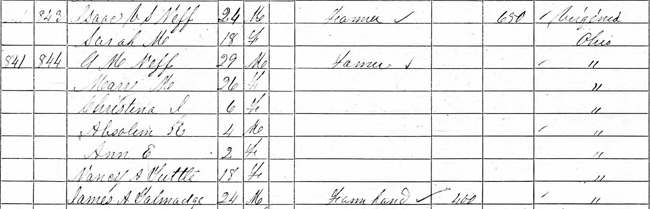
Because I know a lot about the Maddox family, I noticed a very important clue in the 1860 census. The farmhand that was living in Mary's household was related to Mary through the marriage of yet another brother. It could have been coincidence, but it turned out that this clue helped keep me focused on the right family.

Learn about your ancestor's Family, Friends, Associates and Neighbors. Sometimes you can't find your ancestor, but you might find a member of their FAN club to lead you to the poorly written or badly indexed record of your ancestor.


Specific to researchers of the Maddox and Neff families of Pickaway County, Ohio, here's another look at the 1860 census for George M and Mary Maddox Neff.


Notice the farmhand, James A Talmadge. Mary's brother David married Mary Mariah Tammadge, the older sister of James. The spelling of the name varied between Tammadge and Talmadge, depending on the record. Based on the 1850 census, the two were siblings, children of Henry Talmadge.

Tuesday, July 19, 2016

Mary's Husband Served His Country


Continuing with search strategies, let's learn more about Mary. Today's tip is to collect every military record (and every record of any type) you can find on your subject and their immediate family. Each record provides different clues.

I was still looking for what happened to Mary Maddox Neff of Pickaway County, Ohio, after the 1860 census. I'd been looking for Mary for over 10 years, so knew more than names, but not enough. Some of the questions I pondered were:
  • Had I located the right family in the 1860 census? The names George and Mary Neff were not a unique combination.
  • Was she married to the George M Neff who served in Company G, 113th Infantry Regiment, Ohio, during the Civil War?
  • Did her George possibly die during or after the War?
  • If George died, did Mary remarry?
  • Did George or Mary collect a Civil War pension?
My next step was to research George M. Neff, the Civil War soldier.

Military records can be a gold mine of information and should always be collected when available. Pension files are frequently rich in genealogical information. By learning the available records, you'll know what to look for. I wanted to find any Civil War pensions for this couple.

Remember to use Ancestry Categories and Family Search Collections to go straight to military records. Fold 3, which is another Ancestry-owned site, has some military records that are not available elsewhere.

Searching on George M Neff who served from Ohio gives a reasonable number of Civil War records to review, but there were no pension files.


One of the problems with filters is that not every record set is tied to dates and locations. You can miss a record by setting the wrong filter. Experiment with filters to see what is returned with different settings.

In this case, limiting the Military service location to exactly Ohio was the wrong strategy. I had to change that filter to be broad, rather than exact. That basically removed the filter, but would prioritize Ohio records, if the location had been used.


By removing the Ohio limitation, there are 59 pension files of possible interest. These images are only index cards, but they are good clues. Clicking into the pensions, then adding a spouse with the name Mary prioritizes the search results.


The very first result happens to be the Ohio soldier I'm looking for, but the pension was filed from Iowa, an unexpected location. Here are some new clues. Now I know that the soldier George M Neff was indeed married to a woman named Mary. I still have to determine if it is the right Mary. Did my couple move to Iowa?


The card from Ancestry is hard to read. What could I learn at Fold 3? Is the complete pension file available? Remember to use every site you can to collect records. Fold 3 had a different view, but not the complete file.


What do these cards reveal? 

George M Neff applied for a pension from Iowa on May 22, 1890, and he was approved. He died on October 6, 1897. His widow, Mary M Neff applied in October, 1897, for a widow's pension and she was approved. Her death date is not recorded in the index, but would be in her pension file.

The Civil War pension index cards were the breakthrough in my search for Mary.


Monday, July 18, 2016

Correcting Mary's Family


Yesterday my friend Elizabeth shared her tale of search woe in the comments. She found the elusive census record after trying every trick she had. And I found my Mary Maddox Neff after trying a number of tricks, too. Having found those difficult records, we really need to leave breadcrumbs for the next searcher.

Ancestry and some other sites give us the ability to add corrections or additional information for some, but not all, of the information in a record. When we finish our happy dance, we need to take a few minutes to provide that correction. Our children, grandchildren, nieces, nephews and cousins will appreciate the help when they are searching.

Today I'll show you how to view Ancestry corrections and how to make them yourself. I hope you already do that and can just ignore this post.

Let's return to Absalom Neff, born in Ohio, indexed in the 1870 census. Here are the two results.


Notice the pencil after Absolam Loff who is living in Van Buren County, Iowa. That shows that there is a correction or edit to the record that was indexed by Ancestry. Otherwise I'd be wondering how Loff related to Neff. I have to click into View Record (not the image) to see the correction and who made it.


The record was indexed by an Ancestry transcriber as Absolam Loff. Under that name the brackets show the correction (or additional information) is the name Absolam Neff. Click that name to see information about the correction.


I contributed this correction to the name, stating it was a transcription error. I see the trash can only because this is my correction and I can choose to delete it.

Truth be told, the record is nearly impossible to read. Thank goodness for Absalom!


When adding a correction, we can go beyond errors and add some clarifications. I had already added the surname correction, but I could certainly add clarity on the first names. These initials are not at all helpful. Let's fix up his older sister. Still in the text view for Absalom, I clicked on C J Loff, which is one line up.


From this page, I clicked on View/Add alternate info. It brought up a corrections window just like the one for Absalom, above.


I then clicked on the button "ADD YOUR OWN". Now I can add information for Christina.


In this case, I want to add a variation of her name. I use the drop down arrows to see my choices and variation was the best fit. I have to type in the name as it should be. The explanation is optional, but as this is not a transcription error, adding a brief explanation helps the Ancestry reviewer as well as future researchers.

After clicking on "SUBMIT ALTERNATE", one more window comes up because I changed her surname.


I am asked whether to apply the surname change to everyone in the household. You'll want to choose wisely between APPLY and Close when making such a change. When I first submitted the Neff surname last year as a transcription error, I used APPLY, as that specific transcription error does apply to everyone in the household.

In this case, I did not need to repeat the surname change and the information I added is specific to Christina. I clicked on Close.

I can see the corrections that I just made, but no one else can see them until they have been reviewed and accepted by someone at Ancestry. Here's a final look at how Christina's corrections appear.


Today I added a first name for each person in the household, except Absalom. I added brief additional information from the 1880 census and from George's military records to explain the variations for George M, Ann Elizabeth and Laura.

Mary and her family are now all corrected and augmented in the 1870 census index. I'll share more search strategy the next time.

Sunday, July 17, 2016

Mary Had a Little ... Child


Today I have another tip to help speed up searching for online genealogy records.

In yesterday's tip, I was searching for Mary Maddox Neff and used Ancestry Categories and Family Search Collections to focus the search.

Today I've narrowed the Ancestry search by filters, which is a topic for another day. Unfortunately even searching for Mary Neff, born in Ohio, there are over 100 results in the 1870 federal census, according to Ancestry.

I could add a birth year, but this family tended to be sloppy on ages. That's actually a common issue, but I would include it in the filtering to start. It wasn't helping with Mary.


What else do I know about Mary to help narrow the search? The 1860 census of Pickaway County, Ohio, shows her family members.


I know her husband is George M. How many results are there in the 1870 census for George Neff, born in Ohio?


A count of 44 is more workable. But what about the children? Ann is a very common name, but there are two other children.


The tip of the day is to search with the less common names in the family. Just because Mary Maddox Neff is the person I am searching for, I should not limit myself to searching for her name. This strategy works on Family Search as well as Ancestry and on many other sites.

Mary's children's names are the ones to search. Absalom is the obvious choice with two matches. Remember that names were fluid before birth certificates. If I were named Absalom, I would definitely drop that name at some point. He might have already started using another name by the age of 14.

Christina is also a good name to try. Since Christina was 6 in 1860, she would be about 16 in 1870, which is of marriageable age. She might be gone from the household, but it is worth looking at each of the four matches. 

I didn't find the family with this tip, though today you would do so. One of the two matches on Absalom is correct, but only because I submitted a correction after digging up the record.