Sunday, January 29, 2023

Different Backgrounds, 52 Ancestors


During a recent family discussion, I was asked about the difference in the backgrounds of my Swedish great-grandparents. Since week two of the 52 Ancestors challenge calls for a photo, I'll explain a bit about their backgrounds and share their photo. The following is based on my research and impressions and any errors are mine alone. 

When I write about Sweden, I rarely show a map and rarely specify to which family the ancestor belongs. I want to do better this year. I have spent a lot of time studying parish maps, but have never shared the big picture and the geographical differences for this couple. 

Agnes Emilia Fors and Gustaf Emil Ferdinand Ekstrom married in 1888. Gustaf had already buried a wife and two children. The couple buried one more child before they emigrated in 1891 from the city of Linköping, in southern Sweden, to Chicago, Illinois. They opened a tailor shop in Evanston, north of Chicago. I hope they displayed this lovely portrait in their shop window to show off their handiwork.


Photo Colorized at MyHeritage, Digital layout from ClubScrap


Sweden is divided into counties that are are similar to states in the US. The couple came from three different counties of Sweden. Though the areas are close, there were differences in culture and in record-keeping. Agnes and her ancestors came from roughly the area shaded in purple: Södermanland County and Stockholm County. Gustaf's family was from the area shaded in orange: Östergötland County. There were a few ancestors from other counties in both families.


The couple also had somewhat different socioeconomic backgrounds. Both families have a history of poor farmers known by the term torpare, or crofter. The crofters often struggled to feed and provide for their families. Disease, including tuberculosis, was common and high infant mortality was a persistent problem. The families worked in the 1800's to improve their economic lives by learning trades. 

Gustaf was a tailor, as were his brothers and their father. Agnes' grandfather was also a tailor. The extended families included tradesmen such as shoemakers, carpenters and bricklayers. However, Agnes and her family had the more advantageous life. Her father was a bricklayer who worked for the railroad and had moved into management. Her aunt married a schoolteacher who moved to the railroad and into management. Her mother's background was full of military men of the lowest ranks: sailors (known as a båtsman), infantry soldiers (soldat) and cavalry men (ryttare). These men were of a higher socioeconomic level than the crofters. I suspect that nutrition and health were better for Agnes' ancestors.

There seems to be a difference in the survival of the families. There are many more relatives from the Fors side who show up in our DNA test matches. Gustaf is the only one of seven siblings to have living descendants today. I have not identified any other branch in either family that was as decimated as this single Ekstrom branch. The DNA match disparity also raises the possibility that the DNA from Agnes Fors is simply more dominant in my family.

In 2023, I am exploring the edges of my Swedish research. The records of Östergötland are more limited than the other counties, as reflected in the number of ancestors identified on each side. The first multi-post series explores an Ekstrom ancestral branch from the parish of Grebo in Östergötland. It started with one mystery woman, but grew into a research project that covered several generations and some 80 years of tax records. 

The star on the left side marks the ancestors that appeared in the previous post. The next post will explore the issue from a later generation that triggered the search.


Monday, January 23, 2023

Saving the Farm, 52 Ancestors


Måns Andersson, my 6th-great-grandfather, had a problem in the summer of 1748. He was getting older and his health was deteriorating. He could sense that tuberculosis was coming for him, as it had come for so many of his family, friends and neighbors. He and his 15-year-old son, Pehr, had finished their spring planting and had provided required labor for the lease on the torp, which was a croft or tenant farm. Then, on June 30th, young Pehr Månsson died. Not only had Måns lost his son, he had lost labor that he needed for the harvest and the remaining days owed for the lease.

As a crofter, Måns and his two daughters were poor. Hiring a laborer, a dräng, was a financial hardship, but it had to be done. He needed to hire a single man who was worthy of marrying his eldest daughter, Stina. Such a marriage was needed to secure his own future, as well as that of his daughters, 18-year-old Stina and 13-year-old Anna. In addition to having good character qualities, the young man had to be at least age 21 to take over the lease on the torp. He also had to accept Stina's health issues, which will be covered in a future post.

Eric Ericsson, age about 21, was hired sometime during 1748. The young people did not hurry to get married. The yearly tax lists (mantalslängd) tell the evolving story of the family.

The family lived at Lilla Björksved, one of the torps on the lands of Rösten, also known as Rödsten. Their church parish was Grebo, which is about 100 miles southwest of Stockholm and about 12 miles southeast of the city of Linköping in Östergötlands län. 

The website Lantmäteriet, a part of the Sweden Ministry of Finance, is the source of this lovely map of Rösten, drawn in 1805. The fields are all grouped and drawn out on the left side. The areas with little trees were described as stony ground with pine and fir forest. The small and light area number 23, between the pink areas in the center, is where the cottage named Lilla Björksved was located.


The location of Rösten within Sweden is shown in a modern map at this link.

Måns Andersson and his wife, Karin Olofsdotter, married on 17 March 1728, and had moved to Lilla Björksved in 1730. Karin was suffering from tuberculosis by 1743, the last year that she appeared in the tax records. Stina must have taken over the household duties, as no female maidservant (piga) was listed for a head tax.

Did Stina dream of something other than marrying Eric, caring for her father and managing the familiar cottage? Did Eric wish for some other future or have concerns about Stina's health? By the end of 1749, Eric was listed as the Torpare, the crofter, with piga Stina and father Måns in his household. At the end of 1750, Måns appeared for the last time on the tax list. He was listed as the previous farmer and was suffering from tuberculosis. Still the young people were not married.

Eric Ericsson and Stina Månsdotter finally married on 24 June 1751, three years after Pehr's death. A scant four months later, Anna Stina was born to the couple. This raises the question of what finally led to the marriage. Perhaps the child was not Eric's. Perhaps they wanted to wait to marry until Måns died. Perhaps his death forced them to take the step, as Eric might have agreed to the marriage as a condition of his continued employment. The parish minister also had to approve the marriage and an incurable genetic disease was a reason he could refuse to allow the couple to marry. A pregnancy would have forced him to relent. 

With the help of Eric, Måns had managed to retain the lease on the torp. Eric and Stina's marriage ensured the torp could be passed to future generations. They raised her sister, Anna, until she disappeared from the records after 1755. Their children grew up on the torp of Lilla Björksved and both Stina and Eric died there.


To Do List

The records provide snapshots of the family, but there are missing records and often the surnames were not included. There are many more questions to be explored about Måns and Karin:

  • Many questions are about Stina, which will be covered in a different post.
  • What happened to Anna after the tax roll of 1755?
  • Måns and Karin had a son named Olof who did not appear in the tax rolls at age 15. There is no death record. Was he sent out to apprentice, rather than dying?
  • There is no probate for Måns or Karin. Nor are their deaths found in the church records. No ages were recorded in the tax rolls, so they were likely under age 63 when last recorded. Karin's age was not recorded in the baptism records for her children.
  • They were probably born in the period where there are no birth records for Grebo. Were births in Grebo recorded in a different parish?
  • Could they have gone to some sort of tuberculosis institution at the time they left the tax roll?
  • Måns was never indicated on the tax roll as a widower, so was Karin still living?
  • Someone named Karin, noted as mother, came to live with Eric and Stina at Lilla Björksved by 1766. Her surname was not recorded when she died at age 79, in 1772. Whose mother was she?
  • Måns Andersson lived at Kattorp when he married. He may be the son of Anders who was at Kattorp in the 1720's. Can a relationship be shown via christening records and earlier tax records?
  • Karin Olofsdotter lived at Rösten when she married in 1728. The main farm of Rösten did not list any maids in the tax records that year. She may be the daughter of Olof, who was the torpare at Åhagen in that year. She was not listed with Olof for tax. Can any further information be found?

Sources

  • Grebo Church Records for births, deaths and marriages
  • Grebo Mantals Tax Lists 
  • Bankekinds District Court Probate Index


Sunday, January 10, 2021

Thousands of Miles and 200 Years


While the USA is in turmoil, it's hard to think about history. But sitting on my keyboard is a slip of paper which has graced my computer since being found in a fortune cookie several years ago. The advice is very timely:

The farther backward you can look, the farther forward you are likely to see.

So today I'm looking back 200 years, as promised to relatives on a Zoom call. 

Two very old pocket Bibles were passed into my keeping in 2019. While they don't add much to my research, they are precious family heirlooms that traveled from Scotland to America. The images are shared today for cousins near, far and future.

First will be photos of the Bibles. Second will explain briefly to whom they belonged. Third will tell what little they reveal to me and the questions they raise.


Taylor/Mitchell/Henderson Pocket Bible Images

These pocket Bibles are roughly the dimensions of an index card, or 3 inches by 5 inches. Both have missing pages and even missing sections. They are each part of a two-volume set. The date on the title pages is 1816 and they were printed in Edinburgh, Scotland.


Ann Taylor Mitchell Henderson's Old Testament, with Red Cover
 
William Taylor's New Testament, Containing Part of the Old Testament, with Brown Cover


A similar Bible, well preserved, was sold on EBay. This is how the covers would have looked when they were intact. The front part of each cover, including the tab, is now missing, as is the strap on the back cover.

Bible Sold on EBay
Red Bible Back
Brown Bible Back


Each had a volume number on the spine. 


Brown Bible, Volume 2
Red Bible, Missing Volume Number


The red Bible shows very little wear compared to the brown Bible. The red Bible is also missing a lot of pages.


Red Bible Wear
Brown Bible Wear


The red Bible has, written on the flyleaf, in ink traced over pencil: Peter Mitchell, Ann Taylor, 1822. There may also be the notation of a volume number, but that is unclear, as are some other marks.
 

Red Bible Owned by Peter Mitchell and Ann Taylor Mitchell Henderson


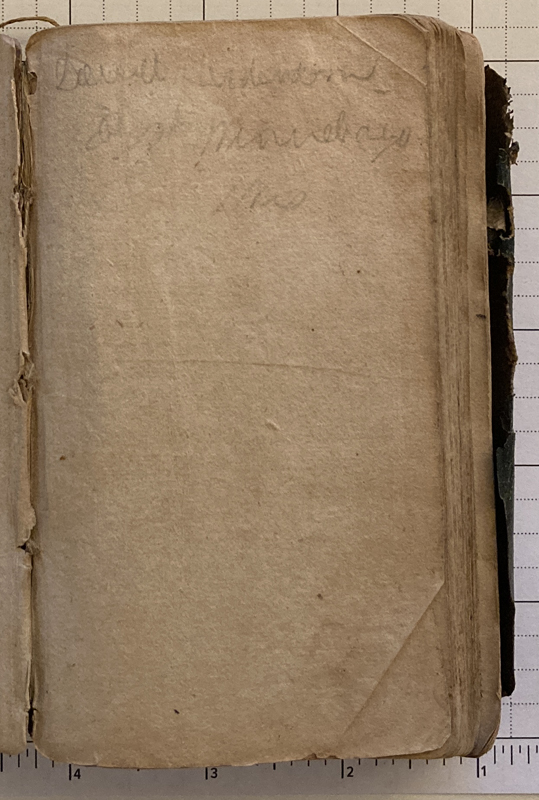
The flyleaf of the brown Bible has the words Willim Taylors Bible and No 2, along with stray marks. The next page has the words, written in pencil only, David Henderson, Fort Winnebago, Wis.
 

Brown Bible Originally Owned by William Taylor

Brown Bible Second Owner, David Henderson, Fort Winnebago, Wisconsin


Taylor/Mitchell/Henderson Pocket Bible Owners

The family immigrated to Wisconsin from Linktown, Fife, Scotland, which is on the north side of the Firth of Forth. I've written about the family members in the past and the posts are linked here.

Ann Taylor (ca 1800 - ca 1886) married Peter Mitchell in 1820 and the first of their four children was born in 1822. Ann married David Henderson (ca 1799 - ca 1880) in 1841. Ann's relationship to William Taylor is not known, but he was probably a brother or cousin. Ann had five children, three of whom have living descendants in 2021. The children were:

George Mitchell (1822-1907) married Phoebe Jane Drummond Gleason, no issue.

Helen Mitchell (1824-1841) died young.

John T Mitchell (1827-1911) married Mary McGregor. Two children (possibly three) have living descendants: Jennie Mitchell Duff (1866-1953) and John Gavin Mitchell (1868-1945).

Margaret Mitchell (1830-1885) married Joseph McFarlane. Their middle son, Walter McFarlane (1864-1922), had one daughter with issue: Ruth Dorothy McFarlane Ekstrom (1898-1931). This is my line.

David Henderson, Jr. (1843-1908) married Jane "Jennie" Robbins. Their eldest son, George Henderson (1887-1981), had one son with issue: Harold Henderson. The Bibles were found in Harold's basement after his death. His daughter "Connie" sent them to me.


Taylor/Mitchell/Henderson Pocket Bible Clues and Questions

 
The Bibles pushed me to dig into our roots in Scotland and Wisconsin. Unfortunately I found very little, especially about William Taylor, whose name is common and hard to research and sort out.
 
It appears that William Taylor's Bible was passed to David Henderson, Jr. If William had returned to Scotland or had children in America, his Bible would have gone to someone else. This is a clue that William died in America, without issue. William appears with the family in both the 1841 Scotland census and the 1850 Wisconsin census. No other Wisconsin records have been found. I look forward to digging into courthouse records when our lives return more to normal.

The names in Ann's Bible are an unexpected blessing that confirms her maiden name and her first husband as Peter Mitchell. Why is there a date of 1822? Was the Bible a gift to celebrate or record the birth of their first child? Were there pages, now missing, to record births, deaths and marriages? Why is her Bible fairly unused? The census tells us that she was literate. We know she sent and received letters. If she had a New Testament volume, it did not survive. Could it be that she preferred it and wore it out?
 
I also wonder about the long journey taken by Ann and her Bible. In late April of 1850, she and her husband and two youngest children started the journey of a lifetime. The first step was to travel the 60 miles to Glasgow and the port of Clyde. The family then boarded the Barque Clutha, which sailed from Clyde on May 2nd, for a five week journey to New York City. It must have taken a lot of courage to get on that ship, knowing they would never see Scotland again. They arrived in New York on June 8th, and had another thousand miles to travel to Wisconsin. How did they make that journey? They may have sailed on the Great Lakes, or traveled by rail, wagon or riverboat. Or they may have used several modes of transportation. Did Ann turn to her Bible for comfort over the many weeks of travel? Did she carry the Bible in her handbag to keep it handy, or was it packed away for safe keeping?

We will never know the answers to these questions and will never know the complete stories of these ancestors. Unfortunately, dementia has stolen the mind of the last Henderson family member who may know some of these family stories.
 
I deeply appreciate "Connie" sharing these heirlooms with me, her distant cousin, so that their images can be preserved for the use of future generations.